Residential Care Facility vs. Nursing Home: An Ohio Insider's Guide for Cleveland Families
Choosing between senior living options in Greater Cleveland can feel overwhelming. You're drowning in glossy brochures, fielding calls from sales directors, and terrified of making a costly mistake. This guide cuts through the marketing fluff to give you the real story.
-
Assisted Living (Residential Care Facility): This is a residential setting. It’s for seniors who need help with daily tasks like meals, medication reminders, and bathing but don't need 24/7 medical supervision. Think support, not a hospital.
-
Nursing Home (Skilled Nursing Facility): This is a clinical setting. It’s a licensed medical facility for individuals with complex health conditions or those recovering from a hospital stay who need round-the-clock skilled nursing care.
-
The Core Difference: It boils down to one question: Does your loved one need help living or intensive medical care? The answer determines the right path.
-
The Biggest Mistake: Assuming a beautiful building means quality care. While brochures show the chandeliers, you need to ask about weekend staffing ratios and state inspection reports.
Your Quick Guide to Ohio Senior Care Options
If you’re a family in Cuyahoga, Lake, Lorain, or the surrounding counties, you're buried under a pile of marketing materials that all sound the same. It's a high-stakes decision, and the fear of making the wrong choice is real. You’re not just picking a new address for your parent; you're entrusting their health, safety, and finances to strangers.
This guide is designed to be your trusted insider. We translate the sales pitches into reality so you can move from researching endlessly to making a confident decision.
Assisted Living vs. Nursing Home: At a Glance
For families just starting out, this table provides a clear, no-nonsense comparison of care levels, typical residents, living environments, and how care is paid for right here in Ohio.
| Factor | Residential Care Facility (Assisted Living) | Nursing Home (Skilled Nursing) |
| :--- | :--- | :--- |
| Primary Focus | Social model; help with daily living, independence. | Medical model; 24/7 skilled care, rehabilitation. |
| Typical Resident | Needs help with bathing, meals, medication reminders. | Needs post-hospital rehab or has complex medical conditions. |
| Environment | Apartment-style, residential, and home-like. | Clinical, hospital-like setting with shared rooms. |
| Primary Payer | Private pay, Long-Term Care Insurance, Medicaid AL Waiver. | Medicare (short-term), Medicaid, private pay. |
Ultimately, the right choice depends entirely on the specific, day-to-day medical needs of your loved one.
The infographic below helps visualize where these two options fall on the senior care spectrum.
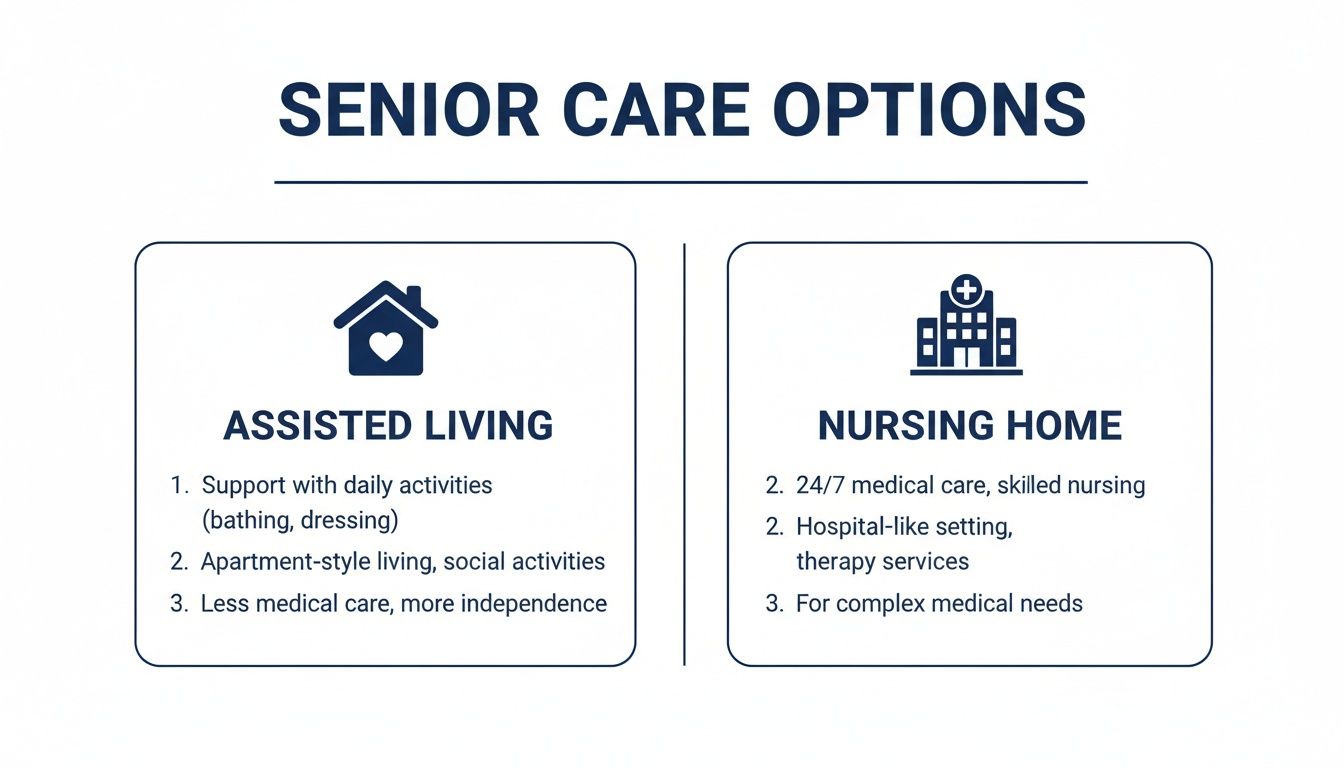
As you can see, the decision hinges on a single question: does your loved one primarily need supportive living services to stay independent, or do they require intensive medical care from skilled professionals? Answering that is the most important first step.
Why This Choice Is So Difficult for Cleveland Families
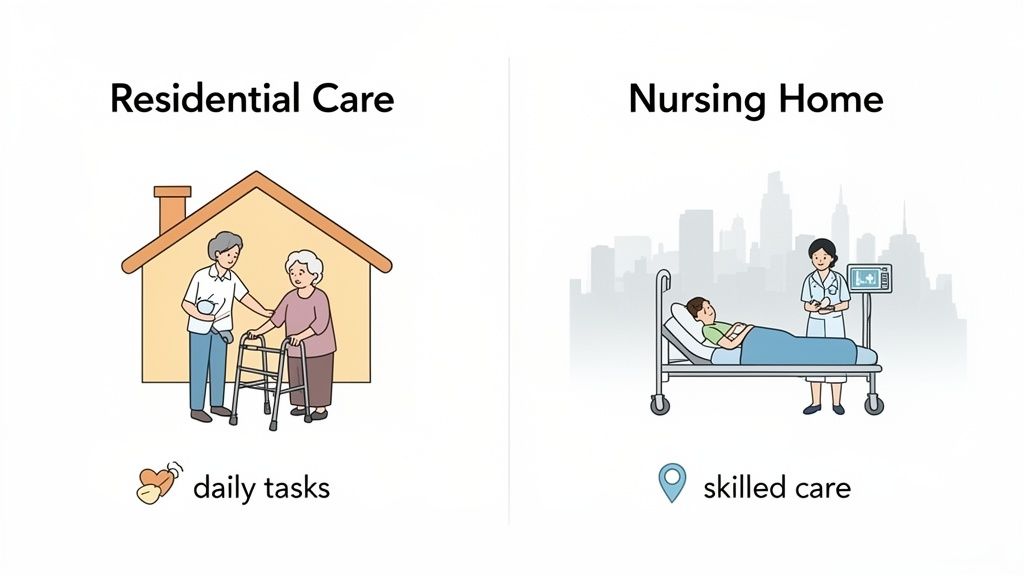
If you’re a family anywhere from Lorain to Mentor, you know this decision feels impossibly heavy. You're sorting through brochures that all look the same, fielding calls from sales directors, and trying your best to translate marketing jargon into what life will actually be like for your parent.
The pressure is enormous. Picking the wrong community isn't just an inconvenience; it can mean emotional distress, a rapid drain on life savings, and even a decline in your loved one's health. You're not just choosing a facility—you're making a profound decision about their safety and quality of life.
The Cost of Going It Alone
We see it happen every week. A well-meaning family pours countless hours into their own research, tours multiple communities, and finally finds a place that seems perfect. Then they hit a roadblock an insider would have spotted from a mile away.
A Solon Family's Story:
A family spent three weeks touring beautiful assisted living communities on the East Side for their mother. They loved the amenities and felt a connection with the staff. But after investing all that time and emotional energy, they found out their top choice didn't accept the Medicaid Assisted Living Waiver she needed to afford care. A quick check with a local advisor would have saved them that time and heartache.
Insider Tip: Facility websites rarely make payment options clear. Critical details—like whether they accept the Ohio AL Waiver or certain long-term care insurance plans—are often buried or missing entirely. Don't waste your time touring until you've verified payment options first.
Navigating More Than Just Logistics
This decision is deeply personal, and it often comes during a crisis, like after a fall or a sudden hospitalization. The emotional journey of caring for aging parents is taxing enough on its own. For many, this also involves confronting the complex legal and personal challenges related to Guardianship of Aging Loved Ones, which adds another layer of stress.
You're suddenly expected to be a researcher, caregiver, advocate, and financial planner all at once. It’s a role nobody is truly prepared for, and it's why having a neutral, expert guide isn't a luxury—it's essential.
The goal isn't just to find a place, but the right place. It's about matching your loved one's specific medical needs, budget, and personality with a community that can help them thrive. Whether they need to be close to University Hospitals for appointments or prefer the West Side near Crocker Park, a local expert gets those nuances. Don't guess; let us help you get it right the first time.
Comparing Medical Care and Staffing Levels in Ohio
This is where brochures are most misleading. The biggest difference between a Residential Care Facility (Assisted Living) and a Nursing Home in Ohio comes down to one thing: the level of medical care and the staff legally required to provide it.
One is a residential setting that offers health services; the other is a licensed healthcare facility that offers housing. A community's brochure might highlight "nursing services available," but an insider knows to ask the real questions: Is a registered nurse (RN) on-site 24/7, or just on-call from home after 5 PM? What happens if your mom has a medical issue on a Sunday morning? These distinctions are everything.
What “Skilled Nursing Care” Actually Means
In Ohio, a nursing home, officially known as a Skilled Nursing Facility (SNF), is licensed by the Ohio Department of Health (ODH) to provide 24/7 skilled nursing care. This isn't just about having nurses around. It's about delivering complex medical treatments that can only be performed by, or under the direct supervision of, a licensed nurse.
Think of it as the level of care right below a hospital. Services that define a nursing home include:
-
IV therapy and injections
-
Complex wound care (for post-surgical incisions or pressure sores)
-
Ventilator or tracheostomy care
-
Feeding tubes
-
Intensive physical, occupational, or speech therapy following a hospitalization
These facilities are required by law to have a Medical Director (a physician), registered nurses (RNs), licensed practical nurses (LPNs), and state-tested nursing assistants (STNAs) on duty at all times. The environment is clinical because it has to be. To learn more, see what skilled nursing care entails in our detailed guide.
The Assisted Living Model of Care
An assisted living community, or Residential Care Facility (RCF), is built on a different foundation. It operates under a social model, not a medical one. Its main purpose is to help residents with Activities of Daily Living (ADLs)—things like bathing, dressing, and managing medications—so they can live as independently as possible.
While most Ohio assisted living communities have nurses on staff, their role is different. State regulations do not mandate an RN be on-site 24/7. It's common for an LPN to be on duty during the day, with resident aides handling most hands-on care. Overnight, the facility may only have aides on-site, with a nurse available by phone.
Insider Tip: Always ask a community for their "weekend staffing ratio" for both nurses and aides. A place that feels energetic during a Tuesday morning tour can feel like a ghost town on a Saturday night. This is a critical detail marketing materials will never mention.
The Real-World Impact for a Cleveland Family
Imagine your father is in an assisted living community in Lakewood. One evening, he develops a urinary tract infection that makes him confused. The overnight aide would call the on-call nurse, who would almost certainly advise calling 911. The result is a stressful trip to the emergency room at the Cleveland Clinic or UH.
Now, picture that same scenario in a nursing home. The on-duty RN could assess your father immediately, consult the facility’s physician, and potentially start IV antibiotics right there in his room. The hospital visit might be avoided entirely. This immediate access to skilled medical intervention is the core difference.
Here’s a simple breakdown of the staffing you can generally expect:
| Staffing Aspect | Residential Care Facility (Assisted Living) | Nursing Home (Skilled Nursing Facility) |
| :--- | :--- | :--- |
| On-Site Nurse | An RN or LPN is typically required on-site for a portion of the day. | A licensed nurse (RN or LPN) must be on-site 24 hours a day, 7 days a week. |
| RN Presence | An RN may be the director of nursing but often works standard business hours. | An RN must be on-site for at least 8 consecutive hours every day. |
| Primary Caregiver | Resident Aides or Caregivers provide most of the hands-on assistance with daily living. | State-Tested Nursing Assistants (STNAs) provide daily care under the direct supervision of licensed nurses. |
| Physician Oversight | Residents keep their own primary care doctors; some facilities have a visiting physician. | A Medical Director (physician) is required to oversee all clinical care within the facility. |
Choosing the right setting is about matching your loved one’s current and potential future medical needs. A mismatch can lead to frequent hospitalizations or another disruptive move. Don't guess. Speak with one of our Cleveland-based Senior Advisors for free to accurately assess the level of care your family member truly needs.
What Ohio Families Actually Pay for Senior Care
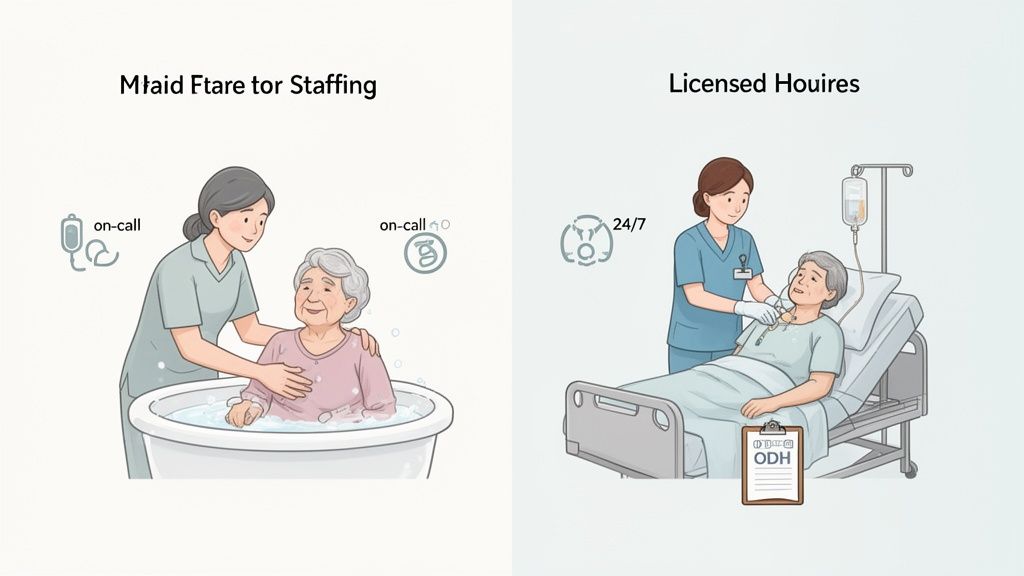
Let’s talk about the number one source of stress for families in Northeast Ohio: money. You’ve seen the beautiful dining rooms, but when it comes to cost, the conversation gets confusing. It’s time to pull back the curtain on what families actually pay.
The pricing structures for assisted living and nursing homes are fundamentally different. This goes beyond the final monthly bill; it reflects the entire model of care you're buying.
The Two-Part Cost Of Residential Care (Assisted Living)
When you get a price quote from an assisted living community, it’s almost never a single number. The cost is typically split into two parts:
-
The Base Rent: This is like apartment rent. It covers the room, three meals a day, housekeeping, laundry, utilities, and access to social events.
-
The Level of Care Fee: This is the additional monthly charge for the hands-on help your loved one needs. It's set after a clinical assessment by the community's nurse. The more help required, the higher this fee will be.
This two-part system means the total monthly cost can vary wildly from one resident to the next.
Insider Tip: That "Level of Care" fee isn't set in stone. If your parent's health changes, the community will do a new assessment, and that fee will go up. Always ask for the prices of every level of care, not just the one your loved one starts at.
The All-Inclusive Cost Of Nursing Homes
Nursing homes in Ohio work on a more straightforward, all-inclusive daily rate, called a "per diem." This single number covers the room (usually shared), 24/7 skilled nursing care, meals, all medications administered by staff, and any required therapies.
There are no separate "levels of care" because the assumption is that every resident requires a high degree of medical supervision. This is why the base cost is so much higher. For a more detailed look, see our guide on assisted living vs. nursing home costs in Cleveland.
How Care Is Actually Paid For
This is where families make expensive mistakes. Knowing which funding source pays for which type of care is critical.
A painful truth for many is that Medicare does not pay for long-term care. It will only cover a short-term, rehabilitative stay in a skilled nursing facility—up to 100 days with strict rules—immediately after a qualifying hospital stay. It pays nothing for assisted living.
This financial reality is changing everything. In Ohio, nursing home occupancy rates have been dropping, while the number of licensed residential care facilities has grown to over 800. The financial pressure is immense, as more than 50% of private-pay nursing home residents exhaust their savings and have to switch to Medicaid within a year.
The table below breaks down the most common ways families in the Cleveland area pay for care.
Estimated Monthly Senior Care Costs In Greater Cleveland
When looking at senior living options in Northeast Ohio, it's crucial to understand the realistic costs and payment sources. The following table provides typical private pay costs and highlights common funding options for both residential care facilities and nursing homes.
| Cost Component | Residential Care Facility (Assisted Living) | Nursing Home (Skilled Nursing) |
| :--- | :--- | :--- |
| Typical Base Rent | $3,500 - $6,000+ per month | Included in daily rate |
| Typical Care Fees | $500 - $2,500+ per month | Included in daily rate |
| Total Private Pay Est. | $4,000 - $8,500+ per month | $9,000 - $12,000+ per month |
| Private Pay | ✅ Yes (Most common method) | ✅ Yes (Often until assets are spent down) |
| Medicare | ❌ No | ✅ Yes (Short-term rehab only) |
| Ohio Medicaid AL Waiver | ✅ Yes (If facility accepts the AL Waiver) | ✅ Yes (Primary payer for long-term stays) |
| Long-Term Care Ins.| ✅ Yes (A primary funding source) | ✅ Yes (A primary funding source) |
| VA Benefits | ✅ Yes (Aid & Attendance can help) | ✅ Yes (Aid & Attendance can help) |
Disclaimer: Updated November 2024. This article is informational, not legal or medical advice. Costs are estimates and can vary. Medicaid eligibility has strict financial and medical requirements.
A Medina Family's Story:
We worked with a couple who assumed their savings would cover about two years of care for the husband in a nursing home at $9,000 a month. A single phone call with our advisor changed everything. We helped them understand the Medicaid spend-down rules, guided them through qualifying for Ohio's Assisted Living Waiver, and found a wonderful local community that accepted it. This move preserved a huge portion of their assets for his wife.
Don't navigate this financial maze alone. Pricing and availability change daily. Our advisors can give you a clear, up-to-date picture of your real costs and options—at no cost to you.
Understanding Ohio Regulations and Quality Reports
It's easy to be impressed by beautiful dining rooms and packed activity calendars. But a community's true quality isn't in the brochure—it’s in the public records. Knowing how to read these reports is one of the most important things you can do to protect someone you love.
Nursing homes and assisted living facilities in Ohio are regulated differently. Nursing homes are held to federal and state standards. Residential care facilities (assisted living) are licensed by the Ohio Department of Health (ODH), but under a separate, less medically focused set of rules.
Decoding Nursing Home Quality: The CMS Five-Star Rating
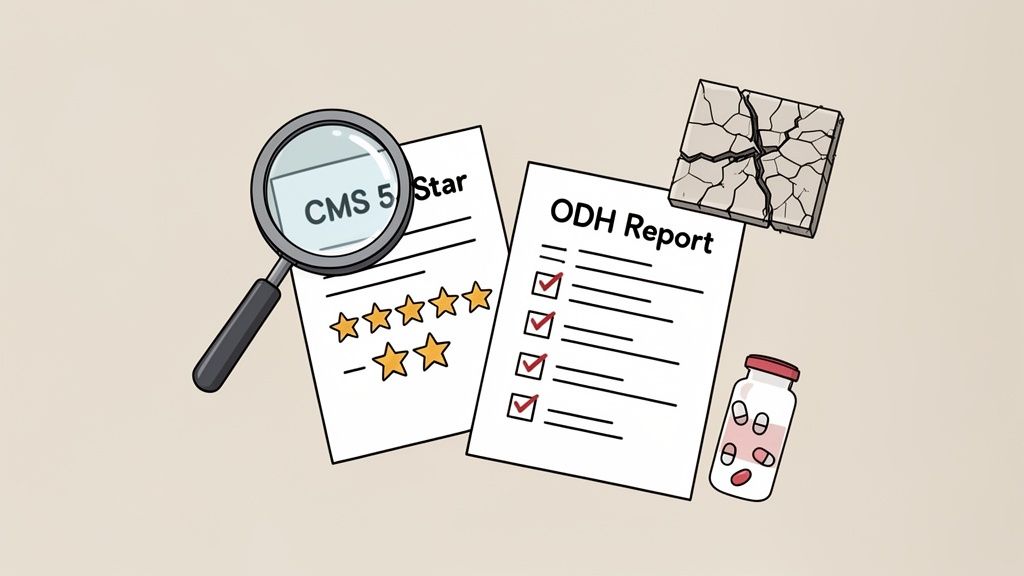
For nursing homes, things are straightforward. They are federally regulated by the Centers for Medicare & Medicaid Services (CMS), which publishes its findings using the Five-Star Quality Rating System. This grades facilities from one star (much below average) to five stars (much above average).
The rating is based on three areas:
-
Health Inspections: Findings from on-site surveys done by the ODH.
-
Staffing: Hard data on nurse and caregiver hours per resident.
-
Quality Measures: Clinical outcomes, like how often residents fall or develop pressure ulcers.
This gives you a standardized way to compare nursing homes. But it doesn't apply to assisted living at all.
The Problem with Assisted Living Quality Reports
This is where it gets tricky. Assisted living communities are not part of that federal five-star system. The ODH does inspect them, but the survey reports can be much harder for families to find and understand. This creates a transparency gap. Without a simple star rating, you have to dig into the actual ODH inspection reports to see a community's history.
A citation for a cracked floor tile is a minor issue. A citation for repeated medication errors is a major red flag. An advisor can help you tell the difference.
How to Read an ODH Survey Like an Insider
That state inspection report, or "survey," is your best look behind the marketing curtain. Never just ask a facility if they have a "clean" survey. Ask to see the full report and look for patterns. It’s also helpful to understand the baseline requirements for staff, such as the process for CNA license registration in Ohio.
Questions to Ask the Admissions Director:
-
"Could I please see your most recent ODH survey report, including any citations?"
-
"What was the nature of your last few citations?"
-
"What specific plan of correction did you put in place?"
-
"Were any of these repeat deficiencies?"
Unfortunately, quality can be all over the map. Recent data showed that Ohio had 130 nursing homes with the lowest possible one-star overall rating from CMS. These facilities are inspected every 9-15 months for problems, which shows how critical it is to do your homework. You can find more details in this report on poorly performing nursing homes in Ohio.
You don't have to become an expert investigator. Our Senior Advisors review these reports all the time. We can quickly spot which communities in the Cleveland area have a solid track record because we know exactly what to look for. Instead of guessing, let us give you a customized report on communities that meet your standards. You might also find our guide on Medicare vs. Medicaid for long-term care in Ohio helpful.
How to Make Your Final Decision with Confidence
You now grasp the crucial differences between residential care facilities and nursing homes in Ohio. The next step is applying this knowledge to your loved one’s unique life. This isn’t a decision you should make alone, especially when you’re already stressed and overwhelmed.
The right choice is a mix of health needs, budget, and geography. A family in Westlake might need to be close for daily visits, while someone on the East Side might prioritize being near the Cleveland Clinic.
From Information to a Personalized Plan
Turning research into a confident decision requires a strategy. This is where having a local advisor makes all the difference. Instead of spending your time calling dozens of communities to ask about pricing and clinical capabilities, we do that legwork for you.
Our Cleveland-based Senior Advisors provide tailored guidance, and our help is completely free to families. We don't just email a generic list. We listen to your story and create a short, curated list of appropriate, pre-vetted options.
This process isn't about finding a "good" facility; it's about finding the right facility for one person. A beautiful community in Solon might be a terrible fit for someone needing specialized memory care, while a less flashy building in Parma could have the best nursing team for your parent's needs.
Your Final Decision Checklist
To help organize your thoughts, use this simple checklist. It shifts your focus from marketing brochures to what really matters.
-
Medical Needs Assessment: Have we been honest about the level of skilled nursing care needed right now and what might be needed in the next year?
-
Budget Clarity: Do we have a firm handle on our budget and know how private pay, insurance, or the AL Waiver program will work?
-
Location Priorities: Have we decided on our geographic "must-haves," like proximity to University Hospitals or family in Cuyahoga or Lake counties?
-
Quality Verification: Have we looked beyond the tour and asked the tough questions about staffing ratios and the facility’s Ohio Department of Health (ODH) survey history?
Answering these questions often highlights what you don't know yet. That’s normal, and it’s where we step in to fill the gaps, saving you from guesswork and emotional drain.
Let us help you take the next step. We’ll help you compare your top choices, coordinate tours, and get straight answers on pricing and availability—details that change daily.
Pricing and availability change daily. Speak to a Cleveland-based Senior Advisor for free to get a current Rate Sheet for communities in your area.
Answering Your Top Questions
The world of senior care is full of confusing terms. Here are straightforward answers to the questions we hear most often from families in the Cleveland area.
Can My Parent Move From Assisted Living to a Nursing Home Later?
Absolutely. This is a common progression. Someone might start in a residential care facility and only move to a nursing home when their medical needs become too complex for that setting.
An experienced advisor helps you plan for this. We often suggest "continuum of care" communities that have both assisted living and a nursing home on the same campus, which makes any future transition much smoother.
How Does the Ohio Medicaid Assisted Living Waiver Work?
This is a big one. The Ohio Medicaid Assisted Living Waiver (AL Waiver) helps cover the cost of care services in an assisted living community. It does not pay for room and board.
To be eligible, your loved one must meet Ohio Medicaid's financial rules and be assessed as needing an "intermediate level of care." Here's the catch: not all residential care facilities are certified to accept this waiver. An advisor can immediately identify which communities in Beachwood, Westlake, or your specific neighborhood are certified, saving you days of wasted tours.
What Is the Difference Between Assisted Living and Memory Care?
A memory care unit is a specialized, secured "neighborhood" often located within a larger residential care facility. It's built to support individuals living with Alzheimer's disease or other forms of dementia.
These units have enhanced safety features to prevent wandering, specially trained staff, and programming designed to engage residents. While standard assisted living can work for someone with mild cognitive changes, a dedicated memory care unit becomes essential when a higher level of supervision and a secure environment are needed for safety.
My Dad Is Being Discharged From the Hospital—Do We Need a Nursing Home?
This is a classic, time-sensitive situation. The answer hinges on the specific care he needs right after discharge.
-
If he needs intensive, short-term rehabilitation (like daily physical therapy after a hip replacement), a skilled nursing facility is the right place. Medicare will likely cover a significant portion of this rehabilitative stay.
-
If he just needs temporary help with daily tasks like bathing and meds while he regains strength, a "respite stay" at an assisted living facility is often a better, more comfortable, and more affordable fit.
A Senior Advisor can speak directly with the discharge planner at the Cleveland Clinic or University Hospitals to quickly pinpoint the right level of post-hospital care, helping you avoid a stressful and expensive wrong turn.
Trying to figure this all out on your own is overwhelming. Guide for Seniors provides free, one-on-one support to help you make the right choice with confidence.
Don't guess. Speak to a Cleveland-based Senior Advisor for free to narrow your list and get the answers you need.
Need Help Finding Senior Living in Greater Cleveland?
Our Greater Cleveland local advisors compare pricing, schedule tours, and answer your questions — completely free.