Your Cleveland Guide to Finding Home Care Without the Overwhelm
Struggling to find the right home care in Cleveland, Ohio? You're not alone. Here’s what you need to know to make a confident decision:
-
Know the Difference: "Home Care" is non-medical help (bathing, meals, safety) that you pay for privately. "Home Health" is skilled nursing or therapy ordered by a doctor and often covered by Medicare for a short time. Most families need Home Care.
-
Agency vs. Private Hire: A licensed agency is the safest choice. They handle background checks, insurance, taxes, and provide backup caregivers. Hiring privately makes you the employer and puts all the risk on your shoulders.
-
Cleveland Costs: As of October 2023, expect to pay between $30 and $38 per hour for licensed, in-home care in the Cleveland area. Costs vary based on the level of hands-on assistance required.
-
Payment Reality: Medicare does not pay for long-term home care. Most families use private savings, long-term care insurance, or Ohio's Medicaid AL Waiver (if eligible).
-
Get Expert Help Free: Don't drown in brochures. A local Senior Advisor can give you a pre-vetted list of trusted agencies that match your specific location, budget, and care needs, saving you weeks of stress.
Your Starting Point for Cleveland Home Care
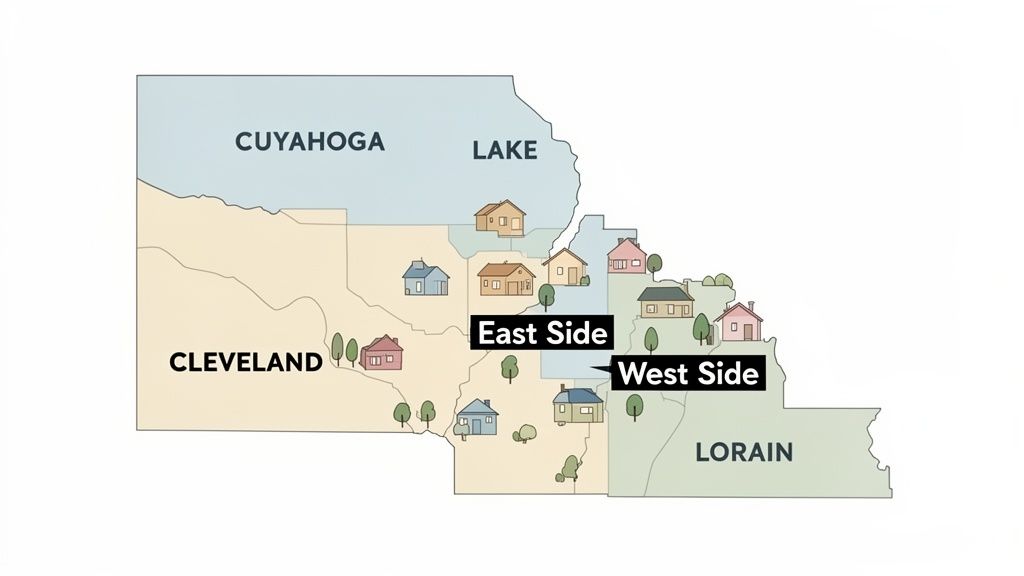
If you're staring at a pile of glossy brochures and feeling completely overwhelmed, this guide is for you. So many families across Cuyahoga, Lake, and Lorain counties spend weeks stuck in the research phase, terrified of making a wrong move that could impact a parent's safety or finances. Our goal is to move you from "researching" to "consulting an advisor" who can provide a real solution.
This isn’t just another directory. Think of us as your trusted insider for the local care landscape. We understand the unique dynamics of Northeast Ohio—from the East Side vs. West Side debate to the logistics of getting to appointments near "The Clinic" (Cleveland Clinic) or University Hospitals (UH).
Why Going It Alone Is So Hard
The home care system is deceptively complex, and a misstep can be costly. Here's a real-world scenario we see often: a family in Solon spent three weeks touring facilities and interviewing caregivers, only to find out their top choice didn't accept the Ohio AL Waiver for payment. A quick check with a local advisor would have saved them that time and heartache.
To give you a head start, here’s a quick look at the essential factors for families considering in-home support in the Greater Cleveland area.
Cleveland Home Care at a Glance
| Care Aspect | Key Cleveland Consideration | Insider Tip |
| :--- | :--- | :--- |
| Agency Licensing | In Ohio, home care agencies must be licensed by the Ohio Department of Health (ODH). This isn't optional—it ensures they meet standards for caregiver screening and training. | While a brochure highlights the friendly smiles, you need to ask for their ODH license number. Our advisors verify this for you, ensuring you only connect with legitimate, compliant providers. |
| Caregiver Vetting | A licensed agency handles background checks, verifies certifications, and manages all payroll taxes. They take on the legal and financial burden. | Hiring privately makes you the employer. That means you're responsible for all vetting, insurance, and tax withholding. It adds a ton of risk and work. |
| Service Area | An agency based in Medina might struggle to provide consistent staff for a client in Willoughby. Geography really matters for reliability, especially during a lake effect snowstorm. | Focus on agencies with a strong, established presence in your specific area—be it Cuyahoga, Lake, or Lorain county—to guarantee consistent coverage. |
| Cost vs. Value | The hourly rate is just one number. You also need to look at shift minimums (e.g., a 4-hour block) and, critically, what happens if a caregiver calls off sick. | An agency with a slightly higher rate but guaranteed backup care often provides far more value and peace of mind than a cheaper, less reliable option. |
This table is just the beginning. This guide will walk you through all these details, step-by-step, helping you ask the right questions and truly understand the system. Instead of guessing, you’ll have a clear framework for making the best possible decision for your family.
So, What Exactly Is Home Care?
When you first start looking for in-home help, it feels like learning a new language. You’ll see terms like "personal care," "companion care," and "skilled nursing" thrown around. But here’s the truth: to Medicare and the state of Ohio, these terms mean very different things. Getting this right from the start is the single most important step you can take.
This confusion isn't just a minor detail; it can lead to real problems. We've seen families in Shaker Heights assume Medicare will pay for someone to help their mom with meals and bathing after a hospital stay. They spend weeks getting everything set up, only to be blindsided by the reality that Medicare doesn't cover that kind of support, leaving them with an unexpected and hefty bill.
Home Care vs. Home Health Care: The Key Difference
Let's clear this up right now. There are two main types of in-home support, and they have completely different purposes, payment methods, and rules. Knowing which one you need is crucial for finding the right home care in Cleveland, Ohio.
-
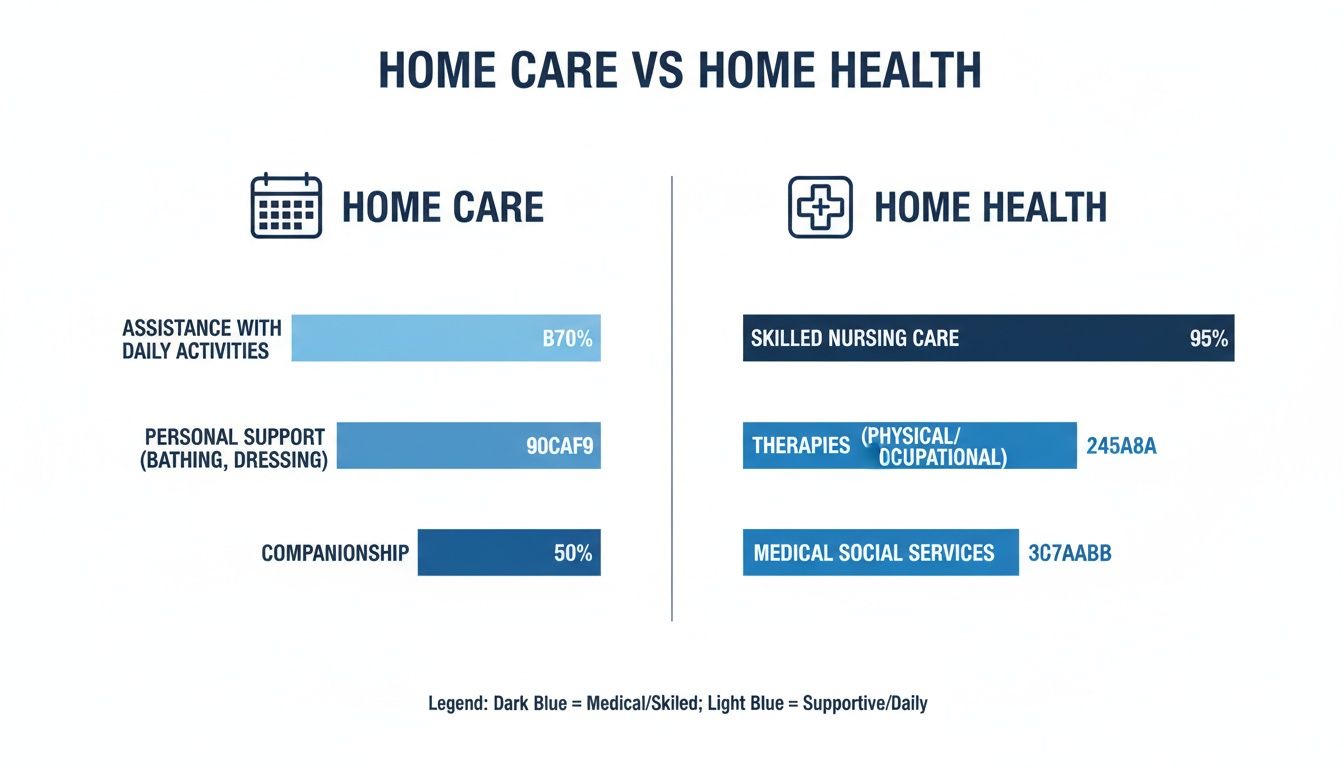
Home Care (Non-Medical): This is the "helping hands" support most families are actually looking for. It’s about assisting with Activities of Daily Living (ADLs)—things like bathing, dressing, making meals, medication reminders, and providing companionship and safety. This care is almost always paid for out-of-pocket, with long-term care insurance, or through the specific Medicaid Assisted Living Waiver (AL Waiver).
-
Home Health Care (Skilled & Medical): This is clinical care that must be ordered by a doctor. It’s delivered by licensed professionals, like a registered nurse (RN) who comes to change a surgical dressing or a physical therapist (PT) who helps with rehab after a knee replacement. This is the type of care that Medicare typically covers, but only for a limited time and only if the patient meets very strict criteria.
Most of the time, what families truly need to keep a loved one safe and comfortable at home is non-medical home care.
Agency Caregiver vs. a Private Hire
You have two main routes: hiring through a licensed home care agency or hiring an individual directly (a "private hire"). While finding someone on a job board might seem cheaper upfront, it opens up a world of risk that agencies are built to handle for you.
Insider Tip: When you hire a caregiver privately, you aren't just hiring help—you are becoming an employer. That means you are legally on the hook for everything: background checks, payroll taxes, liability insurance, and figuring out what to do when they call in sick. For most families, this is a massive, stressful, and legally risky undertaking.
Here’s a look at how the two options stack up:
| Feature | Licensed Home Care Agency | Private Hire Caregiver |
| :--- | :--- | :--- |
| Vetting & Safety | The agency handles background checks, drug screening, and credential verification. | This is 100% your responsibility. You have to run the checks and vet their experience yourself. |
| Insurance | Agencies are bonded and insured, protecting you from liability if an accident or theft occurs. | You'd need a separate liability policy to be covered, which is your responsibility to secure. |
| Backup Care | If your regular caregiver can't make it, the agency sends a qualified replacement. No gaps in care. | You're on your own. You have to scramble to find a substitute, leaving your loved one without help. |
| Taxes & Payroll | The agency is the employer of record. They manage all payroll, taxes, and worker's comp. | You're the employer. This means you are responsible for managing withholdings and filing employer taxes. |
| Oversight | A professional care manager, often a nurse, oversees the care plan and supervises the caregiver. | You are the manager. You have to handle all issues, scheduling, and oversight yourself. |
For families here in the Cleveland area, choosing an agency provides a critical safety net. The peace of mind that comes from knowing your caregiver is fully vetted, insured, and has backup is truly priceless.
Calculating the Cost of Home Care in Cleveland
Let's get right to the question on everyone's mind: "How much is this going to cost?" When you start looking into home care in Cleveland, Ohio, it’s easy to get frustrated by the lack of clear answers. You'll find national averages that don't apply here and vague quotes that don't tell the whole story.
My goal is to give you a straightforward, Cleveland-focused financial picture. Forget the national data. Rates right here in Cuyahoga County are driven by local factors, and understanding them is the first step to building a realistic budget.
Cleveland Home Care Rates: What to Expect (Updated: October 2023)
There isn't a single, flat hourly rate for home care. Think of it as a range that depends on the kind of help your loved one needs.
-
Companionship & Homemaker Services: This is your most affordable option. It covers things like meal prep, light housekeeping, running errands to Heinen's or Giant Eagle, and providing friendly company.
-
Personal Care Services: The rate for this is a step up because it involves "hands-on" help like bathing, dressing, grooming, and moving around safely. The caregivers for this level need more specific training.
-
Specialized Care: If you're dealing with advanced dementia, need someone trained to use a Hoyer lift, or have other complex health situations, the rate will be higher to reflect the advanced skills required.
In the Greater Cleveland area, you can expect the hourly rate for licensed home care to fall in this range:
| Level of Care | Estimated Hourly Rate Range |
| :--- | :--- |
| Personal Care / Hands-On Assistance | $30 - $38 per hour |
| Companionship / Homemaker Services | $28 - $34 per hour |
A Real-World Budget Scenario
Let's translate those hourly rates into a practical weekly budget. Imagine a family in Lakewood needs help for their father. He gets around okay but is starting to forget meals and needs reminders to take his medication. They decide 4 hours a day, 5 days a week is a good start.
-
Total Hours Per Week: 20 hours
-
Estimated Hourly Rate Range (Personal Care): $30 - $38
-
Estimated Weekly Cost: $600 - $760
-
Estimated Monthly Cost: $2,400 - $3,040
Just like that, the family has a realistic baseline for their budget. They can now plan accordingly and see how adding a weekend shift would impact their costs. If you're just looking for temporary help, our guide on respite care costs in Cleveland might be a useful resource.
Insider Tip: Always ask about the agency's "minimum shift." Most agencies in the Cleveland area have a 3- or 4-hour minimum for each visit. This is a critical detail. If you only need someone for an hour, you'll almost certainly be billed for their minimum block of time.
How to Pay for Home Care Services in Ohio
<iframe width="100%" style="aspect-ratio: 16 / 9;" src="https://www.youtube.com/embed/3R-Nu3BEbYA" frameborder="0" allow="autoplay; encrypted-media" allowfullscreen></iframe>Once you have a realistic idea of the cost, the next question is always, "How are we going to pay for this?" This is where many families get lost in a confusing maze of rules. The truth is, there are several ways to pay for care, but each is designed for a very different situation.
Let's break down the major payment sources for home care in Cleveland, Ohio.
Medicare: The 100-Day Misconception
This is the biggest and most costly point of confusion. Let me be clear: Medicare does NOT pay for long-term, non-medical home care. It is designed for short-term, skilled medical care after a qualifying hospital stay.
Think of it this way: your dad has a knee replacement at University Hospitals. Medicare might cover a physical therapist to visit a few times a week for a limited period. What it will not cover is a caregiver to help him with bathing, making meals, or just being there for him over the next several months.
Ohio Medicaid Waivers: A Path to In-Home Support
For seniors with limited income and assets, Ohio’s Medicaid waiver programs can be a lifeline. These programs were created to help people stay in their own homes instead of moving into a nursing facility.
The most common program for seniors is the Medicaid Assisted Living Waiver (AL Waiver), which can also be used for services at home.
-
Who it helps: This is for Ohio residents aged 60+ who are financially eligible for Medicaid and meet the state's "nursing facility level of care" criteria.
-
What it covers: It can pay for a range of non-medical home care, including personal care (bathing, dressing) and homemaker services.
-
How to apply: The journey starts with your local Area Agency on Aging. For most of us in Greater Cleveland, that’s the Western Reserve Area Agency on Aging.
Insider Tip: Applying for a Medicaid waiver is a complex, document-heavy process that can easily take months. One small mistake on the application can lead to a denial or major delays. We strongly recommend working with an elder law attorney who specializes in Ohio Medicaid to guide you through it.
To get a clearer picture of how these two major programs work, you can learn more about the differences between Medicare and Medicaid for long-term care in our Ohio guide.
Long-Term Care Insurance
If your loved one bought a long-term care (LTC) insurance policy years ago, now is the time to find it. Most modern policies do cover licensed home care, but every policy is different.
You'll need to look for a few key details:
-
The Elimination Period: The number of days you must pay for care out-of-pocket (e.g., 90 days) before the policy starts paying.
-
The Daily Benefit Amount: The maximum amount the policy will pay per day for care (e.g., $150/day).
-
Lifetime Maximum: The total dollar amount the policy will ever pay out.
Veterans Benefits: The Aid & Attendance Pension
For qualifying veterans and their surviving spouses, the VA's Aid & Attendance benefit can provide a significant monthly payment that can be used for home care. Eligibility is based on service record, specific medical needs, and very strict income and asset limits. Be warned: the application process is notoriously slow.
Private Pay: The Most Common Method
The reality for most families in Northeast Ohio is that they will pay for home care out-of-pocket, at least initially. This money typically comes from savings, pensions, or Social Security. Understanding the costs we outlined earlier is the critical first step to creating a sustainable budget.
Choosing the Right Home Care Agency in Cleveland
Finding a reliable provider for home care in Cleveland, Ohio, is the most critical step. You’re not just hiring a service; you’re inviting someone into your home and trusting them with a loved one’s well-being. This is about getting past the sales pitch to understand how an agency truly operates.
Your goal is to find a partner in care, not just a contractor. That journey starts with knowing what questions to ask.
Where to Find Licensed Cleveland Agencies
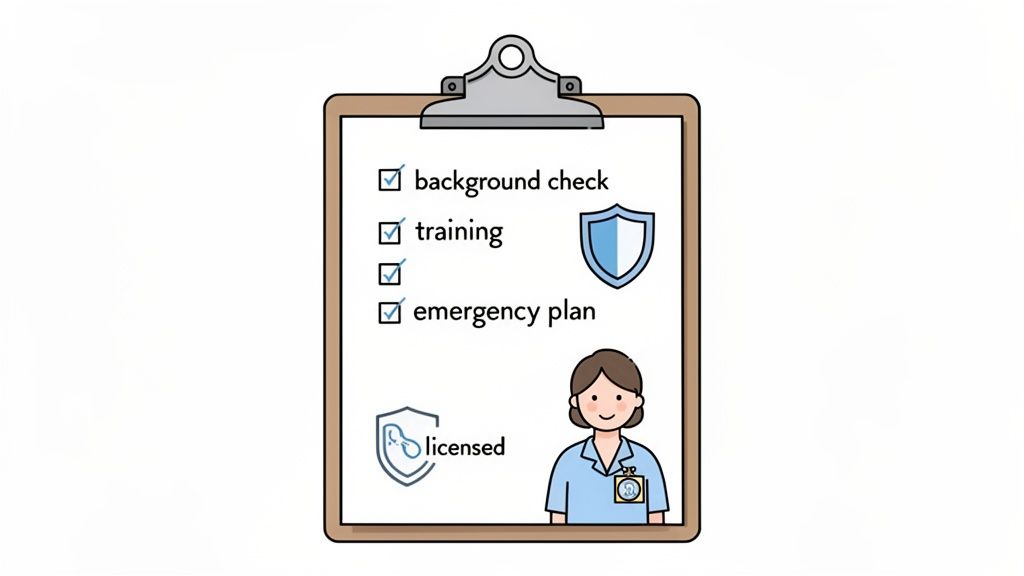
The first filter should always be licensing. In Ohio, home care agencies must be licensed by the Ohio Department of Health (ODH). This is a non-negotiable baseline for safety that ensures employee background checks and training are handled correctly.
-
Ohio Department of Health: The ODH website has a list of licensed agencies, but it can be difficult to search.
-
Area Agency on Aging: The Western Reserve Area Agency on Aging is a fantastic resource, but they provide lists, not personalized recommendations.
-
Guide for Seniors: This is where we act as your concierge. Our local advisors maintain a curated list of vetted, licensed agencies across Greater Cleveland. We give you a short list based on your specific needs—location, budget, and level of care—saving you hours of frustrating research.
Questions to Ask Any Home Care Agency
Once you have a list, it's interview time. This is your chance to cut through the marketing fluff. A good agency will welcome these questions.
Questions About Their Caregivers:
-
What is your exact screening process? Do you run both state and national background checks?
-
What specific training do your caregivers receive? Do you offer specialized training for dementia care?
-
What is the average length of time your caregivers have been with your agency? (High turnover is a major red flag).
-
Can we meet the potential caregiver before services begin?
-
What happens if we're not comfortable with the assigned caregiver?
Questions About Their Operations:
-
Are your caregivers employees (W-2) or independent contractors (1099)? (Insider Tip: W-2 is the only right answer. It means the agency manages, insures, and is fully responsible for them).
-
What is your protocol if a caregiver calls in sick? How quickly can you get a qualified backup to the house?
-
How do you supervise your staff? Are there regular check-ins from a nurse or care manager?
-
Do you create a written, personalized care plan for every client? How often is it reviewed?
Asking these tough questions upfront is the best way to prevent problems down the road. For a broader perspective, read our guide on planning for long-term care.
Your Next Step: Don't get lost in a sea of phone calls. Speak to a Cleveland-based Senior Advisor for free to narrow your list to agencies that actually match your family's exact needs. We’ve already done the legwork, so you can focus on finding the right fit for your loved one.
When It’s Time to Consider Other Options
Everyone’s goal is to keep their loved one at home for as long as possible. But sometimes, keeping someone at home is no longer the safest, most sustainable, or even the most affordable plan. Home care is fantastic, but when care needs become intense, the one-on-one model can create new problems, like crushing costs and social isolation.
The Financial Tipping Point
The Achilles' heel of home care is the cost of around-the-clock coverage. A few hours a day might be manageable, but the bill explodes when someone needs 24/7 supervision.
Let’s do the math. 24 hours of care, even at a conservative local rate of $30 per hour, comes out to $720 a day. That adds up to over $21,000 a month.
When you see numbers like that, it's time to look at the alternatives. Assisted living or memory care communities have staff on-site 24/7, and those costs are spread across all residents, often making it a more practical choice for someone with high-level needs.
Progressive Conditions and Safety at Home
Certain health issues, especially dementia, create safety challenges that are incredibly difficult for a single caregiver to manage alone.
Imagine this scenario: a family in Westlake is managing their mom's dementia at home. One night, she gets confused and tries to leave the house at 2 a.m. The overnight caregiver is alone. Their only option is to call 911. A memory care community is designed for this. They have secured exits, multiple staff members to help de-escalate, and an environment built to reduce anxiety. Home care, for all its benefits, simply can't replicate that built-in safety net.
When Loneliness Becomes the Bigger Problem
Home is familiar, but it can also become an island. For seniors who are still mobile, the social isolation of spending all day with just a caregiver can lead to depression and cognitive decline. This is where assisted living communities shine. They are designed to fight loneliness with planned activities, group meals, and opportunities for residents to form genuine friendships with their peers.
Keep in mind, higher levels of care have significant costs. For instance, nursing home care in the Cleveland area shows a wide range. By 2026, the average cost for a semi-private room in a Cleveland nursing home is projected to hit $354 per day, or $129,122 a year for families paying privately. It's worth exploring the details of nursing home costs to understand all your financial options.
Moving from home care to a community is an emotional decision. It’s easy to feel like you’re giving up. But often, it’s the most loving choice you can make—one that provides better safety, more connection, and a higher quality of life.
Common Questions About Cleveland Home Care
When you're trying to set up home care for a loved one in Cleveland, you're usually working against the clock and under a lot of stress. Let's tackle some of the most common questions families ask.
How Quickly Can We Get a Caregiver to Start?
For most agencies, you can expect to have care in place within 24 to 48 hours of their initial in-home assessment. This first meeting is vital for them to create a specific plan of care. A local Senior Advisor can often point you to Cleveland agencies known for being able to act fast, which is a lifesaver when coordinating a hospital discharge.
What Happens If We Don’t “Click” with the Caregiver?
This is a perfectly normal concern. Personal connection matters. Any professional agency in Cleveland will have a clear process for this. You should never hesitate to say, "This isn't the right fit," and ask for a different caregiver. This is one of the biggest benefits of working with an agency instead of hiring privately.
Will My Long-Term Care Insurance Cover Home Care Here in Ohio?
The short answer is: probably, but you have to check the fine print. Most modern long-term care policies cover licensed home care services. However, you must pull out your policy document and look for two key phrases:
-
"Elimination period": How long you have to pay out-of-pocket before the policy kicks in.
-
"Daily benefit limit": The maximum amount the policy will pay per day.
Call your insurance provider directly before you sign any agreements with a home care agency to avoid any financial surprises.
Trying to piece all of this together—from finding an agency to figuring out insurance—can be exhausting. The Guide for Seniors team is here to be your concierge, providing free, one-on-one help to find the right fit without the guesswork. Speak to a Cleveland-based Senior Advisor today to get your questions answered and receive a curated list of vetted local providers.
Disclaimer: This article is for informational purposes only and does not constitute legal, financial, or medical advice.
Find Medicaid-Approved Communities Near You
Looking for a facility that accepts the Ohio Medicaid Assisted Living Waiver? Browse communities in these Cleveland suburbs:
Medicaid waiver communities on Cleveland's west side
East side communities accepting Ohio Medicaid
Affordable Medicaid options in south suburbs
Near-west Medicaid-approved communities
Southwest suburban Medicaid facilities
Central location with waiver-approved care
Need help navigating Medicaid? Our local advisors provide free guidance →
Need Help Finding Senior Living?
Our local advisors compare pricing, schedule tours, and answer your questions — completely free.