How to Plan for Long-Term Care in Greater Cleveland: A Family Guide
-
TL;DR: Planning for long-term care feels overwhelming, but breaking it down into steps helps.
-
Start with needs: Before looking at places, create an honest list of the daily support your loved one requires. This guides every other decision.
-
Know Ohio's rules: Financial aid programs like the Medicaid Assisted Living Waiver (AL Waiver) and facility regulations are state-specific. Don't rely on national advice.
-
Understand the costs: Care in Cleveland is mainly paid for with private funds, long-term care insurance, or Medicaid. Medicare does not pay for assisted living.
-
Get paperwork in order: Legal documents like a Durable Power of Attorney for Healthcare are essential. Get them done before a crisis hits.
Who This Guide Helps
This guide is for families in Greater Cleveland (Cuyahoga, Lake, Lorain, Geauga, Medina, and Summit counties) who are comparing senior living options like assisted living, memory care, and nursing homes. It’s written for people who are stressed, short on time, and need a clear, calm, solution-oriented roadmap.
Key Takeaways
-
Focus on Needs First: Your first step is to assess your loved one's needs for Activities of Daily Living (ADLs) like bathing and dressing. This will tell you what level of care to look for.
-
Local Resources Are Key: In Ohio, your local Area Agency on Aging is your starting point for programs like the AL Waiver. For Greater Cleveland, this is the Western Reserve Area Agency on Aging.
-
Costs Have Multiple Parts: When you get a price, ask for the breakdown: the base rate (rent and basic services), level-of-care fees (extra cost for hands-on help), and any one-time community fees.
-
Legal Documents Are a Priority: Having a Power of Attorney for healthcare and finances ensures your loved one's wishes are followed and allows you to manage their affairs if they are unable.
Disclaimer: This article is for informational purposes only and is not legal, financial, or medical advice. Please consult with licensed professionals for guidance on your specific situation.
Step 1: Get an Honest Picture of Your Family's Care Needs
Before looking at senior living communities, you must get a clear, honest picture of the support your loved one truly needs. This isn’t about making a medical diagnosis. It’s about creating a practical list that will guide your conversations and decisions.
Getting this right ensures you find a place that can provide the right support today and tomorrow, without overpaying for services that aren't needed.

A good way to start is by looking at two key areas: Activities of Daily Living (ADLs) and Instrumental Activities of Daily Living (IADLs). These are the basic tasks of independence.
Understanding Activities of Daily Living (ADLs)
ADLs are basic self-care tasks. When someone can't do these safely on their own, it’s a strong sign that hands-on support is needed.
-
Bathing and Grooming: Can they shower safely? Are they keeping up with personal hygiene?
-
Dressing: Can they choose appropriate clothes and get dressed without help?
-
Toileting: Can they use the restroom independently?
-
Transferring: Can they move safely from a bed to a chair or stand up from the sofa?
-
Eating: Can they feed themselves once a meal is prepared?
If you see consistent trouble with even one or two ADLs, it's a clear sign that assisted living is needed.
Evaluating Instrumental Activities of Daily Living (IADLs)
IADLs are more complex tasks needed to live independently. You might notice struggles here before ADL challenges appear.
-
Managing Medications: Are they taking the right pills at the right times? This is a critical safety issue.
-
Managing Finances: Is mail piling up? Are there late payment notices or signs of financial confusion?
-
Meal Preparation: Are they able to plan, shop, and cook for themselves? A look in the fridge can be revealing.
-
Housekeeping: Is the home becoming cluttered, dirty, or unsafe?
-
Transportation: Can they still drive safely or arrange for other transportation?
What this means for you: Someone struggling with IADLs but fine with ADLs might be a good fit for independent living with some add-on services. Once help with ADLs is needed, it's time to explore assisted living.
Don't Forget Cognitive and Social Health
The assessment should also include cognitive well-being. Are there memory lapses that could affect safety, like forgetting to turn off the stove?
Pay attention to changes in judgment, personality, or an increase in confusion, as these can be early signs of dementia. If you see these changes, you'll want to learn about the specialized support offered in memory care. Our article on the 5 signs that memory care may be needed can help.
Social health is just as important. Loneliness is a serious health risk. A move to a community can provide vital social connection and activities.
Care Needs Assessment Checklist
Use this checklist to create a clear picture of support needs. Sit down with your family and be as honest as possible. Mark each item as 'Independent,' 'Needs Some Help,' or 'Fully Dependent.'
| Activity Area | Task Example | Level of Assistance Needed |
| :--- | :--- | :--- |
| Personal Care (ADL) | Bathing, dressing, grooming | |
| Mobility (ADL) | Walking, transferring from bed to chair | |
| Continence (ADL) | Using the restroom independently | |
| Nutrition (ADL/IADL) | Feeding oneself, preparing simple meals | |
| Medication (IADL) | Taking correct pills at the right time | |
| Household (IADL) | Light cleaning, laundry, managing mail | |
| Finances (IADL) | Paying bills, managing a bank account | |
| Cognition | Memory, decision-making, safety awareness | |
| Socialization | Interacting with others, joining activities| |
This completed checklist will make your conversations with communities much more productive.
Step 2: Navigate Senior Living Options in Greater Cleveland
Once you understand your loved one's needs, you can explore the different types of senior living in Northeast Ohio. The goal is to find the best fit for your family.
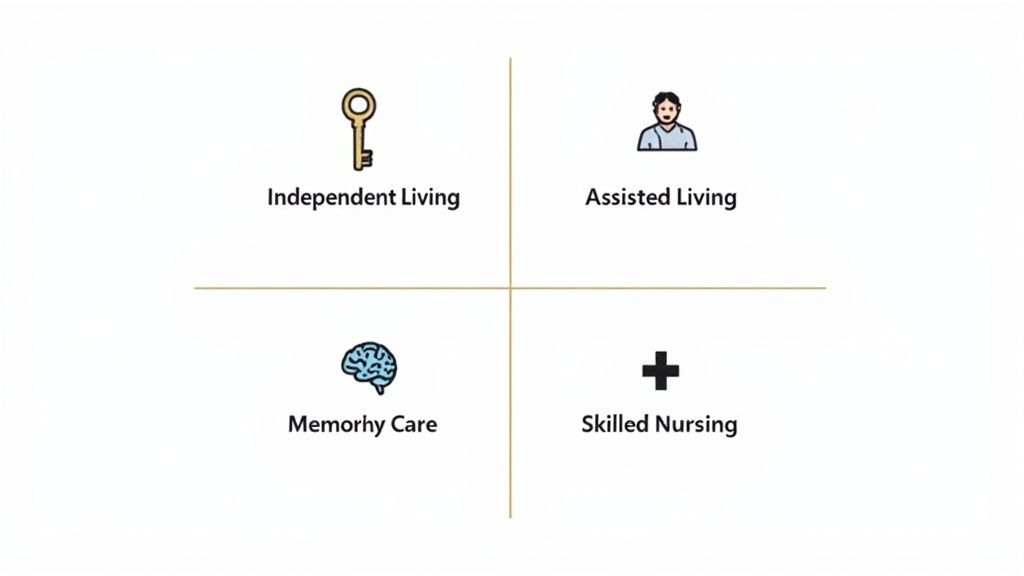
Let's review the main choices you'll find in Cuyahoga, Lake, Lorain, and surrounding counties.
Independent Living: For Active Seniors
Think of independent living as a lifestyle choice focused on convenience and social opportunities. It’s for active older adults who don't need daily personal care but want to ditch home maintenance.
-
Who it's for: Seniors who manage their own care but are tired of cooking, cleaning, and upkeep.
-
What's included: Meal plans, housekeeping, transportation, and a full calendar of social events. Residents live in private apartments.
-
What it isn't: It does not provide hands-on personal care like help with bathing or medication management.
Assisted Living: For Daily Support
This is where most families land when a loved one needs consistent help with ADLs. In Ohio, these communities are licensed as an Assisted Living (Residential Care Facility) by the Ohio Department of Health, ensuring they meet state safety and care standards.
Assisted living balances independence with support. Residents have a private apartment but know help is available 24/7 for things like medication reminders, showering, or an escort to meals. This is an incredibly popular option. You can explore a wide range of assisted living communities in the Cleveland area.
Memory Care: For Specialized Cognitive Support
When Alzheimer's or another form of dementia is a factor, memory care provides a secure, specially designed environment. These are often separate "neighborhoods" within a larger assisted living community.
-
Secure Environment: Safety is the top priority, with secured exits and safe outdoor areas to prevent wandering.
-
Specially Trained Staff: Caregivers receive advanced training in dementia care to manage behaviors with compassion.
-
Purposeful Activities: The day is structured with activities designed to engage residents and reduce anxiety.
Skilled Nursing Facilities (SNFs): For Complex Medical Needs
Often called a nursing home, a Skilled Nursing Facility (SNF) provides the highest level of care outside a hospital. These facilities are regulated by the federal Centers for Medicare & Medicaid Services (CMS). They are for people with serious medical conditions who need 24/7 care from licensed nurses.
The difference is key: assisted living is about personal care, while a skilled nursing facility is about medical care.
| Care Setting | Primary Focus | Typical Resident | Ohio Licensing/Regulation |
| :--- | :--- | :--- | :--- |
| Independent Living | Socialization & Convenience | Active, independent seniors wanting a maintenance-free life. | N/A (Landlord-tenant relationship) |
| Assisted Living | Personal Care & Daily Support | Seniors needing help with ADLs like medication or bathing. | Ohio Dept. of Health (RCF) |
| Memory Care | Safety & Cognitive Support | Individuals with dementia or significant memory loss. | Ohio Dept. of Health (RCF) |
| Skilled Nursing | 24/7 Medical Care & Nursing | Individuals with complex medical needs or post-hospital rehab. | CMS (Federal) & ODH (State) |
Matching your loved one's needs to these options will help you focus your search and save time and energy.
Step 3: Figure Out How to Pay for Long-Term Care in Ohio
For most families, the biggest question is: how will we pay for this? Understanding your options is the first step toward creating a workable plan.
According to the Administration for Community Living, 56% of Americans turning 65 today will need some form of long-term care. You can explore more long-term care statistics from their research. This makes financial planning essential.
<iframe width="100%" style="aspect-ratio: 16 / 9;" src="https://www.youtube.com/embed/_xixvCguj64" frameborder="0" allow="autoplay; encrypted-media" allowfullscreen></iframe>Private Pay: The Starting Point
Private pay means using personal funds to cover the cost. For most people entering assisted living, this is how they start. Money typically comes from a mix of sources:
-
Retirement savings (pensions, 401(k)s, IRAs)
-
The sale of a home
-
Other investments
-
Monthly income from Social Security
When a community gives you a price, always ask for a full breakdown of the base rate, any level-of-care fees, and one-time community fees. For a deeper look at local expenses, see our guide on senior living costs in Cleveland.
Long-Term Care Insurance
If your loved one has a long-term care (LTC) insurance policy, find it and read it carefully. These policies are designed to cover services that regular health insurance and Medicare do not. Look for the daily benefit amount, the "elimination period" (how long you pay out-of-pocket before benefits start), and the lifetime maximum payout.
Veterans Benefits: Aid & Attendance
For qualifying veterans and their surviving spouses, the VA Aid & Attendance benefit provides a monthly payment to help pay for care, including in an assisted living community. To be eligible, a veteran must meet specific wartime service, medical need, and financial requirements. The application process can be slow, so start early.
Medicare vs. Ohio Medicaid: A Critical Difference
-
Medicare is health insurance for those 65+. It does not pay for long-term custodial care like assisted living. It may cover a short, rehabilitative stay in a skilled nursing facility after a qualifying hospital stay, but that's it.
-
Ohio Medicaid is a joint federal and state program for people with limited income and assets. It is the largest payer of long-term care, but you must meet strict financial and medical criteria to qualify.
The Ohio Medicaid Assisted Living Waiver
For many Cleveland-area families, the Medicaid Assisted Living Waiver (AL Waiver) makes assisted living affordable. This program helps pay for care services for Ohioans who qualify.
-
What it covers: The AL Waiver pays for the care services part of the bill. The resident is still responsible for their "room and board" cost, which is typically paid with their monthly income (like Social Security).
-
Who is eligible: An applicant must meet Ohio Medicaid's strict income and asset limits and be assessed as needing an "intermediate level of care" (similar to care in a nursing home).
-
How to apply: Your first step is to call your local Area Agency on Aging (AAA). For Cuyahoga, Geauga, Lake, Lorain, and Medina counties, that is the Western Reserve Area Agency on Aging.
Example: How the AL Waiver Works in Cuyahoga County
A widow in Cuyahoga County has a monthly Social Security income of $1,600 and less than $2,000 in savings. Her doctor has confirmed she needs help with bathing and taking her medications. She contacts the Western Reserve Area Agency on Aging and is approved for the AL Waiver. She finds a participating assisted living community. The AL Waiver program pays the community for her care, and she uses most of her Social Security income to pay for her room and board.
Step 4: Get Your Essential Legal Documents in Order
Getting the right paperwork in place before a crisis is one of the most important things you can do. It ensures your loved one's wishes are respected and gives your family a clear path forward.
Without these documents, critical decisions can get stuck, and courts may have to get involved—a slow, expensive, and stressful process.

Durable Power of Attorney for Healthcare
This legal document lets your loved one (the "principal") choose a trusted person (the "agent") to make medical decisions for them if they become unable to speak for themselves. This agent can talk to doctors, review medical records, and make choices about treatment or moving to a care community. In Ohio, this document must be signed and either notarized or witnessed by two qualified individuals to be valid.
Durable Power of Attorney for Finances
This document appoints an agent to handle financial matters like paying bills, managing bank accounts, or selling property to fund care. It is the practical key that allows the financial part of your long-term care plan to be put into action.
Ohio's Living Will Declaration
A Living Will is different from a regular will. It is a legal document that states a person's wishes about end-of-life medical care, such as the use of life-sustaining treatments if they are in a terminal condition. It removes the burden of these difficult decisions from the family.
Your Document Checklist
We recommend working with an elder law attorney to draft these documents and ensure they comply with Ohio law. Use this checklist to track your progress.
| Document | Purpose | Status (Not Started, In Progress, Complete) |
| :--- | :--- | :--- |
| Durable Power of Attorney for Healthcare | Appoints an agent to make medical decisions. | |
| Durable Power of Attorney for Finances | Appoints an agent to manage financial affairs. | |
| Living Will Declaration | States end-of-life medical treatment wishes. | |
| Will (Last Will and Testament) | Specifies distribution of assets after death. | |
| HIPAA Authorization Form | Allows medical providers to share info with named individuals. | |
What to Do Next: Your Action Plan
Reading about planning is one thing; taking action is what moves you forward. Here are concrete steps you can take this week in Greater Cleveland.
-
Complete the Care Needs Checklist. Use the checklist from Step 1 to have an honest conversation with your family. This document will be your guide as you explore options.
-
Call Your Area Agency on Aging. To learn about financial aid, call the Western Reserve Area Agency on Aging at (800) 626-7277. Ask them, "Can you help me understand the eligibility requirements for the Ohio Assisted Living Waiver?" This is the official first step and costs nothing.
-
Book One Tour. The best way to understand your options is to see them. Schedule a tour of one local assisted living community. It makes the process feel real and less intimidating.
-
Know Your Rights. Keep these links handy. If you have concerns about care, you can report them to the Ohio Department of Health. For advocacy and problem-solving, the Long-Term Care Ombudsman is a free, confidential resource.
Frequently Asked Questions (FAQ)
What’s the real difference between Medicare and Medicaid for long-term care?
Medicare is health insurance for people 65+. It covers short-term, medical needs like a brief rehab stay in a skilled nursing facility after a hospital visit. It does not pay for long-term assisted living.
Ohio Medicaid is a needs-based program for people with limited financial resources. It is the primary government payer for long-term care, including through programs like the Assisted Living Waiver (AL Waiver).
How much does assisted living cost in the Cleveland area?
Costs vary by community and the level of care needed. A general estimate for Greater Cleveland is between $4,500 and $7,000 per month. Always ask for a detailed price sheet that separates the base rent from additional "level-of-care" fees, which are based on how much hands-on support is required.
Do we really have to spend all our money to qualify for Ohio Medicaid?
For many people, yes. To qualify for Medicaid, an individual must "spend down" their countable assets below a limit set by the state (as of 2024, this is typically $2,000 for an individual). The rules for this are complex. Giving away assets can lead to a penalty period of ineligibility. It is highly recommended to speak with an elder law attorney to navigate this process correctly.
When should we start planning for long-term care?
The best time is before a crisis happens. Planning ahead gives you more choices, reduces stress, and allows your loved one to be part of the decision-making process. Getting legal documents like a Power of Attorney in place now is one of the most helpful things you can do.
Trying to figure out the senior living landscape in Cleveland can feel overwhelming, but you're not in this by yourself. The local advisors at Guide for Seniors provide a free service, offering personalized guidance to help families just like yours find the right assisted living or memory care community. We do the legwork to save you time and stress, matching you with great options that fit your loved one's needs, budget, and preferred location. Get started with your free, personalized recommendations today.
Need Help Finding Senior Living in Greater Cleveland?
Our Greater Cleveland local advisors compare pricing, schedule tours, and answer your questions — completely free.