Assisted Living vs Nursing Home Costs Cleveland Comparison: Your Guide
Feeling overwhelmed by senior living options in Greater Cleveland? You're not alone. If you're drowning in glossy brochures and confusing sales pitches, terrified of making a costly mistake, this guide is for you.
We're not here to give you more information to sift through. We're here to be your "insider," translating the marketing fluff into reality so you can move from researching to making a confident decision. This guide helps families in Cuyahoga, Lake, Lorain, Geauga, Medina, and Summit counties find clarity.
Here’s the bottom line upfront:
-
Assisted Living is for support with daily activities (like meals, bathing) in a social, residential setting. It's best for those who are mostly independent.
-
Nursing Homes provide 24/7 skilled medical care from licensed professionals. This is for complex health conditions or post-hospital rehab.
-
The Cost Gap is Huge: In Cleveland, a nursing home can cost nearly double what assisted living does, purely because of the intensive medical care provided.
-
"Sticker Price" Isn't the Real Price: A community's advertised rate is just the start. You must account for "Level of Care" fees, which can add thousands to your monthly bill.
-
Expert Help is Free: A local Senior Advisor can give you transparent, unadvertised pricing and availability, saving you weeks of stressful, dead-end research.
A Cleveland Insider's Guide to Senior Care Costs
If you're a family in the Cleveland area trying to navigate senior care, you're probably feeling overwhelmed. You're sorting through brochures from communities in Westlake, Solon, and everywhere in between. While they highlight the chandeliers, you really need to know about the weekend staffing ratios and the true, all-in monthly costs.
This guide is your local resource, cutting through the marketing fluff to give you clear, honest answers. We'll break down the financial and care differences between Assisted Living and Nursing Homes right here in Northeast Ohio, helping you move from confusion to confident decision-making.
The chart below shows just how stark the cost difference is here in the Cleveland area.
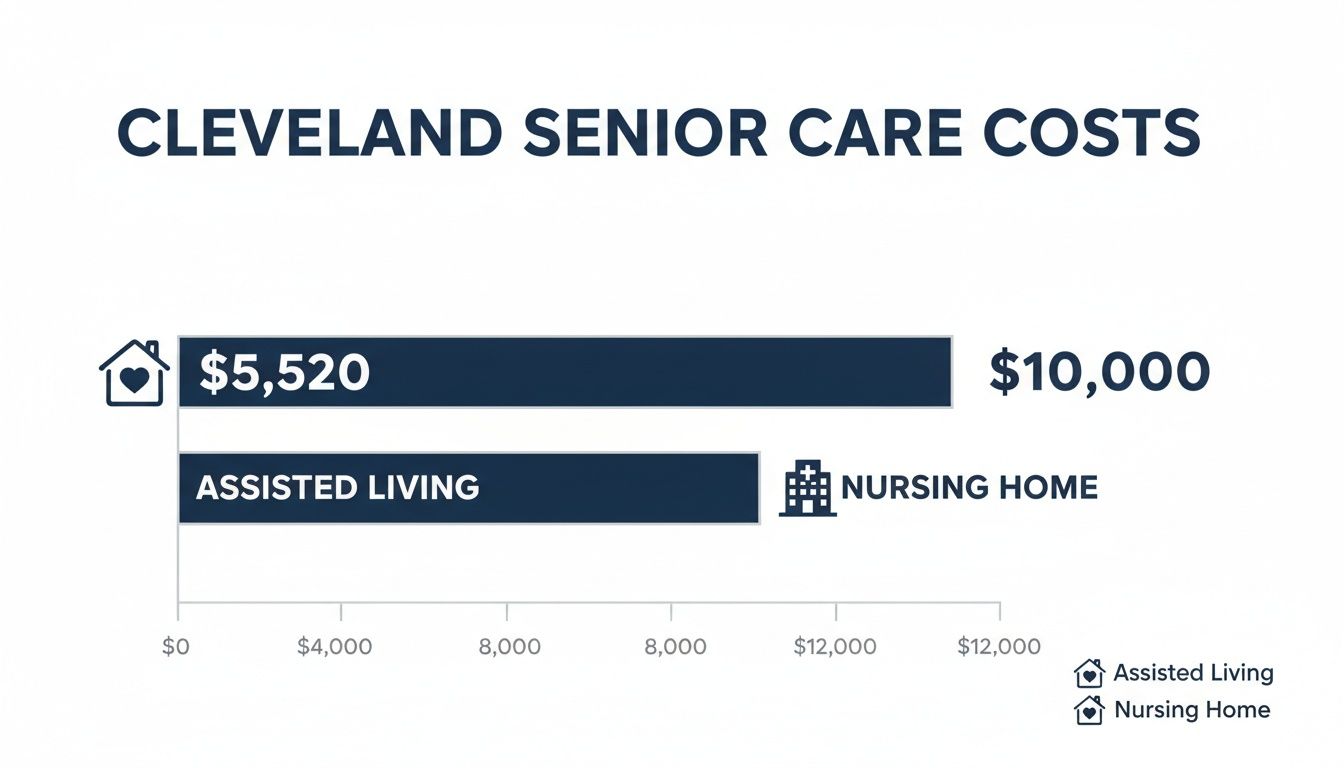
As you can see, the average cost for a nursing home is nearly double that of assisted living. That price tag directly reflects the intensive, round-the-clock medical services that nursing homes are equipped to provide. For a broader look at how these costs are calculated, see our comprehensive guide to senior living costs.
Cleveland Senior Living At A Glance: Assisted Living vs. Nursing Home
Here’s a straightforward comparison to help you understand the key differences. This isn't just about the price; it’s about matching the right environment and services to your family's specific needs.
| Feature | Assisted Living (RCF) | Nursing Home (SNF) |
| :--- | :--- | :--- |
| Who Lives Here? | Seniors who need help with daily tasks (bathing, meals, medication reminders) but are mostly independent. | Residents who need 24/7 medical supervision, are recovering from a hospital stay, or have complex health conditions requiring constant care. |
| Primary Focus | Promoting social connection and safety in a residential, community-focused setting. | Delivering skilled medical care, providing rehabilitative therapies, and offering round-the-clock nursing supervision. |
| On-Site Staff | Caregivers and aides. A licensed nurse is typically on-site during business hours or on-call. | Licensed nurses (RNs/LPNs), certified nursing assistants (CNAs), and various therapists are available 24/7. |
| How You Pay | Primarily private pay, Long-Term Care Insurance, and in some cases, the Ohio Assisted Living Waiver for care services. | Medicare (for short-term rehab), Medicaid (for long-term care), and private pay. |
| Typical Monthly Cost (Updated June 2024) | In Greater Cleveland, expect $4,500 – $6,500+. | Local costs for a semi-private room typically range from $9,000 – $12,000+. |
This table provides a high-level view, but remember that every person's situation is unique. The best choice always depends on an individual's specific health needs, financial resources, and personal preferences.
Understanding the Real Cost of Assisted Living
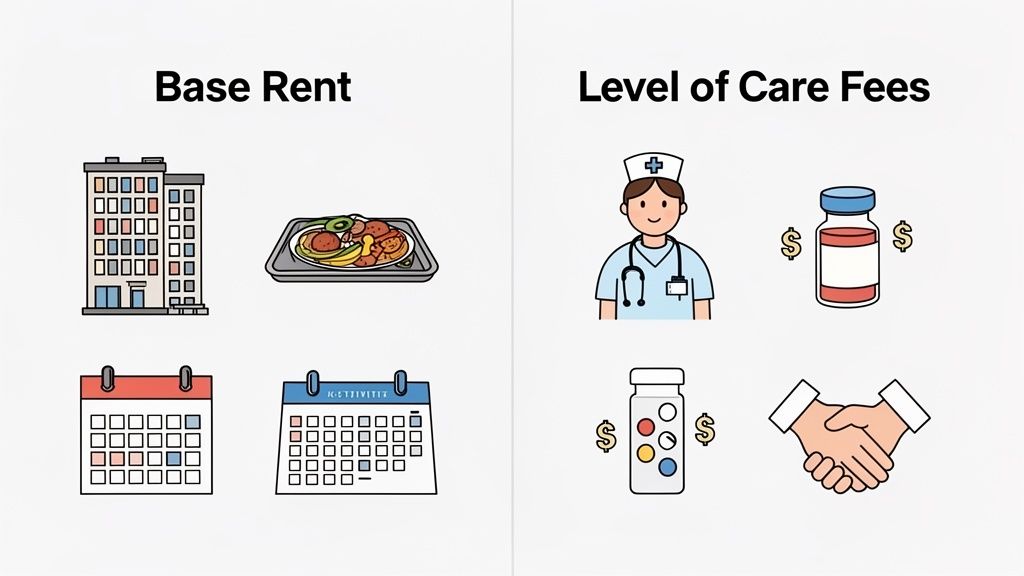
When you see a monthly rate for an assisted living community, treat that number as a starting point, not the final bill. The true monthly cost is a blend of two separate charges: Base Rent and Level of Care fees.
Base Rent covers the apartment, three meals a day, utilities, housekeeping, and social activities. This cost is heavily influenced by location. A community near University Circle will have a higher base rent than one in a quieter Medina suburb.
Level of Care fees are extra monthly charges based on a nurse's assessment of how much hands-on support a resident needs. This is where costs can vary dramatically.
What Drives Up the Level of Care Fees?
This is where the costs can really add up. The Level of Care fee is tied directly to the amount of hands-on assistance a resident needs. Someone who is fairly independent and just needs medication reminders will have a much lower care fee than a resident who requires help getting dressed, bathing, and moving from a bed to a wheelchair.
In Ohio, assisted living communities—officially licensed as Residential Care Facilities (RCFs)—must document each resident's needs to justify these charges. Knowing your loved one's daily assistance requirements before you start touring is crucial. You can get a much deeper look into how these fees stack up in our detailed breakdown of assisted living costs in Cleveland.
Insider Tip: Nearly every community has a one-time "Community Fee" or "Move-In Fee," which can be anywhere from $1,500 to $5,000. This is often the most negotiable part of the agreement. Ask your advisor how to approach this conversation.
Questions to Ask About Assisted Living Fees
Walking into a tour armed with the right financial questions will save you headaches. It’s easy to get wowed by the beautiful decor, but your mission is to uncover the total potential monthly cost.
Bring this checklist to every tour:
-
How is the 'Level of Care' determined? Ask to see a copy of their assessment form.
-
What specific services are included at each care level? Get a detailed list.
-
How often do you re-assess residents? Needs change. Find out if they do it quarterly, annually, or only after a major health event.
-
Can I see your complete rate sheet? You want a document that separates apartment rent from all possible care fees.
-
Are any services charged 'a la carte'? Some places bill extra for incontinence supplies or transportation to a doctor’s appointment at The Clinic.
-
What is your policy on rate increases? Ask for the rate increase history for the past three years. In Ohio, they must give 30-day notice for any price changes.
Getting clear, written answers is the only way to effectively compare your options. A local Senior Advisor has these rate sheets on file and can help you decode the fine print.
Breaking Down Nursing Home Costs in Northeast Ohio
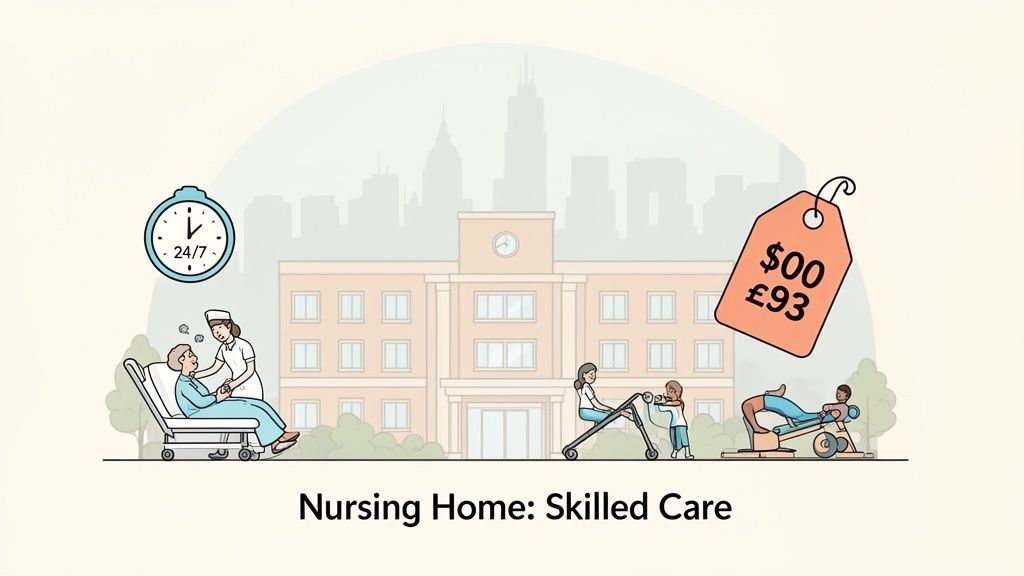
The price jump from assisted living to a nursing home often causes sticker shock, but the reason is simple: 24/7 skilled medical care. A nursing home, known in Ohio as a Skilled Nursing Facility (SNF), is a medical environment first and a residential one second.
Unlike assisted living, where care focuses on daily activities, nursing homes provide constant medical supervision from licensed nurses and therapists. It's the right choice for someone with complex health conditions or needing intensive rehabilitation after a hospital stay. The all-inclusive daily rate you're quoted covers room, board, and clinical oversight, but the final bill is often higher.
What Is Typically Included In The Daily Rate
The base cost in a Cleveland-area nursing home is meant to be comprehensive. You can generally expect these services to be rolled into that daily rate:
-
Room and Board: A semi-private or private room and dietitian-planned meals.
-
24-Hour Nursing Care: Access to RNs and LPNs for medication administration, wound care, and medical monitoring.
-
Personal Care Assistance: Hands-on help from Certified Nursing Assistants (CNAs).
-
Basic Medical Supplies: Routine items like gloves and standard bandages.
-
Social and Recreational Activities: Organized programs accessible for all residents.
Recent data shows nursing home costs in the Cleveland area average $354 per day for a semi-private room, adding up to over $129,000 annually.
Common Extra Costs That Surprise Families
While the daily rate covers a lot, it’s the "extras" that can quickly inflate your monthly bill.
Cost of Inaction Scenario: A family from Solon spent three weeks touring facilities, only to find out their top choice didn't accept the Assisted Living Waiver. A quick check with a local advisor would have saved them that time, gas, and emotional energy.
Be prepared for potential extra charges for things like:
-
Specialized Medications: Prescription drugs are almost never included.
-
Physician Visits: Billed to insurance just as they would be in an office.
-
Rehabilitative Therapies: Physical, occupational, or speech therapy may be covered by Medicare for a short time, but then becomes an out-of-pocket expense.
-
Advanced Medical Supplies: Items like catheters or specialized wound care materials often come with extra fees.
-
Personal Items: Haircuts, salon services, and personal phones are always extra.
Understanding what is and isn't covered is critical. To get a better handle on the medical services provided, it helps to learn more about what skilled nursing care entails.
How To Pay For Senior Care In Ohio
The toughest question is often, “How are we going to pay for this?” Several Ohio-specific programs can help, but navigating them alone is a real headache. Community marketing materials rarely break down the fine print.
The Ohio Medicaid Assisted Living Waiver
For families with a tighter budget, the Ohio Medicaid Assisted Living Waiver (AL Waiver) is a game-changer. This program helps eligible seniors cover the care services portion of their bill.
It’s critical to understand it does not cover room and board. Residents still pay for their apartment and meals, typically using Social Security and other income.
To qualify in Ohio, your loved one must meet:
-
Medical Need: Assessed as needing a nursing facility level of care but able to live safely in assisted living.
-
Financial Need: As of late 2024, the income cap is around $2,829 per month, with an asset limit of $2,000 for an individual.
These numbers look intimidating, but there are legal ways to manage assets to meet these thresholds. A Senior Advisor can connect you with local elder law attorneys who specialize in this. Not every facility is certified to accept the waiver, so confirming this upfront is essential.
VA Aid & Attendance Benefit
Another often-overlooked source of funding is the VA Aid & Attendance pension. This benefit is for wartime veterans (or their surviving spouses) who need help with daily activities. It's an additional monthly payment that can be used for either assisted living or a nursing home.
The application process can be long and complex. We strongly recommend working with a VA-accredited agent to ensure the paperwork is filed correctly the first time.
Finding the Right Financial Path
The glossy brochures won't tell you which local communities have a long waiting list for their waiver beds or which are pros at helping with the VA application. That "insider knowledge" is what keeps you from making a costly mistake.
-
Pricing and availability change daily. Click here to get a current Rate Sheet for communities in your desired Cleveland neighborhood.
-
Don't guess. Speak to a Cleveland-based Senior Advisor for free to determine which payment options fit your family’s budget.
Choosing The Right Care For Your Family
<iframe width="100%" style="aspect-ratio: 16 / 9;" src="https://www.youtube.com/embed/4AIFYzUwc64" frameborder="0" allow="autoplay; encrypted-media" allowfullscreen></iframe>The most important question is: which environment is truly the right fit? This decision is about matching a person's specific needs to the right level of care, not just for today but for the future. Making the right choice now can save you the heartache of another move in a year or two.
When To Choose Assisted Living
Here in Greater Cleveland, assisted living is perfect when someone needs support and a safety net, not constant medical care. It's for seniors who are still largely independent but could use help managing their day.
Assisted living is likely the right call if your loved one:
-
Needs Help With Daily Tasks: They might have trouble with bathing, dressing, or remembering medications, but don't need a nurse's daily attention.
-
Is Feeling Isolated: They would thrive with a built-in community, shared meals, and planned outings to places like the West Side Market or local parks.
-
Faces Safety Risks at Home: You worry about falls, a forgotten stove, or an emergency with no one around.
-
Has Early-Stage Cognitive Decline: Many local assisted living communities have secure memory care neighborhoods that feel more like a home than a hospital.
An Insider's Perspective: "We often talk to families from suburbs like Strongsville or Mentor whose parent is still driving, but maybe shouldn't be. Assisted living gives them back their freedom—transportation to appointments at UH or The Clinic, group trips to restaurants—without the risks of living alone."
When A Nursing Home Is The Right Answer
A nursing home, or Skilled Nursing Facility (SNF), is necessary when a person's medical needs are the primary focus. The environment is clinical for a reason—it’s structured to deliver complex, around-the-clock care.
A nursing home is the appropriate option if your parent or spouse:
-
Requires 24/7 Medical Supervision: They are managing advanced chronic illnesses like late-stage Parkinson's or congestive heart failure that demand constant monitoring.
-
Needs Post-Hospital Rehabilitation: After a stroke or major surgery, they require intensive physical, occupational, or speech therapy.
-
Has Complex Wound Care Needs: They have serious wounds that need daily, professional medical attention.
-
Is Bedbound or Severely Immobile: They require mechanical lifts and the help of multiple staff members to transfer.
The choice comes down to the intensity of care required. A nursing home is fundamentally a medical facility. The key is to take an honest look at your loved one's health to find the most supportive and sustainable home.
Get Expert Help And Stop Guessing
You've done the research, but now the real frustration begins. Every brochure starts to look the same, filled with promises of "exceptional care." You need to shift from gathering facts to making a decision, and a local expert makes all the difference.
Beyond The Brochure: How To Get Real Answers
Marketing materials sell an ideal, not the details you need. They show the fancy dining room, but won't volunteer the information that impacts your peace of mind. Getting answers to tough questions is where families get stuck.
-
How can you find out about their weekend staffing levels?
-
Where do you find the latest Ohio Department of Health (ODH) inspection report?
-
Which communities have a long waitlist for their AL Waiver spots?
You won't find these answers on a website. This is inside knowledge from a neutral, local advisor who has already done the legwork.
Insider Tip: We worked with a Westlake family who was about to sign a contract. Their advisor found the community had received a recent ODH citation for medication errors. That single piece of information, which you'd never find in a brochure, changed their decision and kept their loved one safe.
Your Next Step Toward Clarity
It's time to stop drowning in sales pitches and start getting transparent, personalized information. A Cleveland-based Senior Advisor works like your personal concierge, cutting through the noise to give you what you need to make a confident choice. We vet communities based on your family's actual needs—from budget and location (East Side vs. West Side) to the specific clinical care required.
-
Pricing and availability change daily. Click here to get a current, customized Rate Sheet for communities in the East Side, West Side, or your specific Cleveland suburb.
-
Don't guess. Speak to a Cleveland-based Senior Advisor for free to get personalized recommendations that save you time and stress.
#
<!-- FAQ rendered separately -->Get matched to communities in your budget
Our Cleveland advisors know current pricing and availability — free for families.
Need Help Finding Senior Living in Greater Cleveland?
Our Greater Cleveland local advisors compare pricing, schedule tours, and answer your questions — completely free.