Short Term Respite Care for Elderly Cleveland Cost: A Guide for Overwhelmed Families
-
What It Costs: Expect a daily rate of $180 to $350 in the Greater Cleveland area. Memory care is always on the higher end of that range.
-
How It's Billed: The advertised price is just the "rent." The real cost is the Base Rate + a separate "Level of Care" fee based on your loved one's needs. Always get this breakdown in writing.
-
How to Pay: Most families use private savings. Medicare will not pay for this. A veteran's VA Aid & Attendance benefit is a great option if applicable.
-
What to Do Next: Don't drown in brochures. Speak to a local Senior Advisor who can check real-time pricing and availability for you, saving you time and stress. This service is free for families.
You're Overwhelmed by Senior Care Options in Cleveland. We Can Help.
If you’re a caregiver in Northeast Ohio, you’re likely buried in glossy brochures and listening to sales pitches, terrified of making a costly mistake for your parent. You don't need another librarian handing you a list of facilities; you need a trusted concierge to guide you to the right solution.
This guide is for families in Cuyahoga, Lake, Lorain, Geauga, and Medina counties who need straight answers, not marketing fluff. We're the local insiders who will translate the confusing world of senior living into plain English, helping you move from endless research to a confident decision.
What Really Drives the Cost of Respite Care in Cleveland?
The price tag for respite care isn't one flat fee. Several key factors come into play, and understanding them is key to building an accurate budget. These factors are the same whether you're looking at a community near University Circle on the East Side or out by Crocker Park on the West Side.
-
Level of Care Needed: This is the biggest cost driver. A senior who is fairly independent will have a lower daily rate than someone needing hands-on help with bathing, dressing, or medication management.
-
Memory Care vs. Assisted Living: A respite stay in a secured memory care unit will always cost more. This is due to the required higher staff-to-resident ratios and specialized programming for those living with dementia.
-
Length of Stay: Some communities might offer a slightly better daily rate for a longer stay (e.g., 30 days vs. 14 days), but this is not always the case.
-
Community Amenities and Location: While brochures highlight the chandeliers, you need to ask about the weekend staffing ratios. A new luxury community in Beachwood will have a higher base rate than a more modest, but equally safe, option in Parma.
Typical Respite Cost Ranges in Cleveland
Recent data shows the average monthly cost for long-term assisted living in Cleveland is $5,520. The good news is this is competitive, sitting below both national and Ohio statewide averages. For short-term stays, this figure is broken down into a daily rate. You can discover more insights about Cleveland-area senior care costs to get a fuller picture.
Here’s what you can generally expect to pay per day for short-term respite care in Greater Cleveland.
Estimated Daily Respite Care Costs in Greater Cleveland
Updated: October 2023. These are state-sourced estimates; actual community pricing will vary.
| Type of Care | Typical Daily Cost Range | Best Suited For |
| :--- | :--- | :--- |
| Assisted Living Respite | $180 – $275 | Seniors who need some help with daily tasks but are generally mobile and can communicate their needs effectively. |
| Memory Care Respite | $250 – $350+ | Seniors with Alzheimer's or other forms of dementia who require a secure environment and specialized staff support. |
Insider Tip: These prices are estimates for "room and board." Always demand a care assessment before you sign anything. This forces the community to give you a written quote that includes the separate "Level of Care" fees. Pricing and availability change daily, so never rely on an old brochure.
Understanding the Real Cost of Respite Care: The Two-Part Pricing Puzzle
Here's the truth most facility marketing won't tell you upfront: the price on the brochure is almost never the final price you'll pay. It's a common frustration for families all over Northeast Ohio, from those living near The Clinic to those out in Lorain County.
Communities often advertise an appealing "all-inclusive" number, which can be misleading and lead to serious sticker shock. The total cost is almost always split into two parts. Understanding this breakdown is the most critical step to building an accurate budget and avoiding financial surprises.
Base Rate vs. Level of Care (LOC) Fees
Think of the Base Rate like rent. It’s the foundational cost covering the room, meals, and access to the community's general amenities—things every resident gets regardless of their personal needs.
-
What the Base Rate usually covers:
-
A furnished private or semi-private room
-
Three meals a day
-
Basic utilities
-
Access to social activities
-
Weekly laundry and housekeeping
This is the number they advertise. But it's only half the story.
The other half is the Level of Care (LOC) fee. This is a separate charge added on after a clinical assessment of your loved one's specific needs. Simply put, the more hands-on help they need with Activities of Daily Living (ADLs)—like bathing, dressing, medication management, or mobility—the higher this fee will be.
A Real-World Cleveland Example: A family in Solon spent three weeks touring facilities for their mom, only to find out their top choice didn't accept the Ohio AL Waiver she would eventually need. A quick check with a local advisor would have saved them that time and emotional energy. This is the kind of costly mistake that happens when you try to navigate the system alone.
How to Get a Straight Answer on Price
This pricing model isn't designed to be tricky, but it feels that way if you're not prepared. The secret is to demand total transparency before you sign anything. For a full look at long-term pricing, see our guide on the cost of assisted living in Cleveland, but for a short-term stay, you must be direct.
Use these questions as a checklist during your tour to pin down the real numbers.
Questions to Ask to Uncover the Real Cost
-
Is the price you quoted a flat rate, or is it a base rate with care fees added on top?
-
Please provide your pricing sheet that breaks down the different Levels of Care and their daily costs.
-
Who performs the care assessment, and when is it done? (It should always be done before you sign a contract.)
-
Are there any one-time charges for short-term stays, like a "community fee" or "assessment fee"?
-
What is the exact daily charge for medication management?
-
What specific services are included at each Level of Care? (e.g., "Level 2 includes two showers per week and daily dressing assistance.")
-
What happens if my parent's needs change during their stay? How does that affect the cost?
Walking in with these questions signals that you're an informed consumer and moves you from uncertainty to control.
How to Pay for Respite Care in Ohio
<iframe width="100%" style="aspect-ratio: 16 / 9;" src="https://www.youtube.com/embed/uKqzoyDFzfk" frameborder="0" allow="autoplay; encrypted-media" allowfullscreen></iframe>Many Cleveland-area families assume Medicare will cover a short respite stay in an assisted living community. It's an honest and common mistake, but a costly one.
The reality is that Medicare does not pay for respite care in a residential setting like assisted living (an RCF in Ohio). It may cover a short stay in a Skilled Nursing Facility (SNF) for rehabilitation after a hospital stay, but that is a different level of care entirely. Knowing how families actually cover these costs is the first step to making a realistic plan.
Your Real Payment Options in Northeast Ohio
-
Private Pay: This is the most common method. Families use personal savings, retirement funds, or other private assets to cover the daily rate.
-
Long-Term Care Insurance: If your loved one has a policy, it will almost certainly cover short-term respite stays. Check the policy for the daily benefit amount and any elimination period.
-
VA Benefits: For veterans who served during wartime, the VA Aid & Attendance benefit can be a game-changer. This pension program provides a monthly payment that can be used directly for respite care costs.
Insider Tip: A family in Parma was about to give up on a needed respite stay for their dad due to cost. We asked if he was a veteran and discovered he served during the Korean War. We connected them with a local VA benefits expert who helped them apply for Aid & Attendance, which made the stay completely affordable. Don't overlook this crucial benefit.
The Truth About the Ohio Medicaid AL Waiver
You may have heard of the Ohio Medicaid Assisted Living Waiver (AL Waiver). This is a critical program, but it's crucial to understand its purpose.
The AL Waiver is for long-term care, not for a two-week respite stay. It helps income-eligible seniors pay for care once they've made a permanent move into an assisted living facility. It is not a source of immediate funding for a short-term visit.
However, a private-pay respite stay can be a brilliant way to "test drive" a community that accepts the waiver for long-term residents. If you think your loved one might eventually need Medicaid, this is a very smart strategy.
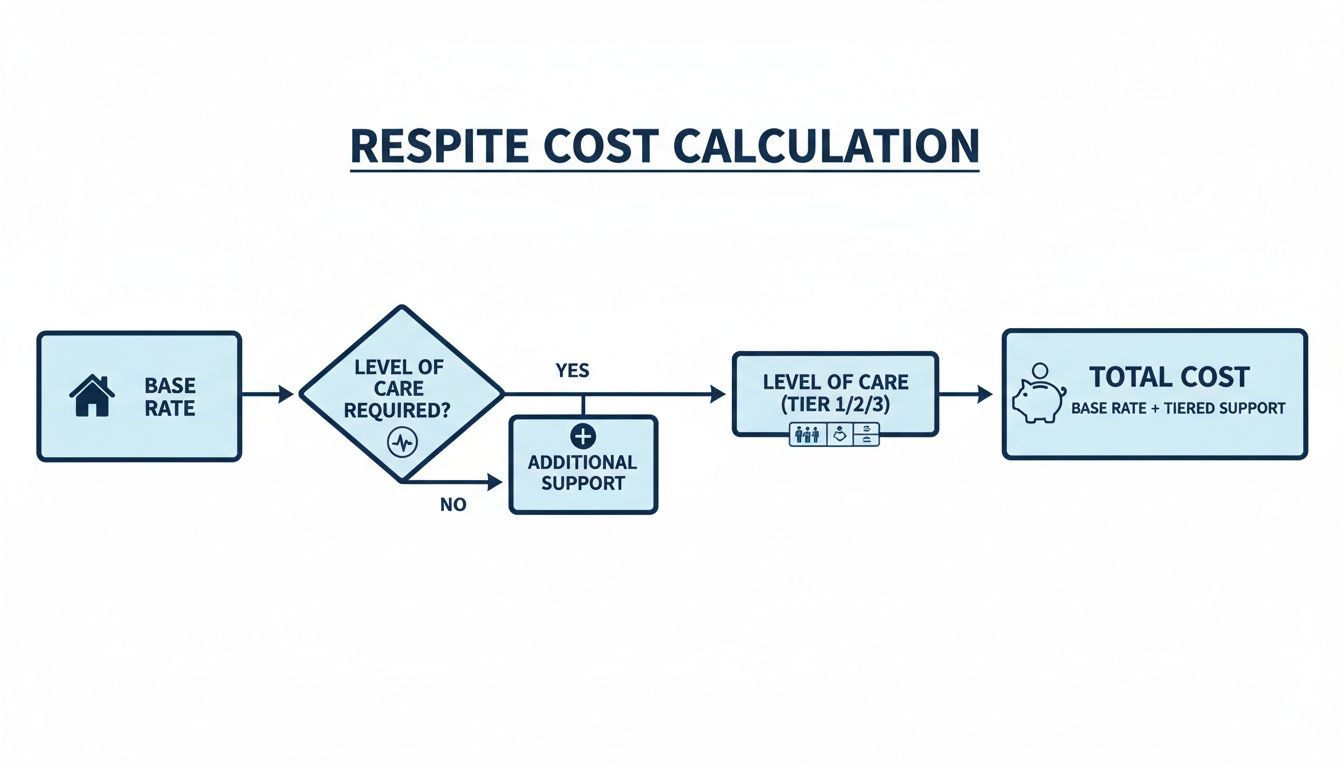
The final price is always a mix of the base room rate and specific care services. You must get both numbers in writing.
How to Get Started with the AL Waiver
If a permanent move might be in the future, your starting point is the Western Reserve Area Agency on Aging. They are the gatekeepers for the AL Waiver program for Cuyahoga, Lake, Geauga, and Lorain counties. They will schedule an assessment to determine if your loved one meets Ohio's financial and medical requirements. This process takes time, so start early. For details, see our guide on how to apply for the Ohio AL Waiver step-by-step.
The rules are complex. A no-cost call with a Senior Advisor at Guide for Seniors can help you determine if the waiver is the right path and get you pointed in the right direction.
Disclaimer: This article is for informational purposes only and does not constitute financial, legal, or medical advice. Please consult with a qualified professional for guidance on your specific situation.
Navigating Respite Care for Dementia and Alzheimer's
Caring for a loved one with dementia is a unique journey. For a short-term respite stay, safety and specialized understanding aren't just amenities—they're absolute necessities.
You will see a clear price difference between a standard assisted living stay and one in a dedicated memory care unit. This higher cost reflects a fundamentally different level of care designed to create a secure, calming environment for someone with cognitive challenges.
Why Memory Care Respite Costs More
The premium for memory care respite funds the layers of safety and specialized care that provide true peace of mind. While brochures show smiling residents, the real value lies in what you might not see on a tour.
-
Secured Environments: Memory care units are built to prevent wandering, a common and dangerous behavior. This means keypad-controlled doors and enclosed courtyards.
-
Higher Staff-to-Resident Ratios: It takes more staff to provide patient, effective, and safe care for individuals with memory loss. This means quicker responses and more one-on-one attention.
-
Specialized Staff Training: Caregivers in these units receive ongoing, specific training in dementia care, learning de-escalation techniques and communication strategies.
-
Purposeful Programming: Activities are designed to reduce agitation and provide gentle, meaningful stimulation, not just to fill a calendar.
Here in Northeast Ohio, we're fortunate to have world-class resources like UH and The Clinic guiding long-term care. It's just as crucial to find a short-term community that invests in that same caliber of specialized expertise.
Questions to Ask Beyond the Brochure
When you tour a memory care unit, you have to dig deeper than the standard marketing pitch.
Insider Tip: Ask to see the community's most recent survey from the Ohio Department of Health (ODH). More importantly, ask the director to explain any citations in plain English. A minor issue isn't always a red flag, but their transparency tells you everything about their commitment to resident safety.
Bring this checklist to guide your conversation:
- Staffing & Training:
-
What is your staff-to-resident ratio during the day? And what is it overnight?
-
What specific dementia-care training is required for all staff in this unit?
-
What is the staff turnover rate in the memory care unit? (A high rate can signal problems).
- Safety & Environment:
-
How do you respond when a resident becomes agitated or anxious? Give me a specific example.
-
Walk me through your security measures to prevent wandering.
-
What is your protocol if a resident falls?
- Daily Life & Engagement:
-
May I see this week's activity calendar for the memory care residents?
-
How do you approach meals for residents who may have difficulty eating?
For a more complete picture of a high-quality environment, see our guide on finding the right assisted living community for a loved one with dementia.
In Ohio, Support for Dementia Caregivers Is a Priority
The state of Ohio recognizes the immense pressure on families. Investment in Alzheimer's and Dementia Respite care reached $4.3 million for FY 2026. This funding supports programs that can help offset costs and provide needed relief, which is proven to reduce caregiver burnout. You can read the full analysis of Ohio's support for older adults to learn more.
Choosing a memory care respite stay is a decision about safety. A higher daily rate isn't an upsell; it's a reflection of the resources needed to deliver that security. A local advisor can help you verify which Cleveland-area communities truly deliver on their promise of specialized care.
The Hidden Cost of Waiting Until There's a Crisis
It's human nature to put off tough conversations about senior care. But when it comes to respite, waiting for a crisis doesn't just create stress—it costs you money and options. A sudden fall or illness can instantly transform your careful plan into a frantic, expensive scramble.
When you're in crisis mode, your leverage disappears. Communities know you're in a bind. The thoughtful search you envisioned is replaced by panicked phone calls that lead to higher fees and fewer, less ideal, choices.
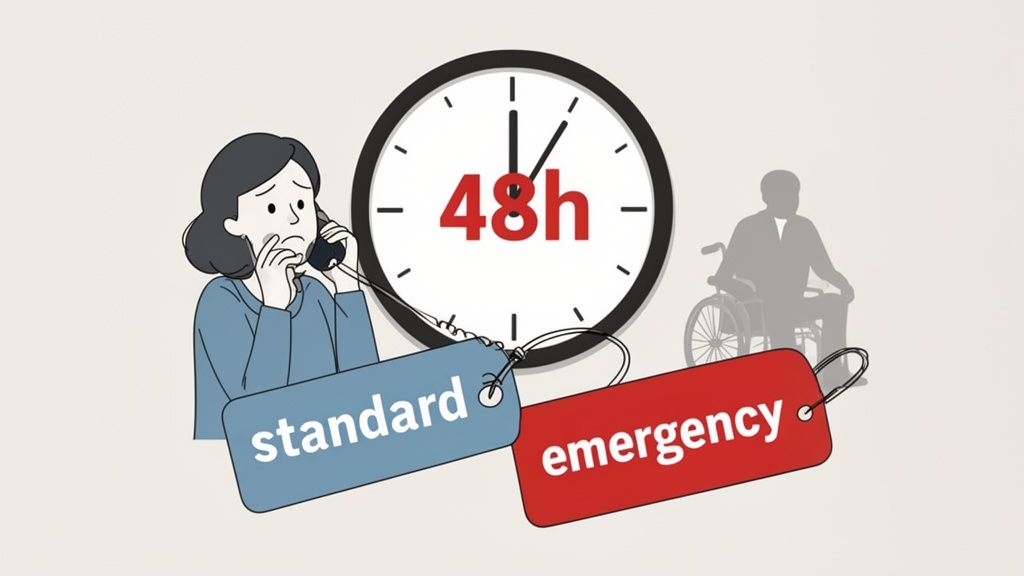
A Local Family's 48-Hour Scramble
A family in Solon was managing their dad's care at home when his primary caregiver—his daughter—needed emergency surgery. They had a terrifying 48-hour window to find a safe place for him.
They called communities from their neighborhood to places near SouthPark Mall in Strongsville. Most were full or couldn't complete the required medical assessment in time. Finally, one community had an "emergency admission" opening at a much higher daily rate. With no other options, they had to pay it. The situation went from stressful to financially draining in an instant.
Insider Tip: Most communities charge a one-time "community fee" (often $1,500–$3,000) for new residents. In a crisis admission, this fee is almost never negotiable. Planning ahead with an advisor often gives you the leverage to get this fee reduced or even waived completely.
Turning Panic into a Plan
That family's experience is a perfect example of crisis-driven decision-making. They had to pick a place based on who had a bed, not what was best for their dad. Proactive planning provides a different outcome.
Working with a local advisor before a crisis gives you three huge advantages:
-
Access to Better Options: You get a vetted list of communities that fit your care needs and budget.
-
Predictable, Lower Costs: You sidestep "emergency" fees and have time to compare true, all-in pricing.
-
Peace of Mind: The process shifts from a desperate race to a calm, manageable transition.
Don't let an emergency dictate your choices and your costs. The cost of short term respite care for elderly in Cleveland is far more predictable when you control the timeline. A five-minute call today can save you thousands of dollars and a world of anxiety.
Your next step isn't a Google search. It's a conversation with someone who knows the lay of the land. Let a Cleveland-based Senior Advisor at Guide for Seniors check real-time availability and pricing for you—at no cost to your family.
Your Next Step: From Researching to Consulting
You now have a solid understanding of respite care costs in Cleveland. But information is one thing; confident action is another.
One path is the one most families take: hours on Google, a dozen phone calls, and a stack of confusing price sheets. It's stressful, and you're never sure you're getting the whole truth.
There is a simpler, clearer path.
Instead of trying to become a senior care expert overnight, you can make one call to a local advisor who already knows the landscape. We act as your personal guide for Cleveland families. Our job is to be your advocate, helping you see past the marketing to the reality of each option. This service comes at no cost to you.
From Overwhelmed to Confident
Making big decisions under pressure is a recipe for mistakes. We take that pressure off your shoulders.
-
Real-Time Pricing and Availability: Brochures are often out of date. We can quickly check which communities in Cuyahoga, Lake, or Lorain counties have open respite suites, saving you from dead-end calls.
-
Personalized, Vetted Matches: We listen to your loved one's needs and your budget to create a shortlist of reputable communities that are a genuine fit.
-
Transparent Guidance: We help you decode the fine print, from community fees to care pricing, ensuring you face no financial surprises.
You've done the hard work of getting informed; let us do the legwork of finding the perfect match.
Ready to find the right respite care without the stress? Speak to a Cleveland-based Senior Advisor for free to narrow your list and get transparent pricing.
Want to see what’s available right now? Click here to get a current Rate Sheet for communities in your desired Cleveland neighborhood.
Frequently Asked Questions About Respite Care
Even with research, practical questions always pop up. Here are straightforward answers to what we hear most often from families in the Cleveland area.
How Far in Advance Should I Book a Respite Stay?
Ideally, plan at least four to six weeks in advance, especially if you need care during a holiday or peak summer travel season. Planning ahead gives you the best choices and more reasonable rates. Last-minute spots can open up, but you lose your negotiating power and risk paying a premium, like the Solon family we mentioned.
Does Medicare Cover Any Part of Respite Care?
This is a major point of confusion. The short answer is no: Medicare does not pay for short-term respite stays in an assisted living community.
Medicare might cover a temporary stay in a Skilled Nursing Facility (SNF) after a qualifying hospital stay, but this is for rehabilitation, not for giving a caregiver a break. For assisted living respite, you will almost certainly use one of these options:
-
Private Pay (personal savings)
-
Long-Term Care Insurance
-
VA Benefits (Aid & Attendance)
What Should I Pack for My Parent’s Stay?
Think of it like packing for a long hotel visit. The community provides furniture, but you should bring personal items to make it feel like home.
-
Several changes of comfortable, easy-to-wear clothes.
-
All current medications in their original prescription bottles.
-
Familiar toiletries (their specific brand of soap or lotion).
-
Comfort items like family photos, a favorite blanket, or books.
-
A folder with copies of important documents: Power of Attorney, insurance cards, and emergency contacts.
Insider Tip: Label everything with your parent's name. It’s a simple trick that prevents personal items from getting misplaced in a busy community.
Can a Temporary Respite Stay Become Permanent?
Absolutely. This is one of the smartest ways to approach a major life transition. Many families use a respite stay as a "trial run" to see if a community is a good long-term fit. It's a low-pressure way to test the waters. If your parent has a great experience, the community staff can help you switch their contract from short-term to long-term, allowing you to make this big decision with real confidence.
Finding the right care shouldn't add more weight to your shoulders. The team at Guide for Seniors is here to offer free, personalized guidance. We can help you compare options and find a safe, welcoming, and affordable respite solution in the Cleveland area.
Click here to get a current Rate Sheet for communities in your neighborhood.
Get matched to communities in your budget
Our Cleveland advisors know current pricing and availability — free for families.
Need Help Finding Senior Living in Greater Cleveland?
Our Greater Cleveland local advisors compare pricing, schedule tours, and answer your questions — completely free.