A Guide to Assisted Living with Dementia Care in Greater Cleveland
-
TL;DR: The Bottom Line
-
Assisted Living is a good starting point. For early to mid-stage dementia, an assisted living community offers a blend of independence and support.
-
Memory Care is a specialized step up. This is a secured environment within an assisted living community for those with advanced symptoms or who may wander.
-
Costs are layered. Expect a base rent plus "level-of-care fees" for hands-on help. Ohio's Medicaid AL Waiver can help cover the care portion, but not room and board.
-
Look for specific training and safety. The best communities have staff trained in dementia care (like Teepa Snow's methods) and features like secured courtyards to prevent wandering.
Who This Guide Helps
This guide is for families in Cuyahoga, Lake, Lorain, Geauga, Medina, and Summit counties who are:
-
Feeling stressed and short on time to research all the different senior living options.
-
Trying to understand the real difference between "dementia-friendly" assisted living and a secured memory care unit.
-
Worried about a loved one's safety and well-being at home.
-
Looking for clear, local information on Ohio costs, rules, and financial aid like Medicaid.
Key Takeaways for Your Family
-
Assisted living can be a great fit. For those in the early to middle stages of dementia, an assisted living community offers the right blend of independence and daily support without requiring 24/7 medical supervision.
-
Memory care is a step up. Think of it as a specialized, secured neighborhood, often within a larger assisted living community. It's specifically for residents with more advanced dementia who might be prone to wandering or need more intensive cognitive support.
-
Costs are complex. You'll typically see a base monthly rate, with additional level-of-care fees (charges based on the amount of hands-on help needed) that increase as your loved one's needs grow. Here in Ohio, the Medicaid Assisted Living Waiver (AL Waiver) can be a huge help for covering the cost of care, though it doesn't cover room and board.
-
Safety comes first. The best communities have staff who are truly trained in dementia care, secure and monitored entrances, and a structured daily routine that provides comfort and predictability.
-
You're not on this journey alone. The need for this kind of care is immense and growing. Dementia affects over 57 million people worldwide. Closer to home, nearly half of all assisted living residents in the U.S.—a staggering 447,216 people—are living with some form of cognitive impairment. You can explore more about these global dementia statistics and the rising need for specialized care00249-8/fulltext).
What Does “Dementia-Capable” Assisted Living Really Mean?
When you’re looking at senior care options, you’ll see the term “dementia-capable” assisted living. It’s more than a marketing phrase. In Ohio, it signals an environment designed to support someone with memory loss, going beyond what a standard Assisted Living (Residential Care Facility) can offer.
Think of it as assisted living with crucial layers of safety, specialized staff training, and tailored activities. These features help manage common dementia symptoms like confusion, agitation, or wandering. The goal is to create a supportive world where your loved one can maintain dignity and live as independently as possible, for as long as possible.
You can see how care levels in Ohio progress from general senior living to the most intensive support found in a dedicated memory care unit.
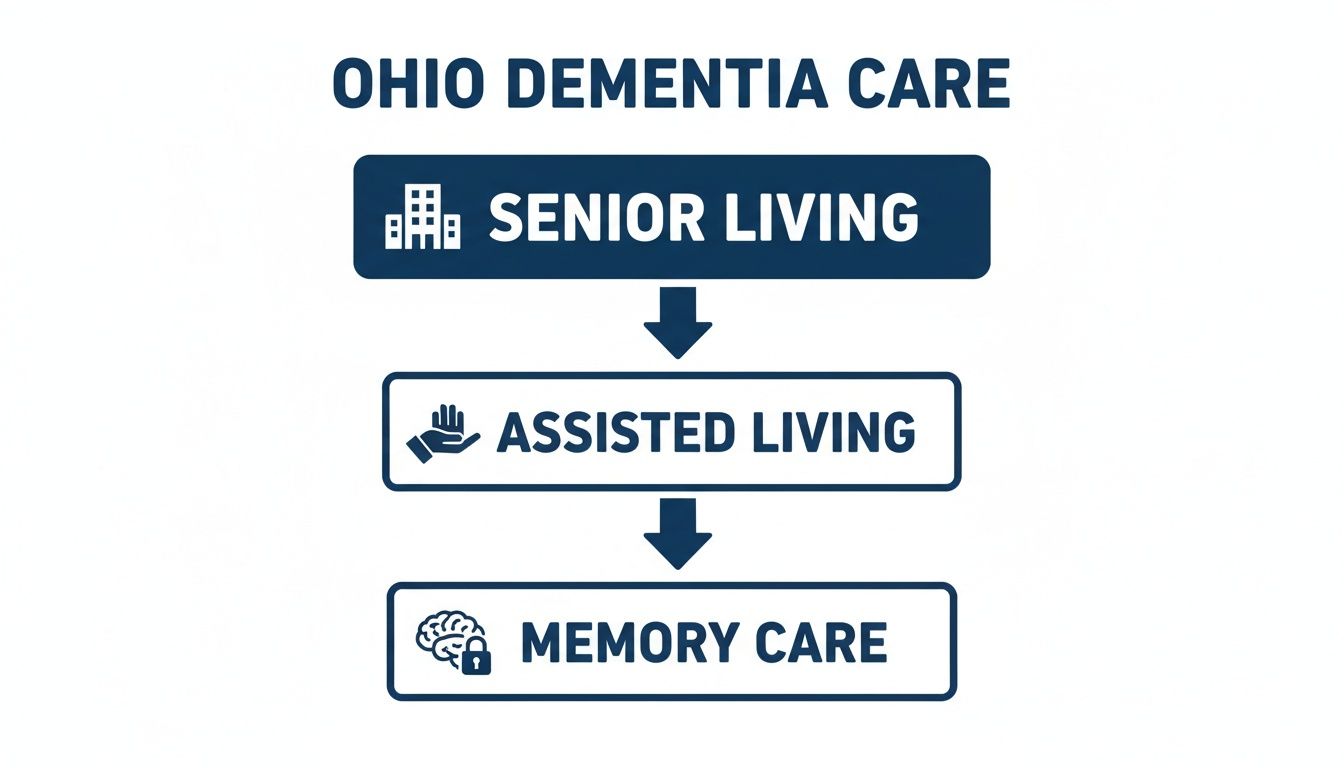
alt text: A flowchart illustrating the progression of dementia care options in Ohio, starting from Senior Living, moving to Assisted Living, and culminating in specialized Memory Care.
As you can see, each step provides a more specialized and secure environment as a person's needs change.
Comparing Ohio Senior Care Levels For Dementia
| Feature | Standard Assisted Living | Dementia-Capable Assisted Living | Secured Memory Care Unit |
| :--- | :--- | :--- | :--- |
| Environment | Open campus, non-secured. | Unsecured or partially secured building. | Fully secured building and outdoor areas. |
| Staff Training | General caregiving training. | Required dementia-specific training. | Extensive, ongoing dementia training. |
| Activities | General social & recreational calendar. | Structured, dementia-friendly activities. | Highly specialized, therapeutic programs. |
| Resident Profile | Mild cognitive impairment; no wandering risk. | Early to mid-stage dementia; minimal wandering risk. | Mid to late-stage dementia; significant wandering risk. |
| Safety Features | Emergency pull cords, grab bars. | May have delayed-egress doors or WanderGuard. | Mandatory WanderGuard systems, coded exits. |
This comparison highlights that "dementia-capable" is a critical middle ground, offering more support than standard assisted living but not requiring the full security of a dedicated memory care unit.
Specialized Staff Training
What truly makes a community "dementia-capable" is the staff. In Ohio, regulations require that any caregiver working with residents diagnosed with dementia receive specialized training. This involves ongoing education on how to communicate effectively, understand behaviors, and manage challenging situations with compassion rather than medication.
When you're looking at communities in places like Cuyahoga or Lorain County, ask them directly about their training programs. Do they use proven methods like Teepa Snow’s Positive Approach to Care? How many hours of dementia-focused training does a new staff member get? The quality of their answers will tell you a lot.
What This Means for You: A well-trained caregiver knows how to de-escalate anxiety, gently redirect a resident who is feeling lost, and tell the difference between a bad day and a medical problem. This expertise creates a better quality of life for your loved one—and gives you peace of mind.
Secure Environments and Safety Features
For many families, the fear of a loved one wandering is a primary worry. Dementia-capable assisted living communities address this with smart safety features.
You’ll often find:
-
Wander-Guard Systems: Discreet bracelets worn by residents that trigger an alarm or lock a door if they approach an unsecured exit.
-
Secured Outdoor Spaces: Enclosed courtyards, gardens, and walking paths that allow residents to get fresh air safely.
-
Keypad-Controlled Exits: Staff and family can use a code to enter and exit, while doors remain secured for residents.
Structured Activities and Cognitive Programming
A predictable routine can be incredibly calming for someone with dementia. Good communities create a structured day filled with purpose. The activities aren't just for passing time; they are designed to engage residents mentally, physically, and socially.
Look for activities like:
-
Music therapy and sing-alongs
-
Simple, success-oriented arts and crafts
-
Gentle movement like chair yoga
-
Reminiscence therapy using old photos or music to spark memories
These programs are vital for helping to maintain cognitive function. To get a deeper understanding of how these specialized services differ, you can read more about the distinctions between memory care and assisted living.
Recognizing When It Is Time For More Support
Deciding to explore assisted living for a loved one with dementia is rarely a single event. It’s usually a series of small changes and growing worries. The goal is to see the signs that more support could improve safety and quality of life before a crisis occurs.
Research shows that many people with dementia don't get consistent daily care, which often leads to preventable emergencies. One multi-national study found that 20% of dementia patients receive no daily care, putting them at a much higher risk for ER visits. You can discover more insights about dementia care gaps from Yale researchers. Professional support acts as a crucial safety net.

alt text: A younger person listens patiently to an older person, illustrating the need to assess care needs like personal hygiene, hearing, and medication management.
Checklist: When Home Is No Longer The Safest Option
Use this quick checklist to take stock of your family's situation. Answering "yes" to several of these questions is a sign that it’s time to start touring local assisted living communities.
-
Wandering & Safety: Has your loved one wandered, gotten lost, or tried to leave the house at unusual times?
-
Medication Management: Are you worried they are missing doses or taking the wrong amount of their medication?
-
Nutrition & Meals: Is your loved one skipping meals, losing weight, or unable to prepare food safely?
-
Household Management: Are bills going unpaid? Is the home becoming cluttered or unsanitary?
-
Your Own Well-being: Do you feel that caregiving is having a negative impact on your physical or mental health?
-
Increasing Agitation or Aggression: Are behaviors becoming more challenging or unsafe for you to manage alone?
What This Means for You: Seeing these signs doesn't mean you have to move tomorrow. It means now is the time to learn about your options in the Cleveland area. This way, you can make a proactive, thoughtful choice instead of a reactive one later.
A Common Cleveland Scenario
Example: A family in Cuyahoga County is caring for their father, who has early-stage dementia. His daughter helps with groceries and bills. Lately, she noticed he forgot a doctor's appointment, has lost weight, and once left the stove on. She is now spending every evening at his house, and her own work and family life are suffering. This is the tipping point where exploring assisted living becomes a solution for both the father's safety and the daughter's well-being.
How To Pay For Dementia Care In Northeast Ohio
<iframe width="100%" style="aspect-ratio: 16 / 9;" src="https://www.youtube.com/embed/xGPEWc8PJag" frameborder="0" allow="autoplay; encrypted-media" allowfullscreen></iframe>For most families, figuring out how to pay for care is the biggest source of stress. The financial weight is enormous; nationally, dementia care costs add up to $781 billion, with families providing 6.8 billion hours of unpaid care. You can learn more about the financial impact of dementia care on families, but the bottom line is that exploring every local resource is essential.
Let's break down how the billing works and where to find help in Ohio.
Understanding The Three Parts Of Your Bill
When an assisted living community in the Cleveland area gives you a price, it usually has three parts.
-
Base Rate (Room and Board): This is the monthly "rent." It covers the apartment, utilities, meals, housekeeping, laundry, and community activities.
-
Level-of-Care Fees: This is an extra monthly charge based on the amount of direct, hands-on care needed. It pays for services like medication management, help with bathing and dressing, or incontinence support. As dementia progresses, these fees will likely increase.
-
One-Time Fees: Most communities charge a one-time community or entrance fee. This non-refundable charge covers the administrative work of moving in. Ask about this amount upfront.
Leveraging Long-Term Care Insurance
If your loved one has a Long-Term Care (LTC) Insurance policy, it's time to find it and review the details. To activate benefits, a doctor typically must certify that your loved one needs help with at least two Activities of Daily Living (ADLs)—like bathing, dressing, or eating. The policy will state a specific daily benefit amount and a lifetime maximum.
What This Means for You: Contact the insurance company immediately to start the claims process. They will send you forms for you and the doctor to complete. Always keep copies of everything you submit.
VA Benefits For Veterans And Spouses
For veterans and their surviving spouses, the VA Aid and Attendance benefit can provide a significant financial boost. It is a monthly payment added to an existing VA pension.
To be eligible, the veteran must have served at least 90 days of active duty, with at least one day during a wartime period. There are also specific medical and financial need requirements. In Ohio, you can get free help with the application from your county’s Veterans Service Commission.
Ohio's Medicaid Assisted Living Waiver
For families with limited income and assets, Ohio's Medicaid Assisted Living Waiver (AL Waiver) is a lifeline. This program helps pay for the care services part of the bill in an approved assisted living community—it does not cover the room and board portion.
To qualify for the AL Waiver, a person must meet strict financial criteria and be assessed as needing an "intermediate" level of care (the kind typically provided in a nursing home, which in Ohio is a CMS-regulated Skilled Nursing Facility).
-
Financial Eligibility: Your local County Department of Job and Family Services determines this by reviewing monthly income and total countable assets.
-
Clinical Eligibility: A care manager from the local Area Agency on Aging (AAA) conducts an in-person assessment to confirm the need for care.
To start this process, contact the Area Agency on Aging that serves your county. For example, the Western Reserve Area Agency on Aging serves Cuyahoga, Geauga, Lake, Lorain, and Medina counties. Not all communities accept the AL Waiver, so this should be one of your first questions. For a deeper dive, you can learn more about how Ohio's Medicaid AL Waiver works.
How to Evaluate Cleveland Area Dementia Care Communities
Choosing a community is about more than nice furniture. You need to investigate staff training, safety protocols, and how they handle the realities of dementia. This framework will help you assess communities in the Cleveland area and see past the glossy brochures.
alt text: Three people discussing senior living options, representing a family making an informed decision about assisted living with dementia care.
Staffing and Specialized Training
The quality of care comes down to the people providing it. A community’s investment in its staff is the most important factor to evaluate.
What This Means for You: High staff turnover is disruptive for residents with dementia who thrive on routine and familiar faces. A stable, well-trained team is more likely to provide compassionate, consistent care.
Protocols for Challenging Behaviors
Dementia can bring challenging behaviors, from agitation to sundowning—a state of increased confusion and anxiety in the late afternoon. How a community responds to these moments reveals its care philosophy. The best communities focus on understanding the reason for the behavior and de-escalating with compassion, not just using medication.
Your Dementia Care Touring Checklist
Take this checklist with you on your visits. The answers will help you compare your options.
Staffing Questions:
-
What specific dementia care training do new caregivers receive? (Look for names like Teepa Snow or Positive Approach to Care).
-
How many hours of ongoing, annual dementia training are required for all staff?
-
What is your current staff-to-resident ratio during the day? And overnight?
-
What was your staff turnover rate over the last 12 months?
Behavior Management Questions:
-
Can you give me an example of how your team handles a resident experiencing sundowning?
-
What are your protocols when a resident becomes agitated?
-
What is your philosophy on using antipsychotic medications for behavioral management?
-
How do you support residents who may wander?
Safety & Environment Questions:
-
What specific security features do you have? (e.g., WanderGuard, secured courtyards, coded exits).
-
Is your dementia care program in a separate, secured part of the building?
-
How is the dining experience adapted for residents with cognitive challenges? (e.g., visual menus, staff help, finger foods).
How to Check Ohio Inspection Reports
Every Residential Care Facility in Ohio is licensed and inspected by the Ohio Department of Health (ODH). These public inspection reports, often called "surveys," are a powerful tool. They offer an unbiased look at how well a community follows state regulations.
-
Go to the ODH Website: Head to the Ohio Department of Health's online portal for long-term care facility information.
-
Search for the Community: Look up a facility by name or county (like Cuyahoga).
-
Read the Survey Findings: The report will list any "citations" (violations of state rules), the specific problem, and the community's plan to fix it.
Don't panic if you see a citation. Look at the severity. A minor paperwork issue is different from a serious problem related to resident safety. Look for patterns of repeat violations, which can signal a deeper issue.
What to Do Next
It's normal to feel overwhelmed. This process is a series of small, manageable steps, not a giant leap. Use these next steps to move forward with a clear plan.
1. Get a Clear Picture of Needs
Use the checklist from the "When Home Is No Longer The Safest Option" section. Be honest about the current situation. This will help you clearly explain your loved one's needs to the communities you visit.
2. Investigate Financial Options
Call your local Area Agency on Aging. For Cuyahoga, Lake, Lorain, Geauga, or Medina counties, that’s the Western Reserve Area Agency on Aging. Ask about the screening process for the Medicaid AL Waiver. Knowing where you stand financially from the start will save you time.
3. Schedule Two Tours
Visit one "dementia-capable" assisted living community and one secured memory care unit. Seeing them back-to-back will make the differences clear and help you decide which environment is a better fit.
Your Advocacy and Safety Toolkit
-
For Advocacy and Rights: The Ohio Long-Term Care Ombudsman program protects the rights of residents and helps solve problems. Their services are free.
-
For Reporting Concerns: You can report serious health or safety issues directly to the Ohio Department of Health (ODH). They license and regulate every assisted living community.
#
<!-- FAQ rendered separately -->Need Help Finding Senior Living in Greater Cleveland?
Our Greater Cleveland local advisors compare pricing, schedule tours, and answer your questions — completely free.