A Guide to Senior Living Costs in Cleveland
Trying to figure out what senior living actually costs in Northeast Ohio can feel overwhelming, especially when you're short on time and dealing with a lot of stress. This guide is designed to give you clear, calm, and practical answers.
-
Cleveland-Area Assisted Living Costs: Expect a monthly base rate of $4,500 – $7,000+.
-
Cleveland-Area Memory Care Costs: Expect a monthly base rate of $6,000 – $9,500+.
-
How Families Pay: Most use a combination of private funds (savings, home sale), long-term care insurance, VA benefits, and, for those who qualify, Ohio's Medicaid waiver program.
-
Key Ohio Program: The Medicaid Assisted Living Waiver (AL Waiver) can pay for the care services portion of the bill for eligible seniors, making assisted living much more affordable.
Who This Helps
This guide is for you if you're:
-
A family member in the Greater Cleveland area (Cuyahoga, Lake, Lorain, Geauga, Medina, or Summit counties) comparing the costs of assisted living, memory care, or a nursing home.
-
Feeling stressed and just want a simple, calm explanation of the costs and how people pay for them.
-
Trying to understand Ohio-specific programs, like the Medicaid Assisted Living Waiver (AL Waiver), and what they could mean for your family.
Key Takeaways
-
Realistic Costs: We provide typical monthly cost ranges for different levels of care right here in the Cleveland area.
-
Payment Options: You'll learn how families typically blend savings, insurance, VA benefits, and Ohio Medicaid to make senior living affordable.
-
Actionable Steps: We’ve included checklists and a clear plan to help you organize your finances and start your search with confidence.
What this means for you: Our goal is to replace financial uncertainty with a clear, confident plan. By the end of this guide, you’ll have the local knowledge and tools you need to make the best possible decision for your loved one.
Understanding Your Senior Living Options in Cleveland
When you first start looking into senior care, the different terms can be confusing. Let's break down the main options you'll find here in Northeast Ohio so you can get a clear picture of what each offers and what it might cost.
Getting a handle on these basics is the first step toward making an informed decision. It helps you compare apples to apples as you start to explore the senior living cost.
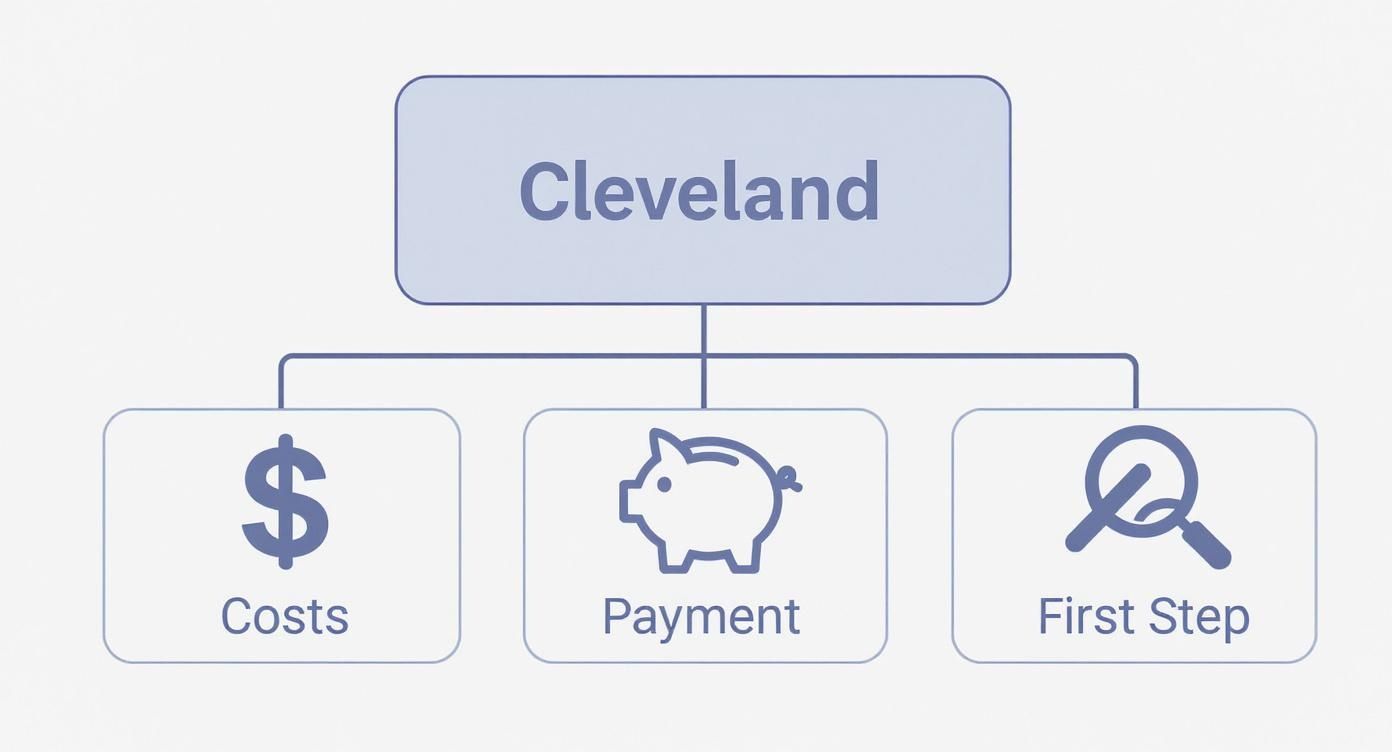
(Image alt text: A flowchart showing 'Cleveland' branching into three categories: 'Costs' with a dollar sign, 'Payment' with a piggy bank, and 'First Step' with a magnifying glass.)
This simple chart shows the process. It's about tackling one piece at a time: first, understand the costs, then figure out how to pay, and finally, start your search. This makes a daunting journey feel much more manageable.
Assisted Living in Ohio
Here's a key local detail: in Ohio, what most people call "assisted living" is officially licensed as a Residential Care Facility (RCF). These communities are ideal for older adults who are still fairly independent but could use help with daily activities like medication reminders, bathing, or dressing.
In an RCF, residents typically have a private or semi-private apartment, enjoy meals in a community dining room, and have access to social activities. The goal is to create a safe, engaging environment where support is always available. Assisted Living (Residential Care Facility) is state-licensed, while a Skilled Nursing Facility (often called a nursing home) is regulated by the federal agency CMS.
Memory Care Communities
Memory care is a specialized type of assisted living for individuals with Alzheimer's disease or other forms of dementia. It offers everything found in assisted living, but with crucial extra support.
You'll find enhanced safety features like secured entrances to prevent wandering and layouts designed to be less confusing. Staff receive specialized training in dementia care to provide patient and effective support. Because of this specialized care and higher staff-to-resident ratio, memory care almost always costs more than standard assisted living.
Typical Monthly Senior Living Costs in the Cleveland Area
This table provides estimated monthly base rate ranges for senior care in Northeast Ohio. These are starting points; the final cost depends on the community and the level of care needed. Data as of March 2025.
| Type of Care | Average Monthly Cost Range (Cleveland Area) | What the Base Rate Typically Includes |
| :--- | :--- | :--- |
| Assisted Living | $4,500 – $7,000+ | Apartment rent, 2-3 daily meals, utilities, housekeeping, laundry, social activities. |
| Memory Care | $6,000 – $9,500+ | All assisted living services plus 24/7 specialized staff, secured environment, dementia-specific programs. |
How the Pricing Actually Works
When communities provide a quote, they use specific terms. Understanding them is key to comparing the senior living cost from one place to another.
-
One-Time Community Fee: An upfront, typically non-refundable fee paid upon move-in. It covers administrative work and apartment preparation.
-
Base Monthly Rate: The core rent. It covers the apartment, utilities, meals, basic housekeeping, and access to social programs.
-
Level-of-Care Fees: These are additional monthly charges based on the amount of hands-on help a resident needs. A nurse will conduct an assessment to determine this cost.
This pricing model can be tricky. That's why we created a detailed guide on what is included in assisted living costs that explains how these fees work.
What this means for you: When you tour a community, ask for a complete, detailed breakdown of all potential fees. Request a copy of the residency agreement and ask them to explain how and when rates might increase.
How Ohio Families Pay for Senior Living
<iframe width="100%" style="aspect-ratio: 16 / 9;" src="https://www.youtube.com/embed/4GzXUP9tSxo" frameborder="0" allow="autoplay; encrypted-media" allowfullscreen></iframe>Once you have an idea of the monthly senior living cost, the next question is, "How do we pay for this?" For most Ohio families, it’s rarely a single source of funding. It’s usually a mix.
Think of it like putting together a puzzle. You’ll likely use a combination of personal savings, a pension, and potentially some state or federal programs. Let’s walk through the most common financial options.
Private Pay Sources
The most direct way to pay is with personal funds. This is the primary method for many families, at least initially.
These funds usually come from:
-
Savings and Investments: Personal savings, stocks, bonds, or retirement funds like a 401(k) or IRA.
-
Pension and Social Security: This steady monthly income often covers a large portion of the base monthly fee.
-
Sale of a Home: The equity in a family home is a significant asset that many families use to fund long-term care.
-
Family Contributions: It’s not uncommon for adult children to pool resources to help support a parent's care.
What this means for you: Before touring a community, sit down and get a clear picture of all available private assets. Knowing your budget will make your search more focused and less stressful.
Long-Term Care Insurance
If your loved one has a Long-Term Care (LTC) insurance policy, now is the time to review it. These policies are designed to help cover the costs of places like assisted living when someone needs help with a certain number of Activities of Daily Living (ADLs), like bathing or dressing.
Every policy is different. Look for key details like the daily benefit amount, the benefit period (how long it pays), and the elimination period (a deductible, measured in days, before benefits begin). The first step is to call the insurance company to start a claim, which typically requires a doctor's assessment.
Veterans Benefits: Aid & Attendance
For veterans who served during wartime (or their surviving spouses), the VA’s Aid & Attendance benefit can be a significant help. It’s an extra monthly payment added to a VA pension, specifically to help pay for long-term care.
To be eligible, an applicant must meet three criteria:
-
Military Service: The veteran must meet specific wartime service requirements.
-
Medical Need: A doctor must confirm the applicant needs help with daily activities.
-
Financial Limits: The VA has strict income and asset caps. However, medical expenses (like assisted living costs) can be deducted from income during the calculation.
You can find official details on the U.S. Department of Veterans Affairs website. It’s a paperwork-intensive process, so starting early is wise.
The Ohio Medicaid Assisted Living Waiver
For many families in Cuyahoga, Summit, and surrounding counties, the Medicaid Assisted Living Waiver (AL Waiver) is a critical program. It helps eligible seniors pay for the care services part of their assisted living bill.
The AL Waiver does not pay for room and board. The resident covers that portion, typically with their Social Security and other income. But the waiver does pay for the care fees, which can be thousands of dollars a month, making assisted living a viable option for many Ohio seniors.
To qualify, an individual must meet both financial and medical requirements.
-
Financial Eligibility: According to the Ohio Department of Medicaid, as of 2024, the applicant’s monthly income is generally limited to $2,829, and their "countable" assets must be under $2,000. These figures change, so always verify them with the official source.
-
Medical Eligibility: A state-affiliated assessor must confirm that the person needs a nursing-home level of care but can receive that care safely in an assisted living community.
The process begins by contacting your local Area Agency on Aging (AAA). We cover this in more detail in our guide to the Medicaid Assisted Living Waiver in Ohio.
Example: A Geauga County family using the AL Waiver
A widow in Geauga County receives $1,600 a month from Social Security and has $1,500 in savings. Her health declines, and she needs daily help. Her family finds an assisted living community that accepts the AL Waiver. Since her income and assets are within Ohio's limits, she qualifies financially. An assessor confirms she needs the required level of care.
How it works: Her $1,600 monthly income goes to the community for her room and board. The AL Waiver then pays the community separately for all her care services, allowing her to get the help she needs.
A Sample Budget for a Cuyahoga County Family
Let's walk through a realistic scenario for a family in Cuyahoga County to make the cost of senior living feel more tangible.

(Image alt text: Two people discussing a monthly budget for senior living costs on a large clipboard.)
A Realistic Scenario in Parma
Eleanor, an 84-year-old widow from Parma, is struggling with daily tasks. Her son, David, helps her explore assisted living options. They find a community in Cuyahoga County where the costs are:
-
Base Monthly Rate: $4,800 (studio apartment, meals, housekeeping).
-
Level-of-Care Fee: $1,500 (medication management, help with showering/dressing).
-
One-Time Community Fee: $2,500.
The total monthly cost is $6,300.
Calculating Affordability and Finding Help
David reviews his mom's finances. Eleanor has $1,950 in monthly income and $45,000 in savings. Her income only covers a fraction of the cost, and her savings would be depleted in less than a year. David remembers the AL Waiver.
He checks the Ohio Department of Medicaid rules. Eleanor's monthly income of $1,950 is below the limit, but her $45,000 in assets is far over the $2,000 threshold.
What this means for you: This is a common situation. Many seniors are "over-asset" for Medicaid but lack sufficient funds to pay privately long-term. This is where careful planning is critical.
Using the AL Waiver to Bridge the Gap
David calls the Western Reserve Area Agency on Aging. A case manager explains that Eleanor can become eligible by "spending down" her extra assets on qualified expenses.
The family creates a plan. They use Eleanor's savings to pay the $2,500 community fee and the full $6,300 monthly cost until her savings fall below the $2,000 limit. Once she becomes financially eligible, they activate the AL Waiver.
From then on, Eleanor's $1,950 monthly income will pay for her room and board. The AL Waiver will pay the community for her $1,500 level-of-care fee. This approach makes her long-term stay affordable.
Your Financial Planning Checklist
Being organized is key. Use this checklist to gather the documents you'll need.
Checklist: Documents to Gather for Financial Planning
| Document Category | Specific Items to Locate | Why It's Needed |
| :--- | :--- | :--- |
| Proof of Income | Social Security benefit statement, pension statements, annuity statements. | To verify monthly income for community and Medicaid applications. |
| Asset Statements | Bank statements (checking & savings), investment account statements (stocks, bonds), life insurance policies. | To establish the total value of "countable" assets for Medicaid eligibility. |
| Insurance Policies | Long-Term Care (LTC) insurance policy, Medicare and supplemental insurance cards. | To understand existing coverage and initiate claims for LTC benefits. |
| Property Documents | Deed to home, recent property tax assessment. | Necessary if selling a home to fund care or for asset valuation. |
Having these documents ready will make conversations with financial advisors, elder law attorneys, and senior living communities much more productive. This budgeting process is similar when figuring out how much memory care costs, though the total amounts will be higher.
Strategies to Manage Senior Living Costs

(Image alt text: Illustration of a balance scale, representing senior living costs and a person considering financial strategy.)
Seeing the price tag for senior living cost in Northeast Ohio can be daunting, but there are practical ways to make care more affordable. A little planning and exploring all your options can make a big difference.
Compare Pricing Structures and Locations
Not all communities charge the same way. A community in a quiet Medina County suburb will likely have a different price than one in a prime location in Cuyahoga County.
When touring, ask how they structure fees. Is it “all-inclusive” (one predictable monthly payment) or “a la carte” (a lower base rent plus services added as needed)? The latter can be more cost-effective if your loved one only needs a little help.
Explore Companion Suites
If your loved one is open to sharing space, a companion suite (a two-bedroom apartment shared with another resident) can dramatically lower the room-and-board portion of the senior living cost, often by 20-30%. Besides the financial savings, it provides built-in companionship, which can ease the transition to a new community.
Plan Ahead with a Medicaid Spend-Down
For families who anticipate needing the AL Waiver, planning is crucial. Many seniors have too many assets to qualify immediately. The process of legally using those excess funds on approved expenses is called a “spend-down.”
What this means for you: This is not a do-it-yourself project. In Ohio, Medicaid has strict rules about asset transfers. A wrong move can trigger a penalty period, making your loved one ineligible for benefits. We strongly recommend working with a certified elder law attorney in Ohio who specializes in Medicaid planning.
Regularly Review the Care Plan
A person's care needs can change. Most communities reassess residents regularly, but you can request a review at any time. If your loved one has become more independent, they might not need the level of support they are paying for. A care plan review could move them to a lower care level, directly reducing your monthly bill.
What to Do Next
Here are the concrete steps to take to move from research to finding the right care.
1. Get a Clear Financial Picture.
Use the checklist in this guide to gather all income and asset documents. Calculate a total monthly income and a total asset value. This will be your starting point for determining an affordable budget.
2. Explore Financial Aid Options.
Contact your local Area Agency on Aging (AAA) to learn about the AL Waiver. They can explain the assessment process, provide current eligibility rules for your county (Cuyahoga, Summit, etc.), and help you begin an application.
3. Tour, Compare, and Ask Questions.
Visit at least two or three communities to compare the atmosphere, staff, and residents. During each tour, ask for a complete written breakdown of all costs, including the one-time community fee, base rent, and all potential level-of-care fees.
4. Check Inspection Reports.
Review the latest health and safety inspection reports for any community you're considering on the Ohio Department of Health's portal.
5. Know Your Rights and Resources.
The Ohio Long-Term Care Ombudsman Program advocates for residents. Keep their contact information handy. If you have a concern, you can also report it directly to the Ohio Department of Health.
Disclaimer: This article is for informational purposes and is not legal, financial, or medical advice. Please consult with qualified professionals for guidance on your specific situation.
FAQ: Your Top Questions Answered
Does Medicare Cover Assisted Living in Ohio?
No. Medicare is health insurance and does not pay for the room, board, or personal care services in an assisted living community. It may cover specific medical services a resident receives, such as physical therapy from a home health agency, but it will not pay the monthly assisted living bill.
What's the Difference Between a Community Fee and a Care Fee?
-
Community Fee: A one-time, upfront, non-refundable fee that covers administrative and apartment preparation costs.
-
Level-of-Care Fee: A monthly charge added to the base rent, based on how much hands-on assistance a resident needs.
When budgeting, you must account for all three parts: the one-time community fee, the monthly base rent, and the monthly care fee.
How Long Does It Take to Get Approved for Ohio's Assisted Living Waiver?
The timeline for the AL Waiver can vary from a few weeks to several months. Delays can be caused by gathering paperwork, scheduling the required in-person assessment, and potential backlogs at the local agency. Because it is not an instant approval, it is best to start the application process with your local Area Agency on Aging as soon as you think you might need it.
Can a Community Raise the Rent After We Move In?
Yes, you should expect annual rate increases. Most residency agreements allow communities to raise rates to keep up with inflation and rising operational costs. When you tour, ask about the community's rate increase history for the past 3-5 years. A predictable increase of 3-5% annually is easier to budget for than sudden, large hikes.
Finding the right path forward in senior living can feel overwhelming, but you're not alone. The local advisors at Guide for Seniors have been inside communities all over the Cleveland area. We can give you a hand-picked list of options that fit your family’s specific needs and budget, and our help is always free.
Ready to get started? Visit Guide for Seniors to get your personalized recommendations.
Get matched to communities in your budget
Our Cleveland advisors know current pricing and availability — free for families.
Find Medicaid-Approved Communities Near You
Looking for a facility that accepts the Ohio Medicaid Assisted Living Waiver? Browse communities in these Cleveland suburbs:
Medicaid waiver communities on Cleveland's west side
East side communities accepting Ohio Medicaid
Affordable Medicaid options in south suburbs
Near-west Medicaid-approved communities
Southwest suburban Medicaid facilities
Central location with waiver-approved care
Need help navigating Medicaid? Our local advisors provide free guidance →
Need Help Finding Senior Living in Greater Cleveland?
Our Greater Cleveland local advisors compare pricing, schedule tours, and answer your questions — completely free.