Assisted Living for Couples in Cleveland, Ohio When One Needs Care: A Trusted Guide
When one spouse needs daily care and the other does not, many Cleveland-area couples assume a move means living apart. In most cases it does not. This guide covers how Greater Cleveland communities house couples with different care needs, how the two-person pricing actually works, and the questions that tell you whether a community can genuinely support you both.
-
Can couples stay together? Yes, nearly all Cleveland-area assisted living communities are designed to keep couples together, even with different care needs.
-
How does it work? The most common model is a shared apartment where one partner receives care services, billed separately. This keeps you under one roof.
-
How much does it cost? You pay a base rent for the apartment (covering both people) plus a separate "level of care" fee only for the partner who needs support.
-
What's the biggest mistake? Wasting weeks touring communities only to find they don't accept your long-term care insurance or the Ohio Medicaid Waiver. A local advisor can prevent this.
Keeping You Together: Your Cleveland Assisted Living Guide
This guide is for you if one partner needs daily support, but the other is still independent, and the thought of being separated is unbearable. You’re facing an emotional decision, and the last thing you need is more confusion. While brochures highlight the chandeliers and restaurant-style dining, you need to be asking about the weekend staffing ratios or how they handle a medical emergency when each of you has different health needs.
That's where we come in. GuideForSeniors.com is your ally, the neutral party who navigates the system for you. We cut through the noise to give you the truth about how Cleveland-area communities accommodate couples.
The Cost of Getting It Wrong: A Solon Family's Story
We see it all the time. A family from Solon spent three precious weeks touring beautiful communities, only to discover their top choice didn’t accept the Ohio Medicaid Assisted Living (AL) Waiver for the spouse who needed it. A single conversation with a local advisor could have saved them that time, gas, and heartache. This guide is designed to prevent those kinds of frustrating, costly mistakes. Our goal is to move you from anxious research to confident action with an expert in your corner.
Insider Tip: Don’t just ask if a community "accepts couples." Ask them to detail exactly how they structure the living arrangements and billing when one partner requires a higher level of care. Their answer will instantly reveal how experienced they are with your specific situation.
To get started, let’s look at the most common arrangements you'll find across Cuyahoga, Lake, Lorain, and Medina counties. Understanding these options is the first step in finding a solution that honors your bond while providing the right support.
Cleveland Living Options for Couples with Mixed Care Needs
Here is a quick overview of the common arrangements available in the Cleveland area. Think of this as your starting point for figuring out what might work best for your family.
| Arrangement Type | How It Works in Cleveland | Best Suited For |
| :--- | :--- | :--- |
| Shared Assisted Living Suite | Both partners live together in one apartment (often a one- or two-bedroom). Care services and fees are added for the partner who needs support. | Couples who want to live in the same space and where the independent partner may provide some light, informal support. |
| Adjacent Units on Campus | One partner lives in an independent living apartment while the other resides in an assisted living unit in the same building or on the same campus. | Couples where partners have significantly different needs (e.g., one is active, the other needs memory support) but want to remain close. |
| Independent Living with A La Carte Care | The couple lives in an independent apartment, and the community provides "a la carte" home health services as needed for one partner. | Couples where the care needs are minimal and predictable, like medication reminders or help with bathing a few times a week. |
Each of these models has its own pros and cons, especially when it comes to cost and flexibility. The key is to match the arrangement to your unique needs as a couple, not the other way around.
How Assisted Living Models for Couples Actually Work
Let's cut through the marketing spin. When you start searching for assisted living for couples in Cleveland, it’s easy to get lost. The main goal is always to keep you both together, but "together" can mean different things depending on the community’s setup. Understanding how these models function in communities from the East Side to the West Side is the first step to finding what works.
Shared Suites with Added Care Services
This is the most popular model for couples. You live together in the same apartment, and the community charges a base rent that covers meals, utilities, and activities for both of you. On top of that, they add a separate "level of care" fee only for the spouse who needs assistance. This fee is determined after a nurse assesses their specific needs, from medication management to help with bathing.
This setup is ideal for couples who want to stay under the same roof. You'll find this is a very common option in communities in suburbs like Strongsville or Mayfield Heights.
Campus Models with Different Levels of Living
Larger communities, often called Continuing Care Retirement Communities (CCRCs), offer a campus-style approach. You might find these near University Circle or in more sprawling suburban locations. In this model, a couple might have two separate but nearby living spaces:
-
Partner A (Independent): Lives in an independent living apartment.
-
Partner B (Needs Care): Resides in an assisted living or memory care suite, often in an adjacent building.
This allows each person to get the exact level of support they need while staying just a short walk away. It’s an excellent solution when one spouse has more advanced needs, like Alzheimer's, that require the safety of a secure memory care unit.
Insider Tip: The real difference here often comes down to the facility's license. In Ohio, assisted living is officially called a Residential Care Facility (RCF), designed for personal care. That’s worlds away from a Skilled Nursing Facility (SNF), which provides 24/7 medical care. Getting this distinction right is vital. To dig deeper, check out our detailed guide on assisted living versus nursing home care.
Understanding Ohio Facility Designations
Knowing the official terms used by the Ohio Department of Health (ODH) protects you from being misled.
-
Residential Care Facility (RCF): This is the state license for what everyone calls assisted living. They provide room, board, and personal care services.
-
Skilled Nursing Facility (SNF): This is what most people mean when they say nursing home. They offer round-the-clock skilled nursing care.
Knowing these terms helps you verify a community's license. If a community near the Cleveland Clinic says they offer high-level medical services, you need to confirm if they have an SNF license on-site. Don't just take a salesperson's word for it—ask your Senior Advisor to verify the facility’s state-issued license. A simple check prevents a huge mistake.
Crunching the Numbers: What Does Assisted Living Really Cost for a Couple in Northeast Ohio?
This is the most stressful part of the search. To get a clear picture, stop thinking of it as one big price tag. Every community in the Cleveland area breaks down the monthly cost into two separate buckets:
-
The Base Rent: This covers the apartment, utilities, housekeeping, and meals for both of you, plus access to community amenities.
-
The Care Fee: This is a separate, additional charge that applies only to the partner who needs help. It's based entirely on their specific needs after a health assessment.
This is great news. It means you’re not paying for two full-time care packages when only one of you needs that level of support. It's the standard, fair way that communities across Cuyahoga County and beyond handle pricing for couples.
How Fees and Costs Are Determined
Before you move in, a community’s wellness director (usually a nurse) will conduct a health assessment for the partner needing support. This isn't a test; it's a conversation to understand exactly what help is needed. The outcome determines their "level of care," which directly sets the price for their monthly care fee.
For a really detailed breakdown of local pricing, check out our comprehensive guide to the cost of assisted living in Cleveland.
Insider Tip: Almost every community has a one-time "Community Fee" at move-in, which can range from $1,500 to $5,000. This is often negotiable! Communities run specials or have flexibility, so ask your advisor how to approach this conversation.
As you start looking, you'll find there are two main ways couples arrange their living space.
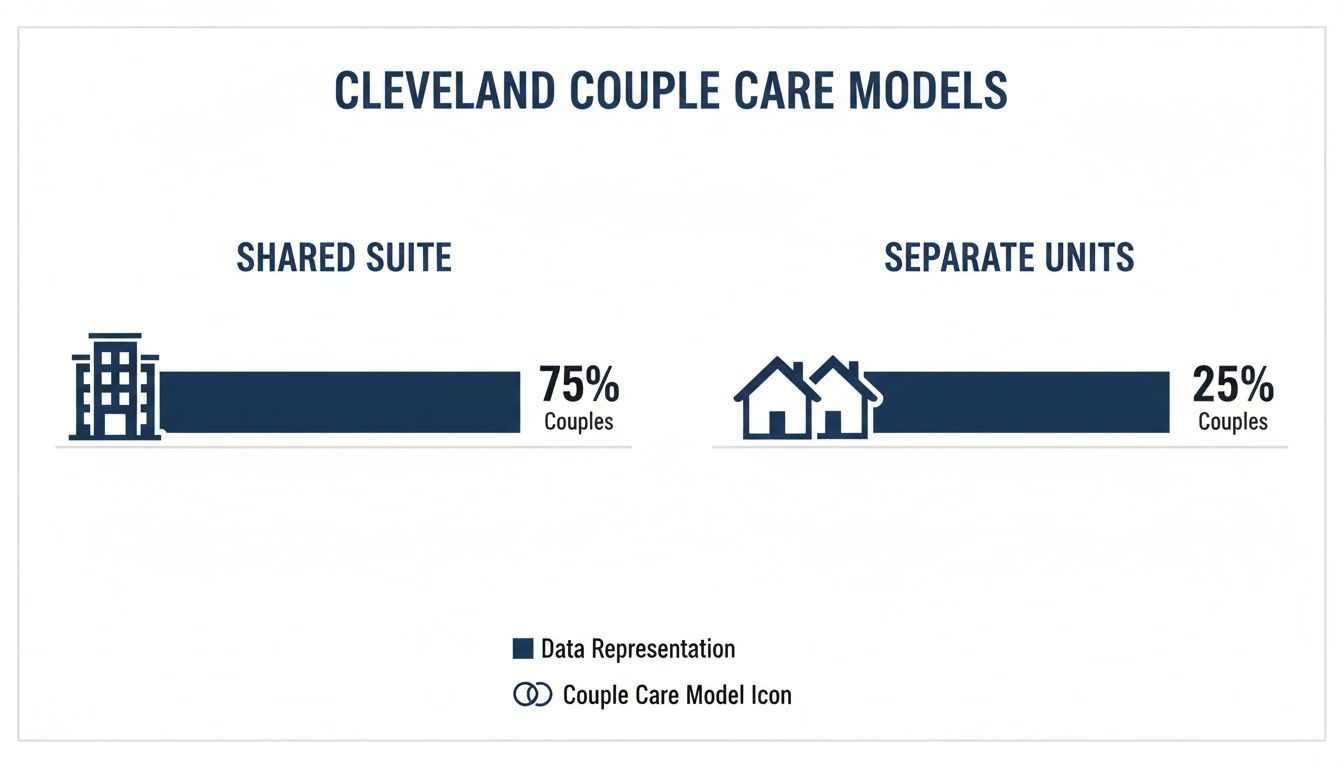
As you can see, the vast majority of couples in the Cleveland area choose to stay together in a shared apartment, with the community’s care team simply coming to them as needed.
To make this more concrete, here’s a sample of what a monthly bill might look like for a couple with mixed needs.
Sample Monthly Cost Breakdown for a Couple in Cleveland (Updated: October 2023)
| Cost Component | Partner A (Independent) | Partner B (Needs Care) | Estimated Monthly Total |
| :--- | :--- | :--- | :--- |
| Base Rent | Included in Shared Rate | Included in Shared Rate | $4,500 |
| Second Occupant Fee | $800 | N/A | Included in Rent |
| Care Fee (Level 2) | N/A | $1,500 | $1,500 |
| Total Monthly Cost | | | $6,800 |
This table is for illustrative purposes only. Pricing varies by community and care needs.
Tapping into Ohio's Financial Assistance Programs
Paying out-of-pocket isn't the only path forward. Ohio has programs designed to ease the financial burden.
-
The Ohio Medicaid Assisted Living (AL) Waiver: For seniors who are financially and medically eligible, this waiver can cover the cost of care services in an assisted living community. It does not pay for room and board (the rent). For a couple, this means if one spouse qualifies, the AL Waiver could cover their entire care fee, dramatically lowering the total monthly bill.
-
VA Aid & Attendance: A monthly pension for wartime veterans and their surviving spouses who meet eligibility criteria. It can be used to pay for any long-term care expense, including assisted living.
How Ohio Protects the "Community Spouse"
In Ohio, Medicaid has built-in rules to prevent "spousal impoverishment." They are designed to ensure the spouse who remains more independent (the "community spouse") doesn't have to spend their life savings to pay for their partner's care. These state-sourced rules allow the community spouse to keep a protected amount of assets and a monthly income allowance.
Trying to figure all this out can feel overwhelming. You don't have to do it alone. Instead of piecing it together, let a local senior advisor give you a clear, up-to-date pricing report from communities that fit your specific situation.
What Cleveland Families Need to Know During Their Search
Moving from online research to touring a community is a huge leap. To make a confident choice, you have to look past the beautiful lobbies and ask the hard questions that reveal how a community really operates.
Finding the right assisted living for a couple in Cleveland is about strategy. It's about confirming the care structure, staffing levels, and emergency plans line up with your specific situation. I’ve heard from countless families wowed by the chandeliers who forgot to ask about nurse coverage on weekends—a detail that can make all the difference.
Navigating the Cleveland Landscape
The classic "East Side vs. West Side" debate isn't just for fun—it has real-world implications. A community in Westlake offers easy access to Crocker Park, while one in Beachwood might be closer to your grandkids. For many families, proximity to world-class care at "The Clinic" (Cleveland Clinic) or "UH" (University Hospitals) is non-negotiable.
Here are a few local factors to think through:
-
Your Support System: Where do your kids, friends, and doctors live? Keeping those connections strong is vital.
-
Medical Access: How long does it actually take to get to a specialist at University Circle during rush hour? Map it out.
-
County-Specific Programs: Resources from the Departments of Aging can vary between Cuyahoga, Lake, and Lorain counties. A local advisor can help sort through these differences.
Your Insider Tour Checklist: Questions to Ask
When you take a tour, the community’s team will show you the best features. Your job is to dig deeper. These questions cut through the sales pitch to get to what matters.
Questions About Staffing & Care:
-
What are your staff-to-resident ratios for the day shift, evening shift, and on weekends?
-
Is there a registered nurse (RN) physically on-site 24/7, or are they just on-call?
-
Walk me through it: how do you handle a medical emergency when one partner is independent and the other needs immediate help?
-
Can you show me a recent, de-identified care plan for a resident with needs similar to my spouse's?
-
If my needs change down the road, what's the process for adding services for me?
Questions About Logistics & Lifestyle:
-
If we live in separate units (e.g., assisted living and memory care), how do you help us stay connected daily?
-
Can we easily eat meals together if one of us needs a special diet, like pureed food?
-
What specific activities do you offer that engage both an independent person and someone with physical challenges?
For more guidance, explore our guide on how to choose the right assisted living community.
Understanding Your Options
Ohio has a robust senior living network with more than 1,140 licensed assisted living facilities [source: SeniorLiving.org]. In the Cleveland area, many communities have experience accommodating couples with different needs. They are well-equipped to help with daily activities, which is critical when you consider that 64.3% of residents nationwide need help with at least one thing like bathing or walking [source: Ohio's assisted living landscape on SeniorLiving.org].
Knowing these places exist is the first step. The next is finding out which ones have availability that fits your timeline and budget—a job a local advisor can do in minutes.
Decoding the Community Care Assessment
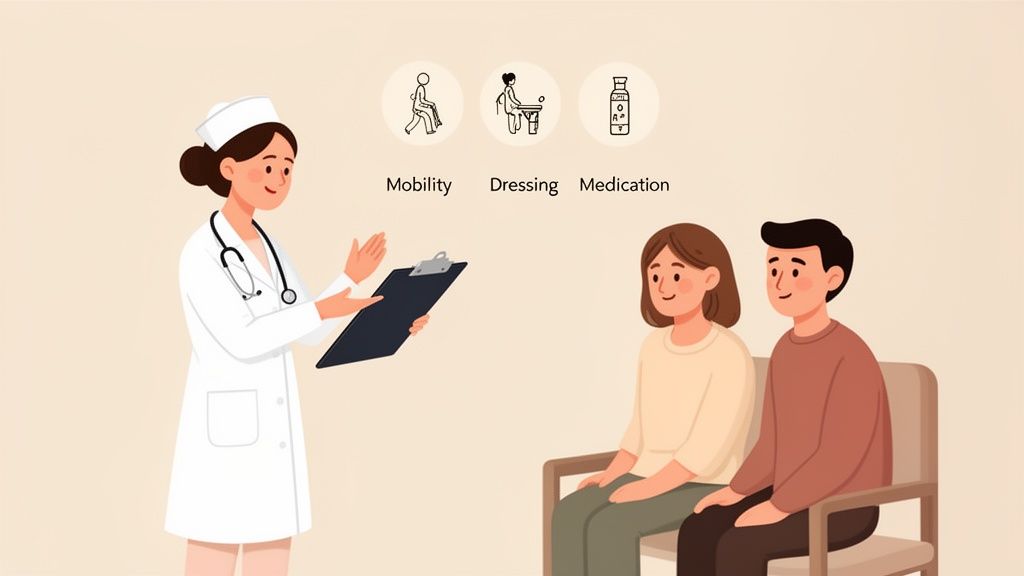
Before any Cleveland community can give you a real price, they must do a care assessment. This is the moment the brochure promises get translated into a concrete plan.
Think of it as a detailed conversation, not a test. The community’s wellness director will sit down with you to get a complete picture of the partner who needs support. Their findings determine the "level of care"—a specific tier of services with a set monthly price.
What the Assessment Actually Covers
The evaluation focuses on Activities of Daily Living (ADLs), a checklist of basic skills for independent living. The nurse will ask gentle questions about:
-
Mobility: How do they get around? On their own, with a cane, or a walker?
-
Bathing & Dressing: Is a helping hand needed to safely get in and out of the shower or with buttons?
-
Toileting: Is assistance needed with getting to the restroom or with personal hygiene?
-
Medication Management: Is a simple reminder enough, or is hands-on help needed?
-
Cognitive Function: Are there signs of memory loss or confusion that require extra oversight?
Insider Tip: It is crucial that you and your spouse are both there for this assessment. You are the experts on your own life. If you feel their snapshot doesn't capture a typical day, speak up. An inaccurate assessment can mean paying for services you don’t need or, worse, not getting the support you do.
From Assessment to Care Plan
The results are used to build a personalized care plan that spells everything out—from a daily reminder to take blood pressure pills to hands-on help with showering twice a week. In Ohio, you have the right to review this plan, ask questions, and be comfortable with it before you sign anything.
Remember, needs change. You can always request a reassessment. If a health condition improves or declines, the care plan—and the cost—should change with it.
How a Local Cleveland Advisor Simplifies Everything
Finding the right care for a partner is one of the most emotionally charged challenges a couple can face. You can spend hours sifting through websites, trying to figure out what’s real and what’s marketing.
Imagine a couple from Parma who spent weeks driving all over, from the East Side to the West Side, touring communities. They finally found a place they adored, only to be told the perfect two-bedroom apartment had a year-long waitlist. A single five-minute phone call to a local senior advisor would have given them a shortlist of communities with current availability, saving them weeks of effort and heartache.
Your Advocate in a Confusing System
Think of a local advisor as your personal concierge for senior living. We live and work right here in Northeast Ohio. We’ve walked the halls of the communities in Westlake, Solon, and everywhere in between. Our job is to be your advocate, armed with insider knowledge you can’t find online:
-
Real-Time Availability: We know which communities have apartments for a couple right now.
-
Transparent Pricing: We get you straight answers on costs, from negotiable community fees to the real price of care.
-
Community Reputation: We hear directly from families, giving us a true sense of a facility's culture and quality of care.
Insider Tip: Community pricing and availability can literally change overnight. Instead of cold-calling a dozen places, let an advisor do that legwork for you. We can often get a current Rate Sheet for communities in your target neighborhood within hours.
Moving from Guesswork to a Clear Plan
You don’t have to do this alone. Our advisors at Guide for Seniors offer their expertise at no cost to your family. We’re paid by our partner communities, allowing us to provide unbiased guidance focused on your needs.
Instead of guessing, we’ll help you build a confident, strategic plan. We can create a custom report comparing your best options, coordinate VIP tours, and ensure you’re asking the right questions. Your time is precious. Let’s make it count.
Don't spend another weekend buried in brochures. Speak to a Cleveland-based Senior Advisor for free to narrow your list and find the peace of mind you deserve.
Your Top Questions Answered by Cleveland-Area Experts
Here are the honest answers to the questions we hear most often from couples in Northeast Ohio.
What Happens If the Healthier Spouse Eventually Needs Care, Too?
This is a smart question. Most quality communities in the Cleveland area are prepared for this. They can simply add a care plan for the second spouse without you ever having to move apartments. The wellness team will do a new assessment, and an additional "level of care" fee is added to your monthly statement. By choosing a place with a full continuum of care, you're setting yourselves up to comfortably age in place, together. A local advisor can tell you which communities truly have this flexibility.
Can We Use the Ohio Medicaid Waiver for Just One of Us?
Yes, absolutely. In Ohio, the Medicaid Assisted Living (AL) Waiver looks at an individual's medical and financial needs. If one of you qualifies, the waiver can pay for their care services, while you both still cover the room and board. To protect the at-home spouse, Ohio has "spousal impoverishment" rules that protect a certain amount of your shared assets and income. This is a complex area, and we always recommend consulting a qualified elder law attorney.
Are There Places in Cleveland for Us If One of Us Has Alzheimer's?
Of course. This is a very common scenario. Many communities across Greater Cleveland have a secure, specialized memory care neighborhood on the same campus as the assisted living apartments. This setup is ideal. It allows the spouse in assisted living to maintain their independence while their partner gets the expert care they need just a short walk away. You can visit every day and stay connected without the pressure of being the sole caregiver. Our advisors can give you a handpicked list of the best communities for this, from Shaker Heights to Avon Lake.
Finding the right path forward can feel monumental, but you are not in this alone. Guide for Seniors offers free, personalized guidance from local experts who know the Cleveland market inside and out. Click here to get a current Rate Sheet for Cleveland-area communities and simplify your search.
Disclaimer: This article is for informational purposes only and does not constitute medical or legal advice. Please consult with a qualified professional for personalized guidance.
Find Medicaid-Approved Communities Near You
Looking for a facility that accepts the Ohio Medicaid Assisted Living Waiver? Browse communities in these Cleveland suburbs:
Medicaid waiver communities on Cleveland's west side
East side communities accepting Ohio Medicaid
Affordable Medicaid options in south suburbs
Near-west Medicaid-approved communities
Southwest suburban Medicaid facilities
Central location with waiver-approved care
Need help navigating Medicaid? Our local advisors provide free guidance →
Need Help Finding Senior Living in Greater Cleveland?
Our Greater Cleveland local advisors compare pricing, schedule tours, and answer your questions — completely free.