Luxury Senior Living in Beachwood vs. Private Care: A Cleveland Family's Guide
Choosing between luxury senior living and private in-home care in Beachwood can feel like drowning in brochures and sales pitches. You're terrified of making the wrong choice for your family. This guide cuts through the marketing fluff to give you the truth, helping you move from researching to finding the right solution.
-
Luxury Senior Living: Best for seniors who are feeling isolated and want a vibrant social life, built-in safety features, and freedom from home maintenance. It offers predictable, all-inclusive monthly costs for rent, meals, and care.
-
Private In-Home Care: Best for seniors who need temporary support after a surgery or have highly specific one-on-one care needs and wish to remain in their familiar home. Costs are billed by the hour and can escalate quickly for round-the-clock care.
-
The Hidden Costs: A community's "Base Rent" doesn't include "Level of Care" fees, which can add thousands per month. Private care's hourly rate doesn't account for agency fees, backup care, or payroll taxes if you hire directly.
-
The Next Step: Pricing and availability change daily. Don't guess. The best way to get clarity is to speak with a local Senior Advisor who can provide current rate sheets and help you compare your specific options.
Who This Guide Helps (and Why Doing it Alone is So Hard)
This guide is for families in Greater Cleveland—from Beachwood and Shaker Heights to Westlake and Medina—who are overwhelmed by senior living options. You're sorting through glossy brochures, all promising "resort-style living" and "compassionate care," but they leave you with more questions than answers. The fear of making a costly mistake is real.
Think of us as your "Concierge," not a librarian. We're the trusted insiders who translate sales pitches into practical reality. We understand the East Side vs. West Side dynamics, the importance of being near the Cleveland Clinic or UH, and the unique challenges of navigating Ohio's senior care system. Our goal is to guide you to a solution, not just give you more information to sift through.
Understanding the Core Differences
At its heart, this is a choice between two philosophies of care. One offers a built-in community with a suite of services under one roof. The other provides unmatched personalization in the comfort of home. Neither is universally "better," but one is certainly a better fit for your family's specific situation.
The image below gives a snapshot of these two models.
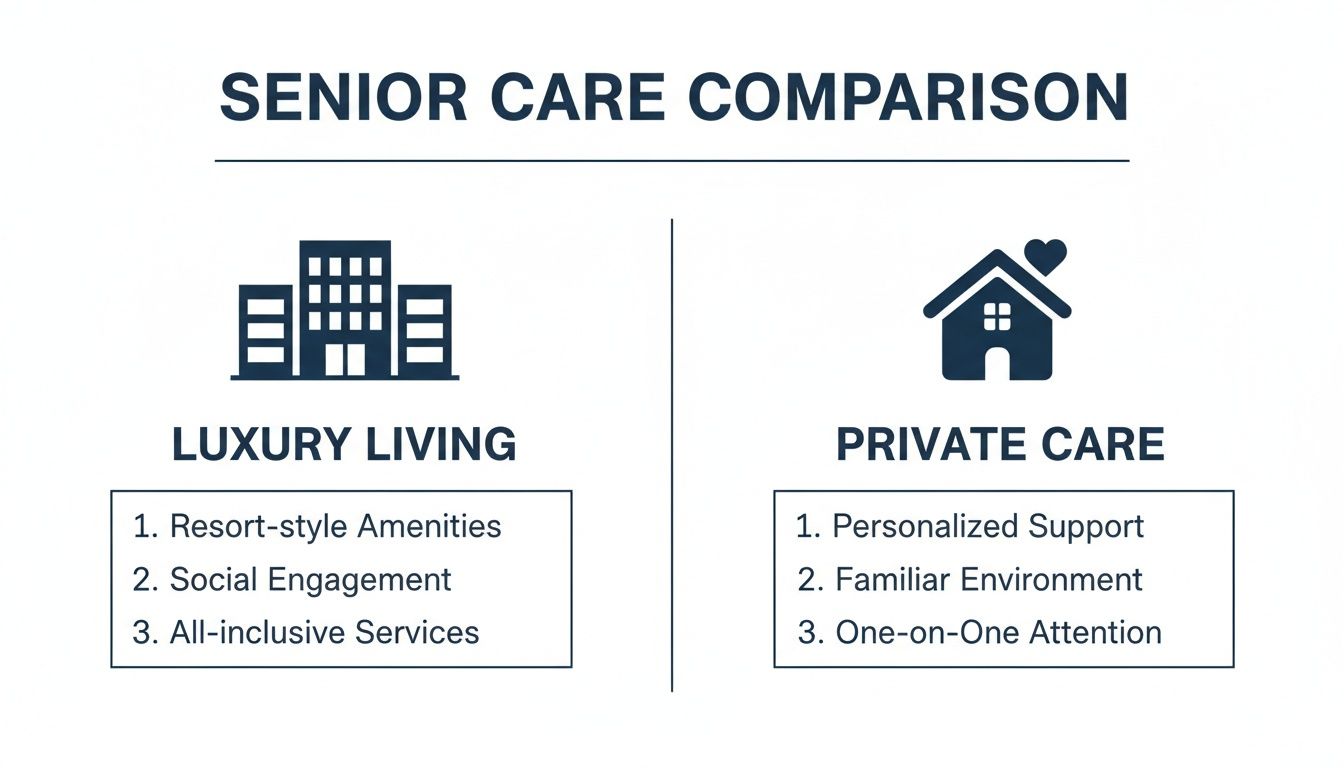
Communities are fantastic for social engagement and all-inclusive amenities, while private care excels at delivering dedicated, one-on-one support in a setting your loved one already knows.
A First Look at the Financial Reality
Let's talk cost, as it’s often the most confusing part. Here in Beachwood, Ohio, the average monthly cost for assisted living is around $4,479 [source: SeniorLiving.org], but premier luxury communities can be significantly higher. On the other hand, private in-home care in the Cleveland area typically runs $28-$35/hour. If round-the-clock care is needed, it can easily surpass the monthly cost of a community. You can find more detailed information on Beachwood senior care costs at SeniorLiving.org.
To help you compare apples to apples, here is a quick overview.
At a Glance: Luxury Community vs. Private Care in Beachwood
This table is designed to give you a high-level look at how these two options stack up.
| Factor | Luxury Senior Living Community | Private In-Home Care |
| :--- | :--- | :--- |
| Cost Structure | All-inclusive monthly fee (rent, meals, care, activities). Predictable. | Billed by the hour. Costs fluctuate based on need and can escalate quickly. |
| Social Environment | Built-in community, daily activities, group dining. Fights isolation. | Primarily isolated unless family actively arranges all outings and visits. |
| Care Delivery | 24/7 on-site staff available to all residents. Integrated team approach. | One caregiver dedicated exclusively to one person during their shift. |
| Best For | Seniors feeling lonely, seeking a vibrant social life, and wanting freedom from home upkeep. | Seniors needing short-term post-surgery support or with highly specific one-on-one care needs. |
This breakdown highlights the core decision: are you seeking a predictable, all-in-one lifestyle package, or highly focused, personalized support in a familiar environment?
Navigating the True Cost of Senior Care in Cuyahoga County
Let's talk about the elephant in the room: money. Getting a straight answer on cost can feel impossible. Brochures for luxury communities in Beachwood paint a beautiful picture, but the price tag you see is almost never the final price you pay. Similarly, the hourly rate for a private caregiver seems straightforward, but it can quickly spiral. Getting a handle on these variables is key to making a sustainable choice.
Breaking Down Luxury Community Costs
A monthly bill for luxury assisted living has two parts. You must understand both.
-
Base Rent: This covers the apartment, three chef-prepared meals a day, housekeeping, utilities, and access to all amenities—the fitness center, scheduled outings to places like Crocker Park, social events, etc.
-
Level of Care Fees: This is the variable. A community nurse assesses your loved one's need for hands-on support (medication management, bathing, dressing). This places them at a "care level" with its own monthly fee. These fees can add $500 to $3,000+ per month to the base rent and will increase as needs evolve.
Insider Tip: The one-time "Community Fee" of $2,500 to $6,000 is often presented as non-negotiable, but it isn't always. Ask your advisor how and when this fee might be reduced or waived.
The Escalating Costs of Private In-Home Care
Hiring a private caregiver provides incredible one-on-one attention, but the cost is a different ballgame. An hourly rate of $28-$35 in the Cleveland area might seem manageable, but the math changes quickly.
If your loved one needs someone for 12 hours a day, seven days a week, you're already looking at a bill that can top $10,000 per month. For true 24/7 care, that figure can easily blow past $20,000 per month.
And the hourly rate is just the start. You also have to factor in:
-
Agency Fees: Good agencies handle payroll, insurance, and background checks for a premium.
-
Backup Caregiver Costs: When the regular aide calls in sick, last-minute coverage often costs more.
-
"Hidden" Employment Costs: If you hire directly, you are the employer. You are responsible for payroll taxes, liability insurance, and workers' compensation.
A Shaker Heights Family's Costly Miscalculation
I worked with a family in Shaker Heights whose mother needed 24/7 care after a fall. They ran the numbers for a private caregiver and figured they could make it work for $15,000 a month. They didn't account for the extra cost of weekend help, overtime, and liability insurance. Their actual monthly spend was closer to $22,000, which was rapidly burning through their mother's savings. A quick consultation would have shown them that an all-inclusive memory care community was the more predictable and financially sustainable choice for her. To see a full comparison, you can learn more about Cleveland senior living costs in our comprehensive guide.
How to Pay for Care in Ohio
Figuring out how to pay for care is where having a local expert makes a difference. In Ohio, several programs can help, but the rules are complex.
-
Private Pay: The most common route, using personal savings, pensions, or home sale proceeds.
-
Long-Term Care Insurance: Policies vary wildly. An advisor can help you find communities that work well with these insurers.
-
VA Aid & Attendance: A great benefit for eligible veterans and surviving spouses. The application is notoriously tricky, but it can provide thousands per year for care costs.
-
Ohio's Medicaid Assisted Living (AL) Waiver: For seniors who meet financial criteria, this program can cover the cost of care (not room and board). The challenge is finding a community with an available "waiver bed"—a problem we specialize in solving.
Comparing Clinical Support and Specialized Memory Care
Forget the chandeliers for a moment—the real substance lies in the clinical oversight available. This is where luxury senior living and private care diverge most dramatically.
A high-end community offers an integrated system of care. You'll find licensed nurses on-site or on-call 24/7 to manage medications, coordinate with doctors from the Cleveland Clinic or UH, and respond to emergencies instantly. State-trained aides provide hands-on assistance for daily activities. As your loved one's needs change, the support system adapts seamlessly.
With private care, you are responsible for building that team from scratch. The clinical support you get depends entirely on who you can find and hire.
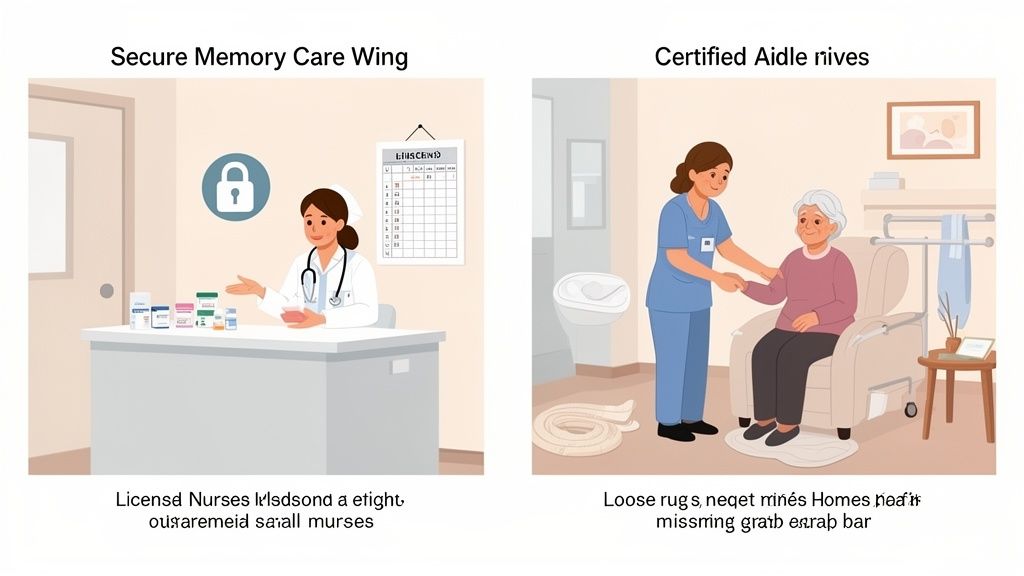
Different Types of In-Home Caregivers
Getting the right help at home means understanding these crucial differences:
-
Companion: Great for social interaction and light housekeeping. Not permitted to provide any hands-on personal care.
-
Home Health Aide (HHA): Certified to help with personal tasks like bathing and dressing. They can monitor vital signs but cannot legally administer medication in Ohio.
-
Licensed Practical Nurse (LPN) or Registered Nurse (RN): A private duty nurse brings skilled nursing into the home. They can manage medications, handle wound care, and provide other complex medical services. This is the most expensive option by far.
The challenge is that a person's needs rarely fit neatly into one box. You might start with an HHA, but if a health issue arises, you're forced back into the difficult process of finding and vetting a new person all over again.
The Critical Difference in Memory Care
For families navigating Alzheimer's or dementia, the contrast is stark. While keeping a loved one at home feels compassionate, it can quickly become unsafe and isolating as the disease progresses.
Luxury memory care units in the Beachwood area are purpose-built for safety and engagement. They feature secure layouts to prevent wandering, specialized dining programs, and sensory activities to reduce agitation. Staff receive specific training on how to care for individuals with cognitive decline. To learn more, see our guide to memory care in Cleveland, Ohio.
A family in Pepper Pike tried to manage their father's advancing dementia at home with a private aide. After he wandered out of the house twice in one week, they realized their home just wasn't equipped for his safety needs, no matter how attentive the caregiver was.
Clinical and Memory Support: A Side-by-Side Comparison
This table breaks down what you can realistically expect from each option.
| Support Level | Luxury Assisted Living / Memory Care | Private In-Home Care |
| :--- | :--- | :--- |
| Medical Oversight | On-site/on-call nurses 24/7 for medication management, emergencies, and physician coordination. | Variable. Requires hiring a private duty LPN or RN at a high hourly rate. An HHA cannot provide medical care. |
| Daily Care | A team of trained aides provides consistent support, supervised by licensed staff. | Depends on the caregiver hired. If they call in sick, you may have a gap in care. |
| Dementia Support | Specialized, secure environment designed to prevent wandering. Staff receive ongoing dementia-specific training. | Home must be modified for safety. Caregiver's expertise varies widely. You are responsible for vetting them. |
| Emergency Response | In-room call systems and on-site staff ensure a response within minutes. | Dependent on the caregiver's presence. Response is limited to calling 911. |
A luxury community offers an integrated safety net; in-home care requires you to build, manage, and adapt that net on your own.
Questions to Ask That Reveal the Truth
While brochures highlight the chandeliers, you need to ask about the weekend staffing ratios. Use these questions to get to the heart of what truly matters.
For a Luxury Community:
-
What are your weekend and overnight nursing staff ratios?
-
How do you create and update resident care plans, and how often are families involved?
-
What specific dementia care training does your memory care staff receive? (Ask for the name of the program).
-
Describe your emergency response protocol. How quickly can staff realistically respond to a call button?
For a Private Care Agency:
-
Are your caregivers W-2 employees or 1099 contractors? (This has huge implications for liability).
-
What is your policy for when a primary caregiver calls out sick? How quickly can you guarantee a qualified backup?
-
What is the full extent of your background check and what certifications do you verify?
-
Describe the dementia-specific training your aides receive. Is it ongoing?
These questions push past the sales pitch and reveal the operational reality of the care being offered.
Lifestyle, Socialization, and Overall Safety
Beyond clinical needs and budget, this decision is about quality of life—genuine social connection and fundamental safety.
For most families, this is where the decision becomes personal. You're not just arranging care; you're helping design your loved one's day-to-day world.
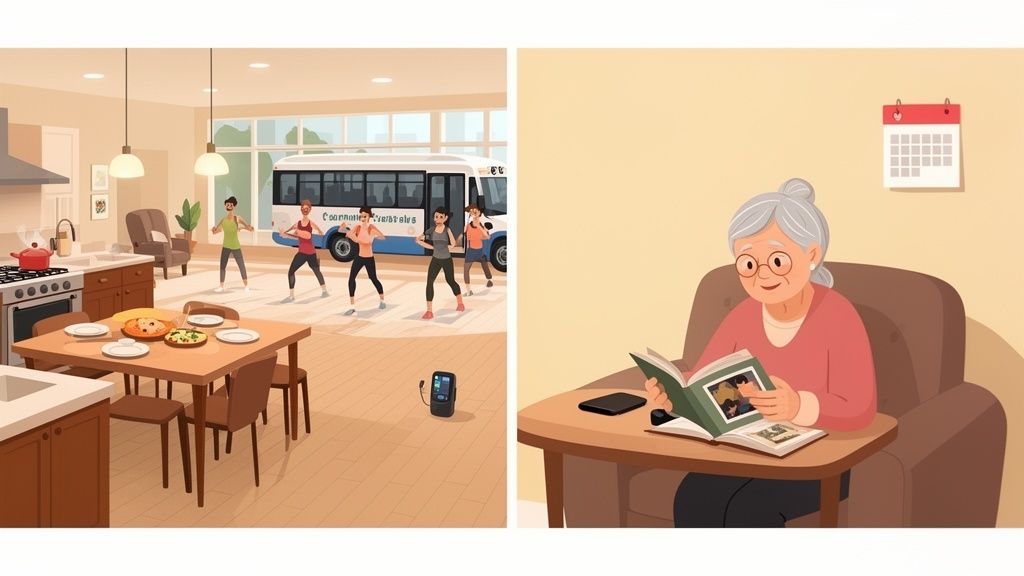
The Social Infrastructure of Community Living
Loneliness is a profound health risk, and luxury communities are engineered to fight it. They provide a built-in social framework that is nearly impossible to recreate at home.
-
Structured Events: Think tai chi classes, guest lectures, and planned outings to University Circle or Legacy Village.
-
Casual Connections: Spontaneous conversations in the hallway or sharing a table for dinner create organic opportunities for friendship.
-
A Renewed Sense of Purpose: Resident-led councils and shared-interest clubs give seniors a meaningful role to play.
Private care can unintentionally foster isolation. Even with a wonderful caregiver, the responsibility for arranging every social outing falls on the family, which can be exhausting.
A Head-to-Head on Safety and Security
Peace of mind about safety is priceless. Here, the two models present a stark contrast.
A luxury community is a controlled environment built for senior safety.
-
24/7 Staff Presence: Someone is always awake, on-site, and ready to respond.
-
Emergency Call Systems: Residents have pendants or pull cords to summon help within minutes.
-
Secure by Design: You’ll find controlled building access and, in memory care wings, secured exits to prevent wandering.
In-home care has inherent safety gaps, particularly overnight or between shifts. The moments a caregiver isn't present are when the risk of a fall or medical issue is highest, with no one there to call for help.
Insider Tip: Every community brochure shows a vibrant activities calendar. Ask to see the calendars from the last three months. This reveals the true consistency of their programming, not just a polished schedule for tours. For more ideas, see our guide on great assisted living activities.
A Chagrin Falls Family’s Safety Scare
I worked with a family from Chagrin Falls whose father had mild cognitive impairment. He had an aide from 9 a.m. to 5 p.m. One evening, he put a pot on the stove, forgot about it, and fell asleep. A smoke alarm alerted a neighbor who got inside before a fire started. That close call was the turning point. They realized the unsupervised hours posed a risk they couldn't take. We found him an assisted living community where the 24/7 staff finally gave everyone true security.
Which Option Fits Your Family? A Scenario-Based Guide
Reading about features and costs is one thing; seeing how these choices play out for real Cleveland-area families brings clarity. One of these stories will likely sound familiar.
Scenario 1: The Social Senior in Solon
Eleanor, 84, is a widow living in Solon. She's mobile and sharp, but the house is a burden and her days are lonely. Her kids tried arranging private caregivers for errands, but it felt like a service, not a friendship. Her core problem—isolation—wasn't getting solved.
-
The Right Fit: A luxury assisted living community is the perfect answer. It frees her from homeownership and places her in a vibrant social scene where she can join clubs, take classes, and enjoy dinner with friends—all without arranging a ride.
-
How an Advisor Helps: Instead of vetting individual companions, an advisor would have immediately identified Eleanor's need for connection and scheduled tours at three top-rated communities near Solon that matched her personality and budget.
Scenario 2: The Independent West Sider in Westlake
Frank, 78, from Westlake just had a hip replacement. He's expected to make a full recovery but needs significant help for the next four to six weeks. He can't cook, drive, or manage personal care on his own, but has zero interest in moving.
-
The Right Fit: Private in-home care is the clear winner. An aide provides the focused, one-on-one help he needs to recover safely at home. Once he's back on his feet, the service ends.
-
How an Advisor Helps: Frank’s daughter spent days calling agencies. A quick call to a Senior Advisor would have connected her with two pre-vetted, trusted West Side agencies that could staff the case immediately, saving her immense time and stress.
A family in Solon spent three weeks touring facilities, only to find out their top choice didn't accept the Ohio Medicaid AL Waiver. A quick check with a local advisor would have saved them that time.
Scenario 3: The Couple with Mixed Needs in Chagrin Falls
Bob and Mary from Chagrin Falls have been married 60 years. Bob is active, but Mary's dementia has progressed to where she needs constant supervision. Bob is exhausted from being her sole caregiver 24/7.
-
The Right Fit: A community with both assisted living and secure memory care is the only sustainable solution. Bob can live in his own assisted living apartment, regaining his social life. Mary receives the specialized 24/7 supervision she needs in a secure environment just steps away. He can visit her anytime, but the burden of being her primary caregiver is lifted.
-
How an Advisor Helps: This complex case requires deep local knowledge. An advisor is essential for identifying the handful of communities in the Chagrin Valley that offer this "continuum of care" and have a proven reputation for memory care.
How to Make a Confident Senior Care Decision in Cleveland
You've just absorbed a mountain of information. Now it's time to turn research into a confident decision. The choice isn't about finding the "best" option—it's about discovering the right fit for your family.
This complex choice boils down to three core considerations:
-
Long-Term Financial Sustainability: Which approach offers a more predictable cost over time, especially if care needs increase?
-
Level of Clinical Need: Does your loved one need 24/7 clinical oversight or are their needs more specific and manageable at home?
-
Social and Emotional Well-Being: Is the main goal to overcome isolation and build new friendships, or to preserve the deep comfort of home?
Answering these questions honestly will light up the path forward.
You don't have to figure this out by yourself. Peace of mind comes from making this decision with local experts by your side.
The truth is, pricing and availability at top-rated Beachwood communities change constantly. A brochure is often outdated the minute it’s printed. This is where we step in as your local "concierge." We can create personalized reports with current rate sheets for the specific communities that match your needs, saving you weeks of frustrating calls and dead-end tours.
Don’t let the stress paralyze you. Getting expert guidance is the quickest way to find a solution that works for your loved one and brings peace of mind to your entire family.
Ready to find your solution?
Pricing and availability change daily. Click here to get a current, customized Rate Sheet for top-rated Beachwood-area communities.
Don't guess. Speak to a Cleveland-based Senior Advisor for free to narrow your list and get your questions answered.
Answering Your Top Questions About Senior Care in Ohio
When families in Greater Cleveland start this journey, the same questions almost always come up. Let's get straight to the answers.
Does Medicare Cover Luxury Assisted Living in Beachwood?
This is a major point of confusion. The answer is no. In Ohio, Medicare does not pay for room, board, or personal care services in assisted living. It might cover certain medical services you receive there (like physical therapy), but it won't touch the monthly bill. Medicare covers healthcare, not "life care."
The Ohio Medicaid AL Waiver program can assist with care costs for those who qualify financially, but finding a luxury community with a "waiver bed" is tough. An advisor's inside knowledge is invaluable here.
How Do I Know a Private Caregiver Is Safe and Trustworthy?
Hiring a caregiver directly makes you the employer, and all vetting falls on you. A reputable Cleveland home care agency takes this burden off your plate by handling:
-
Comprehensive criminal background checks (ODH required)
-
Verification of certifications and licenses
-
Managing liability insurance and payroll taxes
Insider Tip: When interviewing an agency, ask, "What's your protocol if our regular aide calls in sick at 6 a.m. on a weekday?" A good agency has an immediate answer and a deep bench of staff to ensure you're never left without care.
Can We “Test Drive” an Assisted Living Community?
Yes. Many Beachwood-area communities offer short-term "respite stays," which are a fantastic way to experience the lifestyle without a long-term commitment. These stays, often with a 30-day minimum, are perfect for trying out a community or when a family caregiver needs a break. These spots are limited and fill up fast. We can quickly find a match for your timeline, as availability varies.
Disclaimer: This article is for informational purposes only and does not constitute medical or legal advice.
Making the right decision doesn't have to be overwhelming. The local experts at Guide for Seniors offer free guidance to help your family compare options, understand the real costs, and find the solution that feels right. Speak with a Cleveland-based Senior Advisor today to get clarity and peace of mind.
Need Help Finding Senior Living in Greater Cleveland?
Our Greater Cleveland local advisors compare pricing, schedule tours, and answer your questions — completely free.