A Family's Guide to Senior Housing in Cleveland, Ohio
When you begin searching for senior housing options in Cleveland, the process can feel overwhelming. You're faced with new terms like assisted living, memory care, and skilled nursing, and it's tough to know what's right for your family. This guide is designed to provide clear, calm, and solution-oriented answers for families in Greater Cleveland who are navigating this stressful and time-constrained journey.
-
TL;DR: Key Takeaways
-
Know the Levels: Senior housing isn't one-size-fits-all. Independent living is for active seniors, Assisted Living (Residential Care Facility) helps with daily tasks, memory care is for dementia, and skilled nursing provides 24/7 medical care.
-
Understand the Costs: Monthly fees include base rent (apartment, meals, utilities), plus level-of-care fees (extra charges for hands-on help) and one-time community fees.
-
Explore Payment Options: Most families use a mix of private funds, long-term care insurance, VA benefits, and, for those with limited resources, Ohio's Medicaid Assisted Living Waiver (AL Waiver).
-
Check the Records: In Ohio, all licensed communities are inspected by the Ohio Department of Health (ODH). You can—and should—review these public reports online before making a decision.
This guide is intended to help families in Cuyahoga, Lake, Lorain, Geauga, Medina, and Summit counties understand their senior living options. We provide practical checklists, cost examples, and links to official local resources to help you make an informed choice.
Disclaimer: This article is for informational purposes only and does not constitute legal, financial, or medical advice. Please consult with licensed professionals for guidance on your specific situation.
Navigating Senior Living Options In Greater Cleveland
Finding the right senior housing in Cleveland, Ohio, means matching a person's specific needs to the right environment. Each type of community offers a different lifestyle and level of care. Making the right choice from the start ensures your loved one is safe, comfortable, and has the perfect balance of independence and support.
Think of it like choosing transportation. Independent Living is for active seniors who just want to shed home maintenance—it’s like a reliable car for getting around on your own. Assisted Living is like a car with modern safety features, providing a helpful assist when needed. Memory Care is a specialized shuttle with a dedicated driver and a secure, familiar route. And Skilled Nursing is the ambulance, providing intensive, 24/7 medical care.
What Is Independent Living?
Independent living is for active seniors who are self-sufficient but want a maintenance-free lifestyle with built-in social opportunities. These communities handle everything from landscaping to home repairs, allowing residents to enjoy hobbies, events, and friends.
Communities in areas like Rocky River or Chagrin Falls offer apartments or small homes with amenities like fitness centers, dining options, and social calendars. While direct medical care isn't included, staff is on hand for emergencies, providing peace of mind.
Demand for these communities is rising. Projects like the Hough Senior Independent Living development, which will add 55 affordable units, are working to meet this need. You can read more about this new development in Hough.
Understanding Assisted Living
When a loved one begins to need help with Activities of Daily Living (ADLs)—such as bathing, dressing, or managing medications—it may be time for assisted living. This option balances independence with crucial support.
In Ohio, these communities are officially licensed by the Ohio Department of Health (ODH) as Residential Care Facilities.
Residents live in private apartments but receive personalized care based on their unique needs. The goal is to help seniors stay as independent as possible, for as long as possible, in a safe setting. If this sounds like the right path, you can explore it further in our detailed guide to assisted living in Cleveland.
Specialized Support In Memory Care
For individuals with Alzheimer's or other forms of dementia, memory care offers a higher level of supervision in a specially designed environment. Safety is the top priority. These communities are secured to prevent wandering, and staff receive specialized training to compassionately manage challenges like confusion or agitation.
Daily life is structured and predictable to reduce stress. Activities like music therapy, art, and familiar tasks are chosen to engage residents and provide a comforting sense of purpose.
This flowchart can help you visualize how these choices branch out based on a loved one’s core needs.
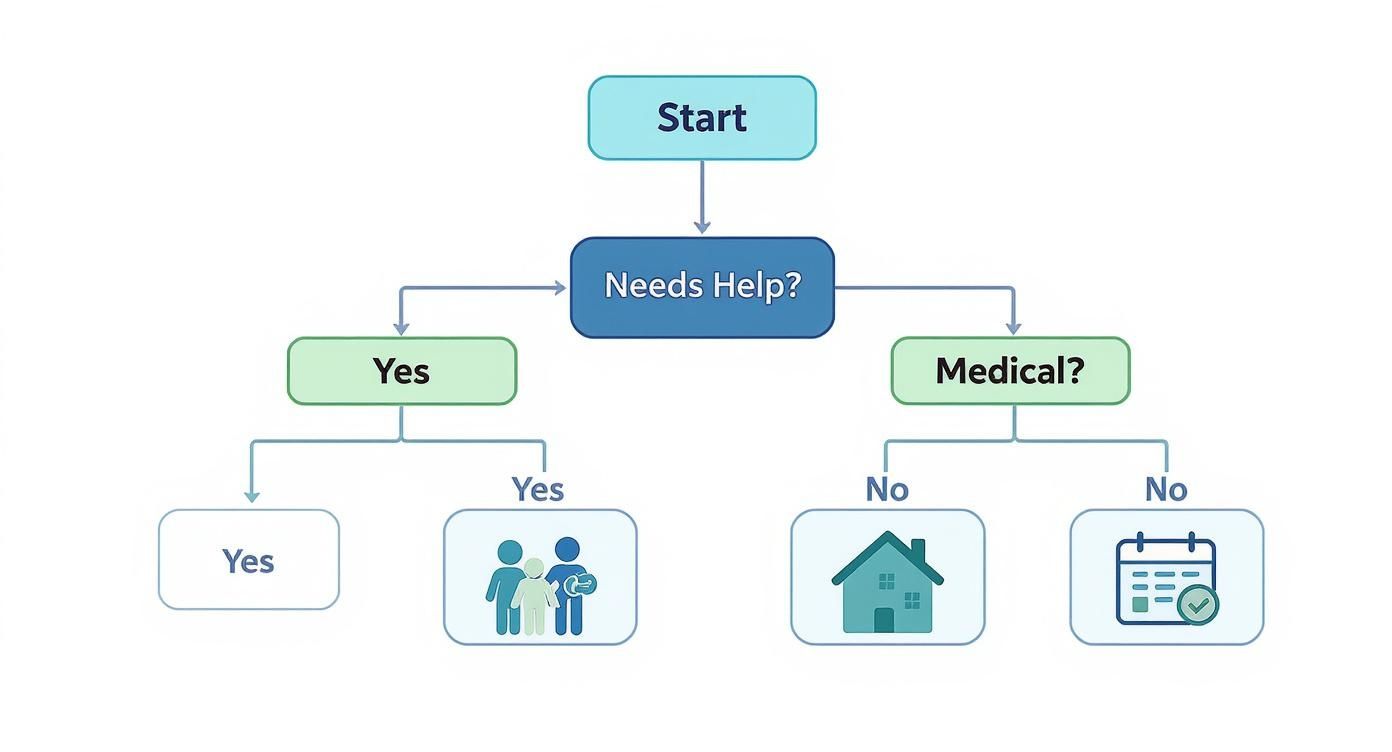
Alt text: Flowchart diagram showing a decision tree for senior housing. It starts with a question about daily help, branching to independent living for "no," and then to assisted living, memory care, or skilled nursing based on the type of help needed.
The decision tree separates social and convenience needs from the need for hands-on personal or medical care.
When Skilled Nursing Is Necessary
Skilled Nursing Facilities (SNFs), commonly called nursing homes, provide the highest level of care outside a hospital. This option is for individuals with complex medical conditions that require 24/7 monitoring by licensed nurses. This may include recovery from a major surgery, management of a severe chronic illness, or long-term care needs that cannot be met at home.
Unlike state-licensed assisted living, skilled nursing is a federally regulated medical environment. It is overseen by the Centers for Medicare & Medicaid Services (CMS) in addition to the state, requiring strict clinical standards. SNFs are equipped for services like wound care, IV therapy, and intensive rehabilitation.
Decoding The True Cost Of Senior Housing
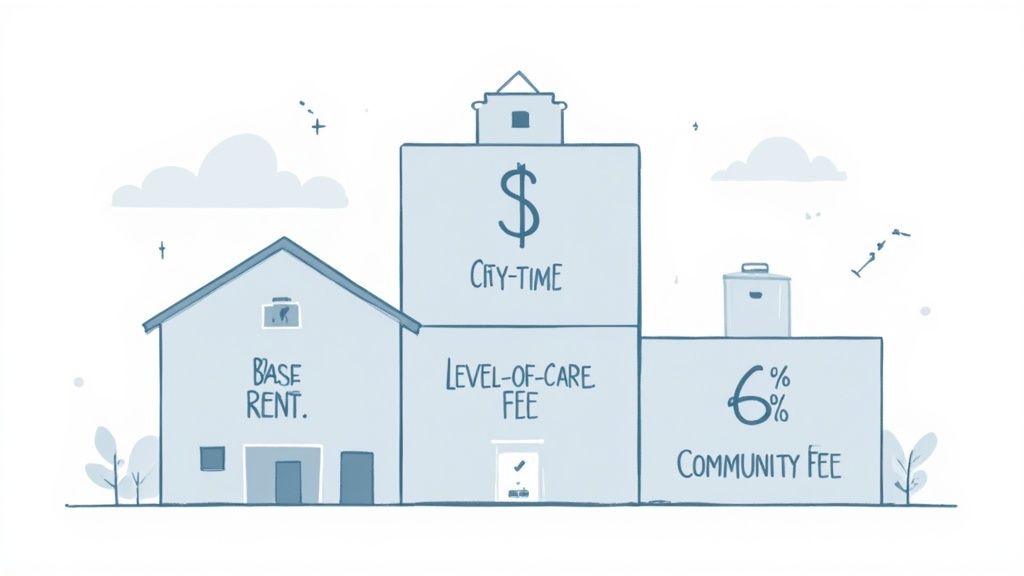
Alt text: Illustrated diagram of senior housing fees. It shows a base rent block, with smaller blocks added on top for one-time fees, level-of-care fees, and community fees, representing the total cost.
When you first ask about the price of senior housing in Cleveland, the number you hear is often just the starting point. The total cost is made up of several parts. Understanding this structure helps you avoid surprises and create a realistic budget.
The Three Main Cost Components
Most assisted living and memory care communities in Cuyahoga, Lake, and Lorain counties base their pricing on three elements. Knowing what to ask about each one will give you a clear financial picture.
-
Base Rent or Monthly Fee: This is the foundation. It covers the apartment, three meals a day, utilities, basic housekeeping, and access to all community activities and amenities.
-
Level-of-Care Fees: This is the most important variable. These are additional charges based on how much hands-on assistance a person needs. Before move-in, a nurse assesses the resident to determine this "level," which can change over time as needs evolve.
-
One-Time Fees: These are upfront, non-recurring costs. The most common is the community fee, a one-time, non-refundable charge for administrative setup and apartment preparation.
Remember to also budget for moving expenses. For some great tips for saving money during your move, this guide is a helpful resource.
What This Means for You: Always ask for a complete cost breakdown. Request a sample invoice and ask how and when the "level-of-care" is reassessed. This helps you understand both the immediate cost and how it might increase as care needs change.
For a deeper dive, check out our complete breakdown of Cleveland senior living costs.
How Ohio Families Pay For Senior Care
Figuring out how to pay for senior care is a major source of stress. The good news is, families in Ohio have several options beyond just personal savings. Each pathway has specific rules, but understanding them can help make high-quality senior housing in Cleveland more affordable.
<iframe width="100%" style="aspect-ratio: 16 / 9;" src="https://www.youtube.com/embed/PDYf0zzotK8" frameborder="0" allow="autoplay; encrypted-media" allowfullscreen></iframe>Private Pay and Personal Assets
The most common way to fund senior care is Private Pay, which means using personal funds. This is how most families begin.
These funds often come from a combination of sources:
-
Savings and Investments: Money from checking/savings accounts, stocks, bonds, or retirement funds (401(k), IRA).
-
Income: Monthly income from Social Security and pensions is often the foundation of the payment plan.
-
Sale of a Home: For many seniors, the equity in their home is the primary financial resource used to fund several years of care.
Long-Term Care Insurance
If your loved one purchased a Long-Term Care (LTC) Insurance policy, now is the time to review it. These policies are specifically designed to cover services like assisted living, which are not covered by standard health insurance or Medicare.
Key details to check in the policy:
-
Daily Benefit Amount: The maximum amount the policy will pay per day.
-
Elimination Period: A waiting period (often 30-90 days) before benefits begin.
-
Benefit Triggers: The conditions required to activate the policy, typically needing a doctor's certification that the person needs help with at least two Activities of Daily Living (ADLs).
VA Aid and Attendance Benefit
For qualified wartime veterans and their surviving spouses, the VA Aid and Attendance pension can provide significant financial help. This federal benefit is for veterans who need assistance with daily activities.
Eligibility is based on service history, income, and asset limits. According to the U.S. Department of Veterans Affairs, this benefit offers a substantial monthly payment that can be used to offset the cost of assisted living.
What This Means for You: If your loved one served during a designated wartime period (even without seeing combat), check their eligibility. The Cuyahoga County Veterans Service Commission offers free assistance with applications and is an excellent local resource.
Ohio's Medicaid Assisted Living Waiver
For seniors with limited income and assets, Ohio's Medicaid Assisted Living Waiver (AL Waiver) can be a lifeline. This state program helps pay for the care services portion of an assisted living bill in participating communities.
It's critical to know the AL Waiver does not cover room and board. The resident must pay for that portion, usually with their Social Security income.
Eligibility rules are strict, based on both financial and medical needs. As of March 2024, an individual must meet low-income and asset thresholds to qualify. To start learning about this option, we recommend our guide: Understanding the Ohio Medicaid Assisted Living Waiver.
Example: Cuyahoga County family using the AL Waiver
-
A resident of Cuyahoga County needs assisted living. Her income is $1,200/month from Social Security, and she has less than $2,000 in savings. A local assisted living community that accepts the AL Waiver costs $4,800/month for room, board, and her level of care.
-
Step 1: She works with the Western Reserve Area Agency on Aging (WRAAA) to apply for and is approved for the AL Waiver.
-
Step 2: The AL Waiver covers the cost of her care services (e.g., $2,500/month).
-
Step 3: She pays the remaining room and board portion ($2,300/month) using her Social Security and a small monthly contribution required by Medicaid.
-
The AL Waiver makes an otherwise unaffordable option possible, allowing her to receive care in a community setting instead of a nursing home.
How to Choose the Right Community: A Practical Checklist

Alt text: A clipboard with a checklist for evaluating senior housing. Next to it are a magnifying glass over an icon of a person (staffing) and a calendar (planning), symbolizing key areas to assess.
Turning your research into a confident decision requires an organized plan. Before you schedule a single tour, take time to define your loved one's needs. This clarity will help you filter out communities that aren’t the right fit and focus on those that are.
Your Must-Have Tour Checklist
A tour is your chance to observe, ask tough questions, and get a true feel for daily life in the community. Use this checklist to look beyond the marketing.
| Area to Assess | What to Look For & Ask |
| :--- | :--- |
| Atmosphere & Residents | Are residents active and engaged, or isolated in their rooms? Does the community feel vibrant and welcoming? |
| Staff Interactions | Do staff members seem calm and respectful when talking with residents? Do you see genuine warmth and patience? |
| Cleanliness & Safety | Do common areas look and smell clean? Are there handrails in hallways and grab bars in bathrooms? Ask about the emergency call system. |
| Staffing Levels | What is the staff-to-resident ratio during the day and overnight? How long have the director and head nurse been there? (High turnover can be a red flag). |
| Financial Clarity | Can we see a pricing sheet detailing all care fees? How often are care levels reassessed? What was the average annual rate increase over the last 3 years? |
| Dining Experience | Ask to see a weekly menu. If possible, stay for a meal. Does the food look appealing? Is the dining room a pleasant, social space? |
Dig Deeper: Check the Official Reports
In Ohio, every licensed assisted living community (Residential Care Facility) is regularly inspected by the Ohio Department of Health (ODH). These inspection reports ("surveys") are public records and provide an unbiased look at a community's performance.
You can find these reports on the ODH website. Focus on any "deficiencies" or citations. Look for patterns of serious or repeated issues, especially those related to resident safety, medication management, or staffing. A single minor issue may not be a deal-breaker, but recurring problems are a warning sign.
What This Means for You: Using official inspection reports alongside your own tour observations gives you a complete, balanced picture. This combination of objective data and your own intuition is the best way to make a choice you can feel good about.
What to do next
Navigating this process can be difficult, but you have clear, actionable steps you can take right now. Taking it one step at a time makes the journey manageable.
-
Contact a Local Aging Authority: Your first call should be to the Western Reserve Area Agency on Aging (WRAAA). Serving Cuyahoga, Geauga, Lake, Lorain, and Medina counties, they are the official, unbiased experts on local programs and eligibility requirements.
-
Book a Tour: Pick one or two promising communities and schedule a visit. Use the checklist from this guide to ask informed questions.
-
Read the Latest Inspection Report: Before your tour, look up the community's latest inspection survey on the Ohio Department of Health website. Ask the director about any citations you find.
-
Check AL Waiver Eligibility: If finances are a concern, contact the WRAAA to begin the financial and medical assessment for Ohio's Assisted Living Waiver program.
For Concerns or Advocacy:
-
Report a Concern: To report suspected abuse, neglect, or poor care in a facility, contact the Ohio Department of Health's complaint line.
-
Talk to the Ombudsman: The Long-Term Care Ombudsman Program advocates for residents. For free, confidential help in Greater Cleveland, call (216) 696-2719.
FAQ: Common Questions from Cleveland Families
What’s the real cost of senior living in Cleveland?
Costs vary widely based on the level of care. As of March 2024, typical monthly ranges in the Cleveland area are:
-
Independent Living: $2,500 - $4,500+
-
Assisted Living: $4,000 - $7,000+
-
Memory Care: $5,500 - $9,000+
-
Skilled Nursing: $8,500 - $12,000+
These figures are estimates. The final cost depends on the community, apartment size, and a resident's specific care needs (level-of-care fees).
Will Medicare cover assisted living?
No. This is a common misconception. Medicare is health insurance and does not pay for long-term custodial care, which includes room, board, and personal assistance in an assisted living setting. Medicare may cover short-term skilled nursing care after a qualifying hospital stay, but not long-term residency.
What is the difference between assisted living and a nursing home?
The main difference is the level of medical care.
-
Assisted Living (state-licensed Residential Care Facility): A residential setting for seniors who need help with daily activities but do not need 24/7 medical supervision.
-
Skilled Nursing (CMS-regulated): A clinical setting for individuals with complex medical conditions who require round-the-clock care from licensed nurses.
How can I check a community's safety record?
In Ohio, you can review public inspection reports on the Ohio Department of Health (ODH) website. These "surveys" detail any violations or deficiencies found during state inspections. Reviewing reports from the last 2-3 years can help you identify any patterns of concern. For skilled nursing facilities, you can also check federal ratings on the CMS Care Compare website.
Finding the right senior housing in Cleveland, Ohio, is a significant decision, but you don’t have to do it alone. The local advisors at Guide for Seniors know the communities here inside and out. We offer personalized, no-cost help to guide your family, compare your options, and find a place that feels right. Get personalized recommendations from a local Cleveland advisor today.
Need Help Finding Senior Living in Greater Cleveland?
Our Greater Cleveland local advisors compare pricing, schedule tours, and answer your questions — completely free.