Assisted Living vs Nursing Home: A Guide for Overwhelmed Cleveland Families
-
The Bottom Line: Assisted living is for daily support in a home-like setting. A nursing home is for 24/7 medical care in a clinical setting. The choice depends entirely on medical needs.
-
Who It's For: Assisted living is best for seniors who are mostly independent but need help with tasks like bathing, meals, or medication reminders.
-
When You Need a Nursing Home: A nursing home is necessary for individuals with complex, chronic health conditions who require round-the-clock skilled care from licensed nurses.
-
The Cost Difference: In Ohio, nursing homes can cost 80% more than assisted living. Medicare does NOT pay for long-term assisted living.
-
Your Next Step: Don't guess. The right choice requires matching specific care needs to the right state license. Speaking with a local advisor can save you weeks of stressful research.
Making The Right Senior Care Choice In Cleveland
For families across Greater Cleveland, from the East Side suburbs to the West Side neighborhoods, the senior care journey often begins with a mountain of glossy brochures and a whole lot of confusion. Sales tours highlight luxury amenities and restaurant-style dining, but the real question — how much medical care does your loved one actually need? — rarely gets a straight answer, and choosing the wrong level of care carries real health and financial consequences.
This isn't just about picking a new apartment near University Circle or Crocker Park. It's a major healthcare decision. The biggest hurdle families face is trying to match a loved one's specific needs to a system that isn't always transparent. A community can look perfect on a tour, but while their brochure highlights the chandeliers, you need to know about the weekend staffing ratios. This is where doing it alone becomes hard, and having a trusted insider to translate the marketing fluff into reality is critical.
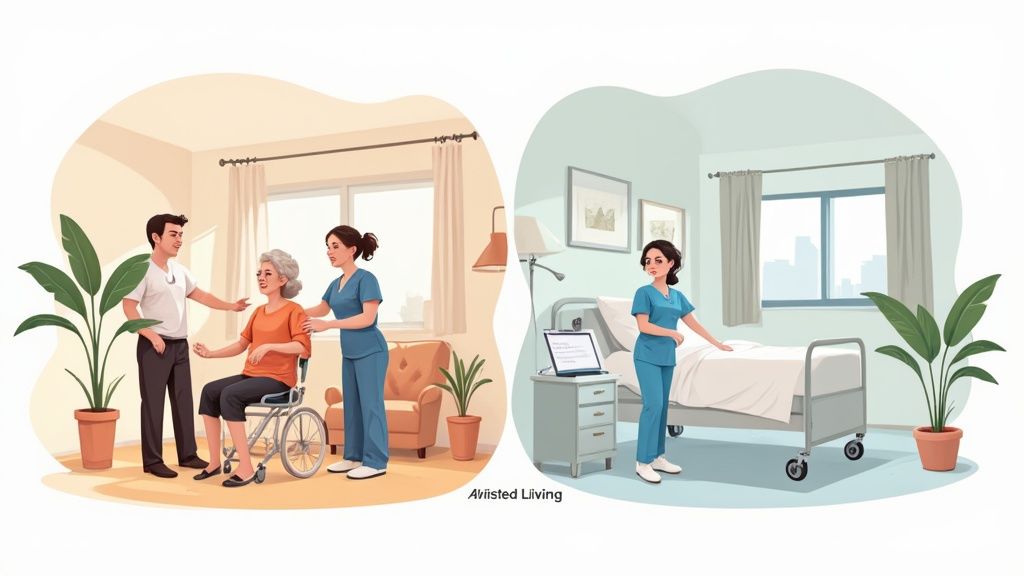
Insider Tip: A Common Cleveland Mistake
A family from Solon recently spent three weeks touring beautiful communities, only to realize their top choice didn't accept the Ohio Medicaid Assisted Living Waiver their mother relied on. A quick check with a local advisor would have saved them that time and heartache right from the start.
Core Differences At A Glance
Getting a handle on the fundamental distinctions is the first step toward making a confident decision. Here in Ohio, the official term for "Assisted Living" is a Residential Care Facility (RCF), and a "Nursing Home" is called a Skilled Nursing Facility (SNF). People often use the terms interchangeably, but from a licensing and care perspective, they are worlds apart. You can explore a more detailed breakdown in our guide to skilled nursing versus assisted living.
To cut through the noise, this table lays out the most important differences between these two main types of senior care in Ohio.
Assisted Living vs Nursing Home At a Glance
| Decision Factor | Assisted Living (Residential Care Facility) | Nursing Home (Skilled Nursing Facility) |
| :--- | :--- | :--- |
| Primary Purpose | Provides help with daily activities (bathing, meals, medication reminders) in a social, residential setting. | Provides 24/7 skilled medical care and supervision for complex health conditions. |
| Living Space | Typically a private or companion apartment with a kitchenette and private bathroom. | Often a shared or private room in a more clinical, hospital-like environment. |
| Medical Staff | Nursing staff are available but not required to be on-site 24/7. Focus is on personal care assistance. | Licensed nurses (RNs, LPNs) and therapists are on-site around the clock to provide medical treatment. |
| Best For Someone Who... | Is mostly independent but needs support, wants social engagement, and does not have acute medical needs. | Has chronic illness, requires post-surgery rehabilitation, or has cognitive decline needing constant medical oversight. |
| Typical Cleveland Cost | Primarily private pay; some accept the Ohio Medicaid AL Waiver or Long-Term Care Insurance. | Covered by Medicare for short-term rehab; Medicaid is a common long-term payer. |
Looking at this, you can see a clearer picture. Assisted living is built around independence with a layer of support, while a nursing home is structured entirely around providing complex, continuous medical care.
Understanding Ohio's Senior Care Terminology
The brochures are filled with confusing terms, making an already stressful decision feel even harder. In Ohio, the state uses very specific legal names for different types of care. Getting a handle on this language is the first step to cutting through the marketing fluff and comparing your options apples-to-apples.
Think of it this way: a community near Crocker Park might feel like a vibrant social club with private apartments, while another facility with proximity to "The Clinic" or "UH" has a more hospital-like atmosphere. They serve completely different needs but might both show up in a general "senior living" search. Knowing the official terms helps you filter your search immediately.
What Ohio Calls Assisted Living
What most people call Assisted Living is officially licensed by the Ohio Department of Health (ODH) as a Residential Care Facility (RCF). This is a crucial distinction. An RCF is designed for seniors who can no longer live safely on their own and need a hand with daily activities—things like bathing, getting dressed, and managing medications.
The key takeaway is that an RCF is a residential model, not a medical one. It’s built for support, not constant skilled nursing.
-
Environment: These communities are designed to feel like home, usually offering private or semi-private apartments.
-
Staffing: Aides are on hand to provide personal care, and while a nurse is available or on-call, they are not typically required to be on-site 24/7.
-
Goal: The focus is on helping residents stay as independent as possible in a safe, social setting.
This focus on independence is a national trend. Across the United States, assisted living facilities house around 1,016,400 residents. The average stay is just 22 months, which tells you it serves a more mobile, independent senior population. You can dig into more of these assisted living statistics on caring.com.
What Ohio Calls a Nursing Home
When you hear "nursing home," the legal term in Ohio is Skilled Nursing Facility (SNF). As the name implies, this environment is for individuals who need round-the-clock skilled medical care from licensed nurses and therapists. It’s not about lifestyle; it’s about managing complex health conditions.
An SNF is essentially a step down from a hospital. The environment is clinical because the primary focus is delivering constant medical treatment, rehabilitation therapy, and intensive personal care.
Someone typically moves to an SNF for a few key reasons:
-
They're recovering from a major surgery, a stroke, or a serious injury.
-
They need help managing a chronic illness like advanced Parkinson's or late-stage dementia.
-
They require wound care, IV therapy, or other treatments that must be administered by a licensed nurse.
Unlike the RCF model, an SNF is built entirely around medical necessity. The Ohio Department of Health holds these facilities to much stricter regulatory standards for staffing and medical care precisely because the residents are so medically fragile. A nursing home is the right choice when a loved one’s primary need is constant medical attention.
Analyzing Senior Care Costs In Greater Cleveland
Let's talk about the part of this process that causes the most stress: the money. When you start looking at senior care pricing, it’s not as simple as comparing two numbers. Forget those generic national averages you see online. The cost of living in Cuyahoga County is different from Geauga or Summit County. Our focus here is on the real numbers you'll see in Northeast Ohio.
Breaking Down The Monthly Bill
One of the first mistakes families make is getting fixated on the advertised "base rent." That number is just the starting point. The true monthly cost is almost always split into two distinct parts:
-
Base Rent: This covers the apartment or room, plus meals, housekeeping, laundry, and access to community amenities.
-
Level of Care Fees: This is a separate charge based on how much hands-on help a resident actually needs. As needs increase, this fee can go up.
Insider Tip: Most communities charge a one-time "Community Fee" when you move in, which can be anywhere from $1,500 to $5,000. This is often negotiable, especially if a community has open apartments. Ask your advisor how to approach this conversation.
Typical Cleveland-Area Costs and Payment Sources
Understanding who pays for what is just as important as knowing the price. Private savings, long-term care insurance, and government programs all come into play, but they apply very differently to assisted living versus a nursing home.
Here’s a look at the estimated costs you can expect to find in the Greater Cleveland area, based on local data.
Estimated Monthly Senior Care Costs in Greater Cleveland
A breakdown of typical cost ranges in Cuyahoga, Lake, Lorain, Medina, Geauga, and Summit counties. Data is locally sourced.
| Care Option | Typical Base Rent + Care Fees Range (Monthly) | Common Payment Sources |
| :--- | :--- | :--- |
| Assisted Living | $4,500 - $7,000+ | Private Pay, Long-Term Care Insurance, VA Benefits, Ohio Medicaid AL Waiver (for care costs, not rent) |
| Nursing Home | $9,000 - $12,000+ | Medicare (for short-term rehab only), Medicaid (for long-term care), Private Pay, LTC Insurance |
| Updated: October 2023. These are estimates; actual prices vary. | | |
As you can see, the difference is stark. Recent data shows that, on average, nursing home care can cost a staggering 80% more than assisted living. This huge financial gap is a primary driver behind the growth of the assisted living market, as families look for a way to balance getting the right support without draining their life savings. You can read more about the global assisted living market trends on PrecedenceResearch.com.
Navigating Payment Options In Ohio
Figuring out how you're going to pay is often the most confusing part of the entire journey. For a much deeper dive into financing, take a look at our comprehensive guide on the cost of senior living. In the meantime, here’s a quick rundown of the main payment sources in Ohio:
-
Private Pay: Using personal savings, pensions, or the sale of a home. This is the most common way families pay for assisted living.
-
Long-Term Care Insurance: Policies bought to cover long-term care. It's crucial to read your policy to understand the daily benefit and any "elimination period."
-
Medicare: This is a huge point of confusion. In Ohio, Medicare does NOT pay for long-term assisted living. It may cover up to 100 days of skilled nursing care for rehabilitation in a nursing home after a qualifying hospital stay.
-
Ohio Medicaid Assisted Living (AL) Waiver: For eligible, low-income seniors in Ohio, this program can help pay for the care services portion of the bill in an assisted living community. It does not cover room and board. Not all communities accept the waiver, and those that do have a limited number of spots.
-
VA Aid & Attendance: A fantastic benefit for qualifying veterans and their spouses that provides an additional monthly pension to help offset care costs.
Don't waste your time guessing which communities fit your budget.
Pricing and availability change daily. Click here to get a current Rate Sheet for communities in your target neighborhood.
Matching Your Loved One to the Right Care Level
Every community brochure paints a perfect picture. But the real challenge is matching the precise level of care your loved one needs right now—and what they might need down the road. Getting this wrong is the most common and stressful mistake Cleveland-area families make. The goal isn't just to find a nice place; it's to find the right place with the proper license and staff.
Who Is a Good Fit for Assisted Living?
The ideal assisted living resident is someone who's still mostly independent but could use a safety net. They're often tired of the daily grind of homeownership and worry about being alone.
This person is a great candidate if they:
-
Need help with daily tasks: Reminders to take medication, a steady hand while getting dressed, or assistance with bathing.
-
Crave a social environment: They feel isolated at home and would thrive with planned activities and communal dining.
-
Don't have complex medical needs: Their health is generally stable. They aren't dealing with daily injections or conditions that require the constant eye of a registered nurse.
At its core, assisted living is for help with Activities of Daily Living (ADLs) in a social, residential setting. The focus is on quality of life, not intensive medical treatment.
Who Belongs in a Nursing Home?
A nursing home, or Skilled Nursing Facility (SNF), is a medical setting. The move here is almost always driven by a major health event or a chronic condition that requires round-the-clock clinical care.
A person typically needs a nursing home when they:
-
Require 24/7 skilled nursing care: This includes people who need IV therapy, complex wound management, feeding tubes, or support for conditions like advanced ALS.
-
Are recovering from a hospital stay: They might need intensive physical, occupational, or speech therapy after a surgery, stroke, or serious injury.
-
Have advanced cognitive decline with medical complications: While many assisted living communities have wonderful memory care, a person with late-stage dementia who also has complex medical issues often needs the higher level of care in a skilled nursing facility.
The real differentiator is medical necessity. If your loved one's primary needs are clinical and require a licensed nurse to be available at all hours, a nursing home is the only appropriate choice.
This decision tree infographic can help you visualize how your loved one's needs, payment sources, and care options connect.
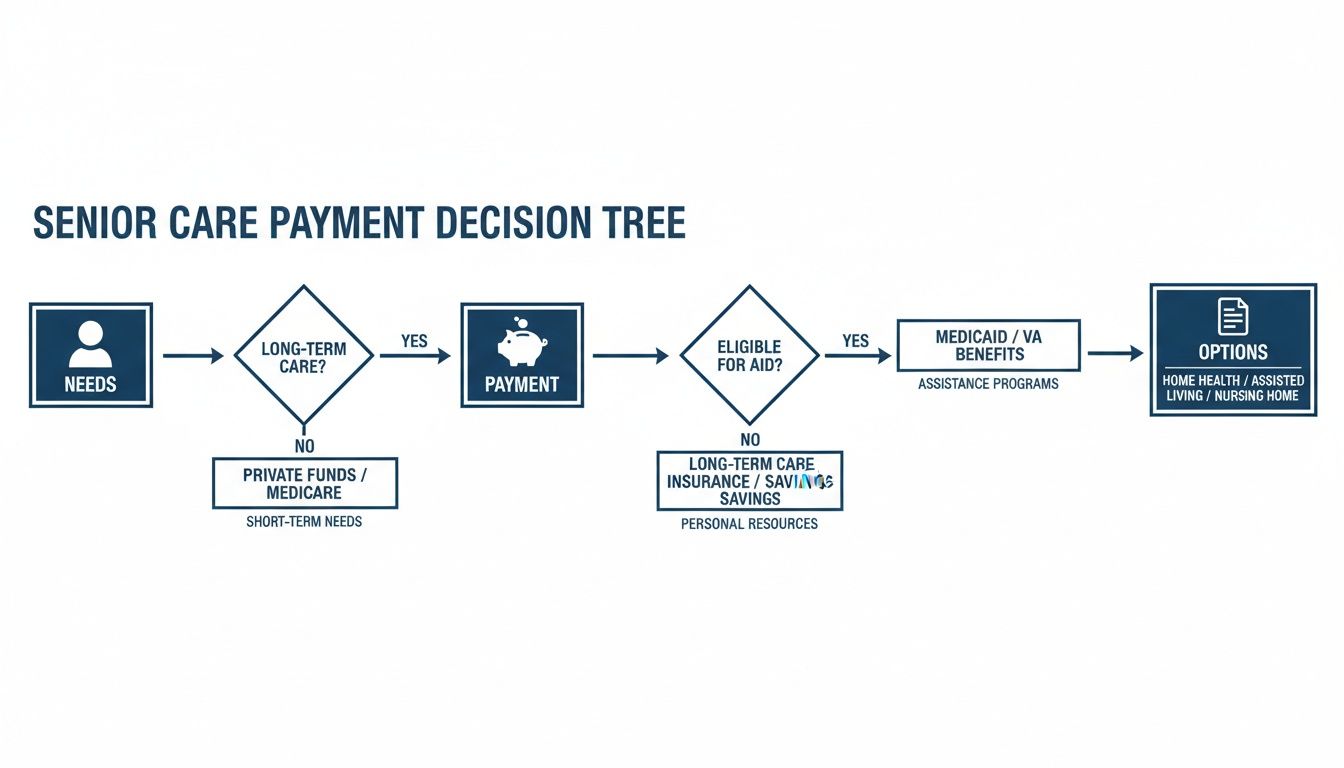
As the chart shows, the journey starts with an honest assessment of daily and medical needs. That assessment then points you toward the viable payment methods and, ultimately, the right type of community.
Questions To Ask About Your Loved One's Needs
It’s tough to be objective when you're so close to the situation. Run through this checklist to get a clearer picture of where your family member’s needs really fall.
-
Medical Tasks: Do they need daily help from a licensed nurse (e.g., injections, wound care)? (Yes = Nursing Home, No = Assisted Living likely a fit)
-
Mobility: Can they get around on their own, even with a walker? (Yes = Assisted Living possible, No/Bed-bound = Nursing Home)
-
Daily Help: What specific tasks do they need a hand with (bathing, dressing, meds)? (Just a few = Assisted Living, Help with almost everything = Points toward a Nursing Home)
-
Cognitive State: Is the main challenge memory loss, or are there significant medical problems too? (Memory loss but healthy = Memory Care Assisted Living, Memory loss + complex health issues = Skilled Nursing Facility)
Answering these questions honestly moves the conversation from "what looks nice" to "what is truly necessary and safe."
Don't guess on the level of care. Speak to a Cleveland-based Senior Advisor for free to narrow your list to communities that match your specific needs.
What to Look For When Touring Senior Communities
A tour is your chance to look past the marketing photos and see what daily life is actually like. But it's easy to get distracted by the beautiful chandeliers. You have to go in with a plan to uncover what truly matters. Think of yourself as a detective for an hour.

Go Beyond the Basic Questions
Anyone can ask about the activities calendar. A prepared family asks the questions the facility hopes you'll forget.
-
Instead of asking: "What's your staffing ratio?"
-
Ask this: "What are your specific caregiver-to-resident ratios on the weekends and the overnight shift? How many licensed nurses are physically in the building at 2 AM on a Saturday?"
-
Instead of asking: "Do you have activities?"
-
Ask this: "Could I see next month's activity calendar? What percentage of residents typically participate?"
Insider Tip: One of the most telling clues is the smell of the community. A clean, fresh smell is a great sign. Persistent odors, especially those masked by heavy air fresheners, can be a red flag for issues with incontinence care or housekeeping.
How to Read Between the Lines
What you observe is just as important as what you ask. As you walk through the building, keep your eyes and ears open for unscripted moments.
Key Observations to Make:
-
Staff-Resident Interactions: How do caregivers talk to residents? Do they make eye contact and call people by name? Or do they seem rushed and avoid interaction?
-
Resident Engagement: Look at the residents who aren't on your tour. Do they look engaged? Or are most sitting alone in their rooms or staring at a TV?
-
The Call Light Test: Ask how long it takes to answer a call light. In Ohio, facilities must respond in a timely manner. While you're there, listen. Are call bells constantly going off?
Verifying a Community’s Record
Every licensed facility in Ohio is regularly inspected by the Ohio Department of Health (ODH). These inspection reports, or "surveys," are public record but can be hard to find and interpret. A single citation isn't always a dealbreaker; what matters is the severity and whether it's a recurring problem. This is where an advisor is invaluable. We not only have access to these reports but can translate the jargon into plain English.
For a more detailed guide, check out our comprehensive senior living tour checklist. Don't let a beautiful lobby blind you to potential problems.
How A Local Advisor Can Simplify Your Search
<iframe width="100%" style="aspect-ratio: 16 / 9;" src="https://www.youtube.com/embed/J1aCnZjjsok" frameborder="0" allow="autoplay; encrypted-media" allowfullscreen></iframe>This guide lays out the complex world of senior care in Northeast Ohio. But turning information into the right decision is the toughest step. The number of communities across Cuyahoga, Lake, Lorain, and surrounding counties can feel overwhelming. A free consultation with a local Cleveland Senior Advisor at GuideForSeniors.com is your direct path through the noise.
Get Insider Knowledge and Verified Data
Brochures are marketing tools. They don't give you the full story. An advisor is your neutral third party, translating marketing promises into practical reality.
-
Current Openings: Availability varies by floor plan. We know which communities in Medina or Geauga have immediate availability. Contact our team to verify current openings.
-
Waiver Acceptance: We keep updated lists of communities that accept the Ohio Medicaid Assisted Living (AL) Waiver and know which ones have spots open right now.
-
State Survey Histories: Our team digs into the Ohio Department of Health (ODH) inspection reports. We explain a facility’s track record in plain English, so you don’t have to decipher complicated regulatory documents.
We recently helped a family in Lakewood who had spent a month calling communities to find an assisted living that would accept their father's VA benefits and had a first-floor apartment. Our advisor found them three qualified options in a single afternoon.
Save Time and Avoid Costly Mistakes
Your time and energy are limited. Trying to juggle tours and compare pricing on your own feels like a full-time job. Our advisors streamline the entire process, and our help is completely free for families. Instead of spending weeks on the phone, we give you current, verified data. Let us help you narrow down the options with real confidence.
Don't guess. Speak to a Cleveland-based Senior Advisor for free to narrow your list and get verified pricing.
Frequently Asked Questions About Senior Care In Ohio
As families dig into the differences between assisted living and nursing homes, a lot of the same questions pop up. Here are some straight, clear answers.
Can Someone Transition From Assisted Living To A Nursing Home In The Same Community?
Absolutely, but only in specific "continuum of care" or Life Plan communities. You'll find campuses like this in suburbs like Westlake or Solon where they have independent living, assisted living, and skilled nursing all on one property. This setup is designed so a resident can "age in place." As their needs change, they can move to the next level of care without leaving familiar surroundings. However, most communities do not offer this full continuum. If long-term stability is important, you must verify this from the start.
How Does The Ohio Assisted Living Waiver Program Work?
This is a big one. The Medicaid Assisted Living Waiver (AL Waiver) is an Ohio program that helps Medicaid-eligible seniors pay for care services in an assisted living community. The waiver helps cover the cost of care—like help with bathing and medication reminders.
It does not pay for room and board. The resident is still responsible for the monthly rent.
To qualify, a person has to meet both medical and strict financial limits set by the state of Ohio. Finding a community that accepts the AL Waiver and has an open spot can be a real challenge. A local advisor always has the most current lists.
What Is The Biggest Mistake Families Make When Choosing Care?
By far, the most common mistake is taking the brochure at face value without asking tougher questions about total cost and state oversight. Families see an advertised base rent and are blindsided by "level of care" fees that can add thousands to the monthly bill. A close second is not checking a community's state survey history with the Ohio Department of Health (ODH). A facility can look beautiful but have underlying problems with staffing or care quality. A local expert knows how to find and make sense of these reports, giving you a look behind the curtain.
Navigating state waivers, survey histories, and hidden costs is where having an insider on your side makes all the difference. The team at Guide for Seniors offers this local expertise completely free of charge.
Disclaimer: This article is informational, not legal or medical advice.
Don't guess. Speak to a Cleveland-based Senior Advisor for free to narrow your list and get verified pricing.
Need Help Finding Senior Living in Greater Cleveland?
Our Greater Cleveland local advisors compare pricing, schedule tours, and answer your questions — completely free.