How to Protect Your Assets from Nursing Home Costs in Ohio
-
Your Goal: The main goal is to legally protect savings and the family home from being spent down on long-term care, primarily by becoming eligible for Ohio Medicaid.
-
The Big Hurdle: Ohio Medicaid has a strict "five-year look-back period." This means any gifts or transfers of assets made within five years of applying can lead to a penalty, forcing you to pay for care out-of-pocket.
-
Key Tools: Proactive planning often involves setting up an Irrevocable Trust well in advance. For last-minute or "crisis" situations, tools like a Medicaid Compliant Annuity or spousal protections can be used.
-
Your Next Step: The rules are complex and vary by county. Don't go it alone. The safest move is to consult with a Cleveland-area senior advisor to understand your options and connect with a qualified elder law attorney.
Your Guide To Protecting Your Family's Nest Egg in Cleveland

This guide is for families across Greater Cleveland—from Lakewood to Mentor, Medina to Chagrin Falls—who are staring at a stack of senior living brochures and feeling completely overwhelmed. You're not just researching; you're terrified of making a catastrophic mistake that could wipe out a lifetime of savings.
The problem is that the glossy marketing materials never tell the whole story. While they highlight the chandeliers and fine dining, they're silent on the staggering costs and complex payment rules. Doing this alone is hard because you're up against a system designed to be confusing.
Our goal is to be your trusted insider, translating the marketing fluff into reality and guiding you toward a clear, actionable plan. We're not here to just give you information; we're here to connect you with a solution.
You Have Options, But Timing Is Everything
The single most important lesson we’ve learned from helping families across Northeast Ohio is this: you have options, but they are almost all tied to timing. When you apply for long-term care benefits in Ohio, Medicaid scrutinizes your financial history for the past five years. Any significant gifts or transfers made during that "look-back" window can trigger a penalty period, forcing you to pay for care out of your own pocket until that penalty is served.
This is why planning ahead is absolutely critical.
The Cost of Inaction: A Solon Family's Story
A family in Solon spent three weeks touring assisted living communities for their mom, finally falling in love with a beautiful facility near their home. They put down a deposit, only to find out later that it wasn't certified for the Ohio Medicaid Assisted Living Waiver, which their mom would eventually need. A quick check with a local advisor would have saved them that time, money, and heartache.
Here’s a quick look at the main strategies families in Cuyahoga, Lake, Lorain, and surrounding counties can explore.
Key Strategies For Ohio Asset Protection At A Glance
| Strategy | What It Means For Your Family | Best Time to Act |
| :--- | :--- | :--- |
| Irrevocable Trusts | You place assets into a trust that you no longer control directly. This moves them out of your name, protecting them from being counted for Medicaid eligibility after the 5-year look-back period. | At least 5+ years before needing care. This is the cornerstone of proactive planning. |
| Medicaid Compliant Annuities | This involves converting a lump sum of countable assets into a steady, predictable income stream. It’s a crisis-planning tool often used when someone needs care immediately and is over the asset limit. | When care is needed now or in the very near future (within the 5-year look-back). |
| Spousal Protections | In Ohio, the law allows the healthy spouse (the "community spouse") to keep a certain amount of assets and income to avoid becoming impoverished while their partner receives Medicaid-funded care. | During the Medicaid application process. |
| Exempt Asset Planning | Some assets, like your primary home (up to a certain equity limit) and one vehicle, are not counted by Medicaid. Planning can involve paying down a mortgage or making home improvements. | Both for proactive and crisis planning. It helps to know what’s protected. |
Understanding these options is the first step toward taking control. Before we dive deeper, know this: The rules are complex and can be applied differently depending on your county. A small mistake in a Cuyahoga County application could cost your family tens of thousands of dollars. The goal here is to shift your mindset from worry to empowerment. You’ve worked your entire life to build a nest egg; now, let's explore the proven strategies to keep it safe.
The Shocking Cost of Nursing Home Care in Ohio—and Why You Need a Plan Now
It's easy to think about future healthcare costs as a distant, abstract problem. But when you see the actual price tags for long-term care here in Northeast Ohio, that abstract worry becomes very real, very quickly. Hoping for the best simply isn't a strategy. Knowing these numbers is often the wake-up call that motivates families to finally put a solid plan in place.
The High Price of Waiting: A Story from Parma
Let me tell you about a couple from Parma. He was a retired union worker, she was a former school secretary, and they had done everything right—saved diligently, paid off their home, and built a nest egg of about $350,000. They thought they were set.
Then, a severe stroke changed everything. He needed round-the-clock skilled nursing care. The family was floored when they found out their chosen facility cost nearly $11,000 per month. In less than two years, their life savings were practically gone. His wife was left terrified, facing the possibility of losing their home with nothing left to live on. This isn't a rare cautionary tale—it's the harsh reality for families who react in a crisis instead of planning ahead.
A Look at the Real Numbers in Northeast Ohio
(Updated: October 2023)
The glossy brochures show beautiful dining rooms, but they rarely put the monthly bill in giant print. These costs are staggering, and they aren't covered by Medicare or standard health insurance.
In Ohio, the median monthly cost for a semi-private room in a nursing home is $7,908, with a private room jumping to $9,125 [source: Genworth Cost of Care Survey]. Here in Greater Cleveland, those numbers are often the starting point. Costs can swing quite a bit depending on location—from a suburb near Crocker Park on the West Side to one closer to University Circle on the East Side—and the exact level of care someone needs.
Insider Tip: The "Base Rent" is just the beginning. Always ask for a full breakdown of "Level of Care" fees. While brochures highlight the chandeliers, you need to ask about weekend staffing ratios and extra charges for medication management or help with bathing. These can add thousands to the monthly bill.
Why You Absolutely Cannot Afford to Wait
Every day you put off planning is a day you lose valuable options. The most powerful strategies for protecting assets from nursing home costs, like setting up certain types of trusts, are directly tied to Ohio's five-year Medicaid look-back period. Taking action before a health crisis strikes is what keeps you in the driver's seat.
Waiting until a hospital discharge planner from The Clinic or UH hands you a list of facilities is the single most expensive mistake you can make. It throws you into a reactive "spend-down" crisis, forcing you to burn through assets just to qualify for help. This is about more than money. A proactive plan preserves dignity and ensures a spouse remaining at home isn't left financially vulnerable.
To see how different care levels stack up, take a look at our guide on assisted living vs. nursing home costs in Cleveland. The financial pressure is immense, but a smart plan is your family's best defense.
Understanding Ohio Medicaid and The Five-Year Look-Back Period
If there’s one rule that catches more Northeast Ohio families by surprise, it’s this one. When you apply for Medicaid to cover long-term care, the state doesn’t just glance at your current bank balance. They dig deep. In Ohio, Medicaid officials will demand five years of financial records, poring over every significant transaction. This is the infamous “five-year look-back period,” and its purpose is to stop people from giving away all their money right before asking for help.
Even a generous gift, made with the best intentions, can cause a world of trouble.
Imagine a grandfather in Lakewood giving his granddaughter $20,000 for college. A wonderful gesture. But two years later, he has a stroke and needs nursing home care. When the family applies for Medicaid, that $20,000 gift becomes a massive problem. Medicaid flags it as an “improper transfer,” which triggers a penalty period, forcing the family to pay for his care out-of-pocket until that penalty is over.
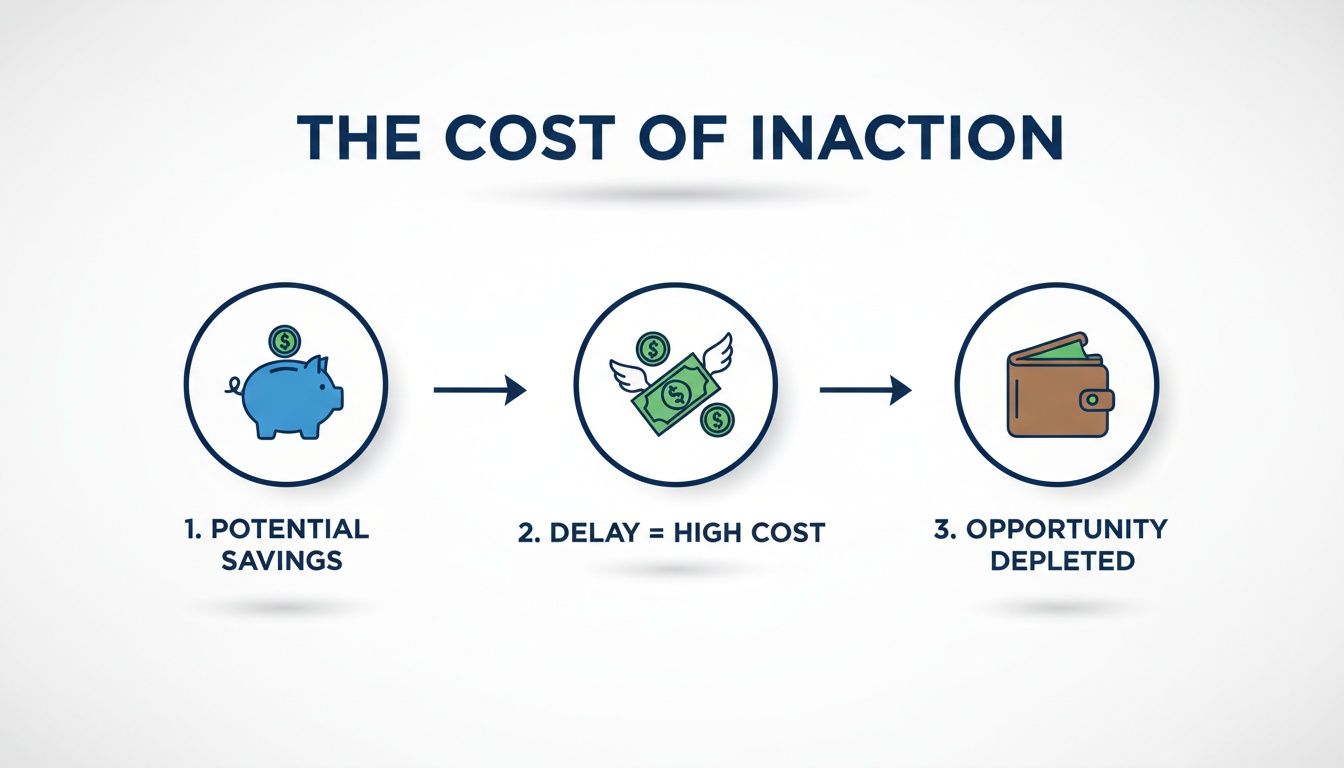
This is the financial reality for so many families who wait too long. A healthy nest egg gets eaten away by the relentless cost of care, leaving them under immense financial and emotional strain.
How The Penalty Period Is Calculated
The penalty isn’t a small fine; it's a cold calculation. In Ohio, the state takes the total value of any improper transfers and divides it by a figure known as the "average private patient rate" for nursing facility care. As of early 2024, that number is $7,992 per month [source: Ohio Administrative Code 5160:1-6-05.1].
Let’s go back to our Lakewood grandfather who gifted $20,000:
- $20,000 (the gift) ÷ $7,992 (the state’s monthly rate) = 2.5 months
This means Medicaid will refuse to pay for his care for 2.5 months. The cruelest part? This penalty period doesn't start until after he’s already spent down his remaining assets and would otherwise be eligible. For those months, the family is on the hook for the full nursing home bill.
Common Mistakes That Trigger The Look-Back Penalty
These aren't cases of fraud; they usually come from a simple desire to help loved ones. Here are the most frequent missteps we see families make in Cuyahoga, Medina, and surrounding counties:
-
Selling the House for $1: A parent "sells" their home in Strongsville to their child for a token amount. Medicaid considers the difference between that dollar and the home's fair market value a gift.
-
Adding a Child's Name to the Bank Account: Putting a son or daughter on your checking account as a joint owner seems smart. Unfortunately, Medicaid often views this as a gift of half the account's value.
-
Paying for a Grandchild's College: Directly paying tuition or giving large cash gifts to family members is a classic penalty trigger.
-
"Loaning" Money with No Paperwork: If you give a relative money without a formal, legally sound promissory note, Medicaid will almost always treat it as a gift.
Insider Tip: Never assume a financial transaction is "off the record." Medicaid caseworkers are trained to find these. They will request five years of bank statements and property records and will question any large, undocumented withdrawal.
The critical takeaway is that any plan to protect your assets must respect this five-year timeline. To get a clearer picture of the different programs, you can learn more about the differences between Medicare and Medicaid for long-term care in our Ohio guide.
The rules are incredibly complex. This is why getting advice from an elder law attorney who lives and breathes Ohio's specific regulations isn't a luxury—it's a necessity.
What You Can Keep: A Guide to Countable vs. Exempt Assets in Ohio
When families in Northeast Ohio first hear about the five-year look-back, panic sets in. The immediate thought is, "Do we have to give up everything?"
The answer is no. The state of Ohio doesn't expect your loved one to be left with nothing.
The whole game is understanding how Ohio Medicaid sorts your assets into two buckets: countable and exempt. Getting a clear picture of what goes into each bucket is the first step in building a smart plan. This isn’t about hiding money; it’s about legally structuring what you own according to Ohio's rules.
The Two Buckets: Countable vs. Exempt
Exempt assets are the things your loved one can keep without hurting their chances of qualifying for Medicaid.
Countable assets are everything else—the resources Medicaid will scrutinize. As of 2024, an individual applying for long-term care Medicaid in Ohio can have no more than $2,000 in countable assets. That number causes a lot of stress, but once you see what's exempt, it becomes far less intimidating.
Ohio Medicaid Asset Checklist: What to Ask About
To make this tangible, use this list to start an inventory of your family's assets. Ask yourself where each item falls.
-
Checking & Savings Accounts: Are these below the $2,000 limit? (Almost always countable)
-
Stocks, Bonds & Mutual Funds: What is the total market value? (Countable)
-
Primary Home: Is the equity value under $713,000 (for 2024)? (Usually exempt)
-
One Vehicle: Does the family own one primary car? (Usually exempt, regardless of value)
-
Vacation Home/Second Property: Do we own a cottage on Lake Erie or a condo in Florida? (Almost always countable)
-
Personal Belongings: Furniture, jewelry, household goods. (Exempt)
-
Prepaid Funeral Plan: Do we have an irrevocable funeral contract? (A common, and smart, way to spend down assets)
-
Life Insurance: Is the total face value of all policies over $1,500? (If so, the cash surrender value becomes countable)
This checklist is your starting point. The real power comes from using this information to make strategic moves before you need care.
The Most Important Protection: The Community Spouse
Perhaps the biggest fear we hear is what happens to the spouse who remains at home. If one person needs care in a facility near University Hospitals, but their partner still lives in their home in Euclid, does the healthy spouse lose everything?
The answer is a firm no.
In Ohio, a vital protection called the Community Spouse Resource Allowance (CSRA) prevents the "community spouse" from becoming impoverished. As of 2024, the community spouse can keep up to $154,140 of the couple's joint assets. This is in addition to the $2,000 the institutionalized spouse can keep, plus exempt assets like the house and a car.
A Real-World Scenario: We worked with a couple in Medina who had $200,000 in savings, plus their home and car. When the husband needed nursing care, they thought they'd have to spend it all down to $2,000. We showed them that under the CSRA, the wife could keep $154,140, their home, and their car. They only needed a strategy for the remaining countable assets, which was far more manageable and much less terrifying.
Knowing what you can keep is half the battle. Instead of watching savings disappear, you can start making informed choices. The next step is learning about the tools—like trusts and annuities—that can legally protect those remaining assets.
Using Trusts, Annuities, and Insurance to Protect Your Assets
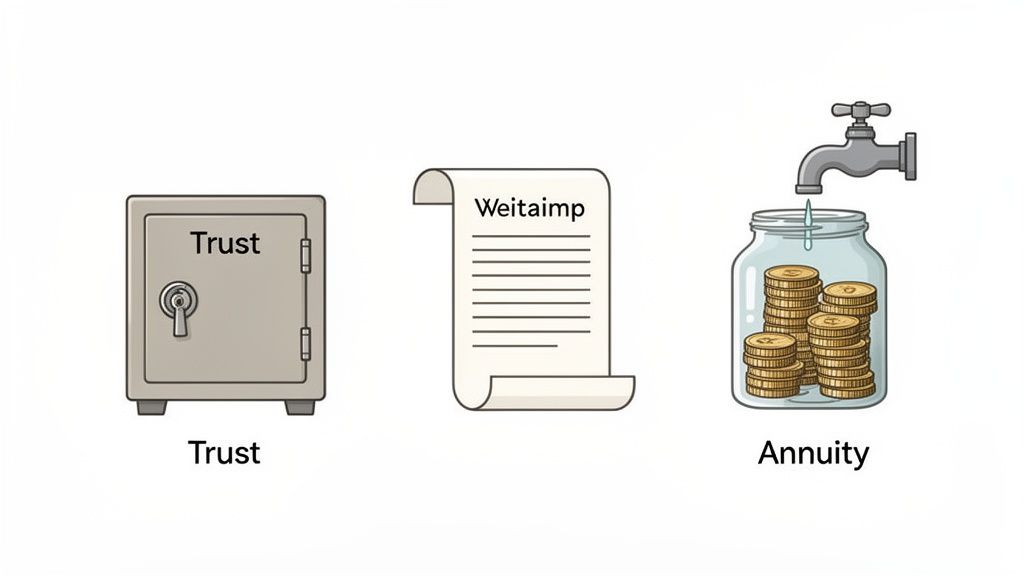
You understand the look-back and what assets are counted. Now, let’s talk about the practical tools used to navigate the system. These are well-established strategies designed to give your family more control over your life savings.
Think of this as a blueprint. But remember, a blueprint is useless without a skilled builder. Each of these tools requires the expertise of an experienced Ohio elder law attorney to be constructed correctly.
The Irrevocable Trust: Your Asset Safe Deposit Box
For families planning well in advance, the most powerful tool is the Irrevocable Trust. It’s a secure "safe deposit box" for your most valuable assets. You place things like your home or investments into this trust, and a person you appoint (the trustee) manages them according to your rules.
The key word is irrevocable. Once assets are in the trust, you no longer own or control them directly. That’s a big step, but it’s what gives it its protective power. Because the assets are no longer legally yours, Medicaid generally can't count them against you. The catch? You must respect the five-year look-back period. The trust must be created and funded at least five years and one day before you apply for Medicaid. This is not a last-minute fix.
A Real-World Scenario
A couple in Shaker Heights, on their attorney's advice, placed their paid-off home and a $200,000 investment portfolio into an Irrevocable Trust while in their late 60s. Seven years later, when the husband needed memory care, those assets were completely protected. They weren't counted for Medicaid eligibility, preserving a significant inheritance and ensuring the wife had the financial security to stay in her home.
Medicaid Compliant Annuities: The Crisis Planning Tool
What if you’re already in a crisis, inside that five-year window? This is where a Medicaid Compliant Annuity (MCA) can be a game-changer. This is a highly specific financial product used for immediate, crisis-level Medicaid planning.
An MCA converts a large, countable asset (like cash) into a predictable, non-countable stream of income. It's most often used to protect assets for the healthy spouse. The annuity is structured to pay out over the person’s life expectancy, and—this is critical—the state of Ohio must be named as the remainder beneficiary. This complex maneuver transforms a disqualifying pile of cash into an allowable income stream, helping someone become eligible for Medicaid much sooner. This is absolutely not a DIY strategy.
Long-Term Care Insurance: The Proactive Shield
Another crucial piece of the puzzle is Long-Term Care (LTC) Insurance. While not a direct Medicaid planning tool, it's one of the best asset protection strategies because it can help you avoid needing Medicaid in the first place. This private insurance policy covers care costs, allowing you to pay for a facility without spending down your savings. The best time to look into this is typically in your 50s or early 60s. For Cleveland-area families, a solid LTC policy provides the ultimate freedom to choose any facility you want, from one near the Cleveland Clinic to one closer to family on the West Side.
Finding the Right People for Your Plan
Reading about these tools is one thing; putting them into practice correctly is something else entirely.
-
Elder Law Attorney: Your architect. They specialize in Ohio Medicaid rules and will design your legal strategy.
-
Guide for Seniors Advisor: Your "concierge." We connect you with trusted local elder law attorneys and help you see how these legal strategies align with the real-world costs and availability of care here in Northeast Ohio.
Don't try to build this structure on your own. Your family's financial security is too important.
Pricing and availability change daily. Click here to get a current Rate Sheet for Cleveland-area communities and start your plan with real numbers.
What's Next? Let's Talk to a Cleveland Advisor
<iframe width="100%" style="aspect-ratio: 16 / 9;" src="https://www.youtube.com/embed/NATVmDnKvaU" frameborder="0" allow="autoplay; encrypted-media" allowfullscreen></iframe>Trying to figure out Ohio's Medicaid rules and protect a lifetime of savings is not a DIY project. The regulations are a maze, and going it alone is one of the biggest risks you can take.
This is the point where you shift from researching to taking smart, decisive action. Instead of trying to become an elder law expert overnight, talk to a professional who lives and breathes this stuff every day right here in Northeast Ohio.
The Real-World Cost of a Small Mistake
I've seen it happen. A family from Shaker Heights tried to manage the Medicaid application on their own. A single forgotten document caused a three-month delay in getting their mother's coverage approved. That delay cost them over $25,000 out-of-pocket to pay the nursing home. An advisor would have spotted that missing paper in a heartbeat.
You can get a better sense of the bigger picture by reading about how to plan for long-term care, which drives home why having a solid strategy is so important.
The system is complicated for a reason. Don't leave your family's financial future to guesswork.
How to Find Clarity and Peace of Mind
Our local Senior Advisors are your personal guides. We're here to cut through the jargon and lay out a clear path for your family. We’ll help you understand your immediate care options and connect you with the right local experts.
This journey doesn't have to be filled with anxiety. We can connect you with the support you need.
Don't guess. Speak to a Cleveland-based Senior Advisor for free to narrow your list.
Your Top Questions Answered
It's natural to have some "what if" questions. Let's tackle a few of the most common ones we hear from families right here in the Cleveland area.
In Ohio, Can the Nursing Home Really Take My House?
No, a nursing home can't just "take" your house. For Medicaid purposes, your primary home is usually an exempt asset.
The real threat comes later, through estate recovery. After a Medicaid recipient passes away, the State of Ohio has the right to seek reimbursement from their estate for the costs of care it paid. Your home is often the largest asset in the estate, making it a target. However, there are powerful legal protections, especially if a spouse or disabled child still lives there. An elder law attorney can help you implement strategies like trusts to shield your home from recovery.
When Is the Best Time to Start Asset Protection Planning?
Yesterday. The absolute best time to plan was five years ago, but the second-best time is right now.
The reason is Medicaid’s five-year look-back period. Any planning you do today starts that clock ticking, opening up far more effective options than you would have in a last-minute crisis.
Insider Tip: Starting early gives you the full range of proactive tools, like certain types of Irrevocable Trusts, which simply aren't on the table when you're facing an immediate need for care. Don't wait for a hospital discharge to force your hand.
What's the Difference Between an Elder Law Attorney and My Financial Advisor?
This is a critical distinction. A financial advisor is a specialist in growing your wealth. They are fantastic at investments and building your nest egg.
An elder law attorney is a specialist in protecting that wealth from the catastrophic costs of long-term care. They live and breathe Ohio's Medicaid regulations, trust law, and estate recovery rules. Your financial advisor builds the ship; the elder law attorney makes sure it's shipwreck-proof.
Disclaimer: This article is for informational purposes only and does not constitute legal, financial, or medical advice. You should consult with a qualified professional for advice tailored to your individual situation.
Don't guess. Speak to a Cleveland-based Senior Advisor for free to narrow your list.
Get matched to communities in your budget
Our Cleveland advisors know current pricing and availability — free for families.
Need Help Finding Senior Living?
Our local advisors compare pricing, schedule tours, and answer your questions — completely free.