How to Obtain Guardianship of a Parent in Ohio: A Cleveland-Area Guide
Making the choice to seek guardianship for a parent is one of the toughest decisions a family can face. It’s an emotional and legal step, requiring you to go before an Ohio probate court to gain the authority to make decisions for a parent who can no longer do so safely. This is a serious responsibility and is almost always a last resort.
-
TL;DR
-
Guardianship is a court process for when a parent can no longer make safe decisions and has no Power of Attorney (POA).
-
In Ohio, you must prove your parent is legally "incompetent" with a doctor's evaluation.
-
The process involves hiring an elder law attorney, filing in your local probate court (e.g., Cuyahoga, Lake), and a court hearing.
-
Ohio law requires exploring all less restrictive options first, like a POA for healthcare or finances.
-
After being appointed, you have ongoing legal duties, including filing annual reports with the court.
Who this helps: Families in Greater Cleveland (Cuyahoga, Lake, Lorain, Geauga, Medina, and Summit counties) who believe a parent can no longer manage their own health or finances and need to understand the legal process to protect them.
Key takeaways:
-
A valid, existing Power of Attorney usually makes guardianship unnecessary.
-
The process is complex; you will need an experienced Ohio elder law attorney.
-
The court's primary goal is to protect your parent's rights and safety.
Disclaimer: This article is informational and not legal, financial, or medical advice. Please consult with licensed professionals for case-specific guidance.
When Is Guardianship Necessary For A Parent?
ALT TEXT: Illustration of a family with an elderly parent reviewing a legal document, symbolizing the decision to seek guardianship.
Realizing your parent might need a legal guardian is a heavy burden. This isn't just about helping out more; it's a formal court process that becomes necessary when a parent can no longer manage their personal care, health, or finances safely. In Ohio, this means a probate court must officially declare them legally "incompetent," meaning they are unable to make sound judgments for themselves.
This scenario often arises when a parent is struggling with advanced dementia or Alzheimer’s and, crucially, never set up a Power of Attorney (POA). A POA is a legal document your parent would have signed while they were still of sound mind, naming a trusted person (the "agent") to make decisions for them if they ever became unable to.
Guardianship vs. Power of Attorney: Key Differences
It's vital to know that guardianship and a POA are not the same. A POA is a proactive choice made by your parent. In contrast, guardianship is a reactive, court-imposed solution put in place after a person has lost the capacity to make their own decisions. Simply put, a Power of Attorney is a plan your parent makes. Guardianship is what happens when there was no plan.
| Aspect | Power of Attorney (POA) | Guardianship |
| --- | --- | --- |
| Origin | Created by the individual (the "principal") when they have capacity. | Imposed by a court after an individual is found to be incapacitated. |
| Authority | The agent's powers are defined by the POA document. | The guardian's powers are determined and overseen by the court. |
| Timing | A proactive tool for future planning. | A reactive measure when no other plans are in place. |
| Control | The individual chooses their trusted agent. | The court appoints the guardian, who may or may not be a family member. |
| Oversight | The agent has a fiduciary duty to act in the principal's best interest. | Requires ongoing court supervision, including annual reports and accountings. |
What this means for you: If your parent has a valid POA, you likely don't need to pursue guardianship. The person they appointed can step in. If there is no POA, or the named agent cannot serve, the court process is the only way to gain the legal authority needed to protect your parent.
While our focus is on Ohio, it can be helpful to see how guardianship fits into the broader legal landscape. Understanding the key differences between legal guardianship and adoption can clarify its specific role in protecting a vulnerable adult.
Ultimately, the need for guardianship often signals that a parent requires a much higher level of daily care. This is when many Cleveland-area families begin exploring options like assisted living or memory care to ensure their parent’s safety and well-being.
Exploring Less Restrictive Alternatives First
Before stepping into a probate court in Cuyahoga or a surrounding county, understand this: guardianship is the absolute last resort. In Ohio, law requires courts to consider every less restrictive option first. This approach respects your parent’s autonomy and can save your family significant stress, time, and money.
The most powerful alternatives are legal documents your parent might have already created. These tools allow them to choose who makes decisions, keeping their dignity and control intact.
Durable Power of Attorney for Health Care
A Durable Power of Attorney for Health Care (HCPOA) is a document where your parent names an "agent" to make medical decisions if they can't. This agent is their voice—they can talk to doctors, approve treatments, and access medical records. If your parent has a valid HCPOA, this document often makes a "guardian of the person" completely unnecessary.
Durable Power of Attorney for Finances
A Durable Power of Attorney for Finances lets your parent appoint an agent to manage their financial life—paying bills, managing bank accounts, filing taxes, and protecting assets. When a valid financial POA is in place, a court-appointed "guardianship of the estate" is usually not needed. The agent your parent trusted can ensure bills get paid and protect them from scams.
What this means for you: If your parent signed these documents while they were of sound mind, you have a clear roadmap that doesn't involve a judge. Your role is to support the named agent or, if it's you, to step up and carry out your parent's wishes.
Living Wills and Advance Directives
Beyond POAs, look for a Living Will or other advance directives. In Ohio, a Living Will is a specific document that states a person’s wishes about life-sustaining treatment if they are in a terminal condition or a permanently unconscious state. These documents provide clear instructions that can lift a massive weight off the shoulders of family and doctors.
These conversations are tough, but they are essential for honoring a parent's wishes. If you're struggling with how to start, our article on how to talk to parents about assisted living offers practical tips for these sensitive topics.
Checklist: Documents to Look For Before Filing
Use this checklist to search for critical papers that could prevent the need for guardianship.
| Document Type | What It Does | Where to Look |
| :--- | :--- | :--- |
| Durable Power of Attorney for Finances | Appoints an agent to manage money, property, and bills. | Safe deposit box, home office files, with their attorney or financial advisor. |
| Durable Power of Attorney for Health Care | Appoints an agent to make medical and care decisions. | With their primary care physician, hospital records, home files, with their attorney. |
| Living Will | States wishes for end-of-life medical care. | Same locations as the HCPOA. Often prepared as a single package. |
| Revocable Living Trust | Manages assets during life and after death, avoiding probate. | With their estate planning attorney, financial advisor, bank records. |
Finding even one of these documents can change everything, allowing you to focus on your parent's care instead of a courtroom battle.
Navigating the Ohio Guardianship Filing Process
When all other options are exhausted, the next step is filing for guardianship with the probate court. It is a formal legal process, but the system in Ohio has checks and balances to protect your parent's rights while ensuring they get needed care.
The process is handled by the probate court in the county where your parent lives, whether that's Cuyahoga, Lake, Lorain, Geauga, or Medina. While the core steps are the same statewide, each court has local rules and procedures.
Your Attorney is Your Guide
Trying to file for guardianship alone is not advisable. An experienced Ohio elder law attorney is essential. They know the local system, the judges, and the potential pitfalls.
Your lawyer begins by filing a formal Application for Appointment of Guardian with the correct probate court. This document states who you are, your relationship to your parent (the "proposed ward"), and explains why guardianship is the only remaining option to keep them safe.
The Medical Evidence is Non-Negotiable
Your word, no matter how sincere, is not enough. The cornerstone of every guardianship case is medical evidence. In Ohio, the law requires a Statement of Expert Evaluation to be filed with your application.
This is a specific legal form that must be completed by a licensed physician or clinical psychologist who has recently examined your parent. The evaluation must detail the diagnosis, prognosis, and a professional opinion on your parent’s capacity to handle their own decisions. This document provides the objective proof the court needs to legally determine that your parent is "incompetent."
How the Court Protects Your Parent
Once the application is filed, the court puts safeguards in place. The court appoints an investigator, often a social worker, to visit your parent, observe their living conditions, and explain what is happening. The investigator then files a confidential report with the judge.
The court also appoints a separate attorney whose only client is your parent. This lawyer's job is to advocate for what your parent wants, even if that means arguing against the guardianship. This ensures your parent has a legal voice.
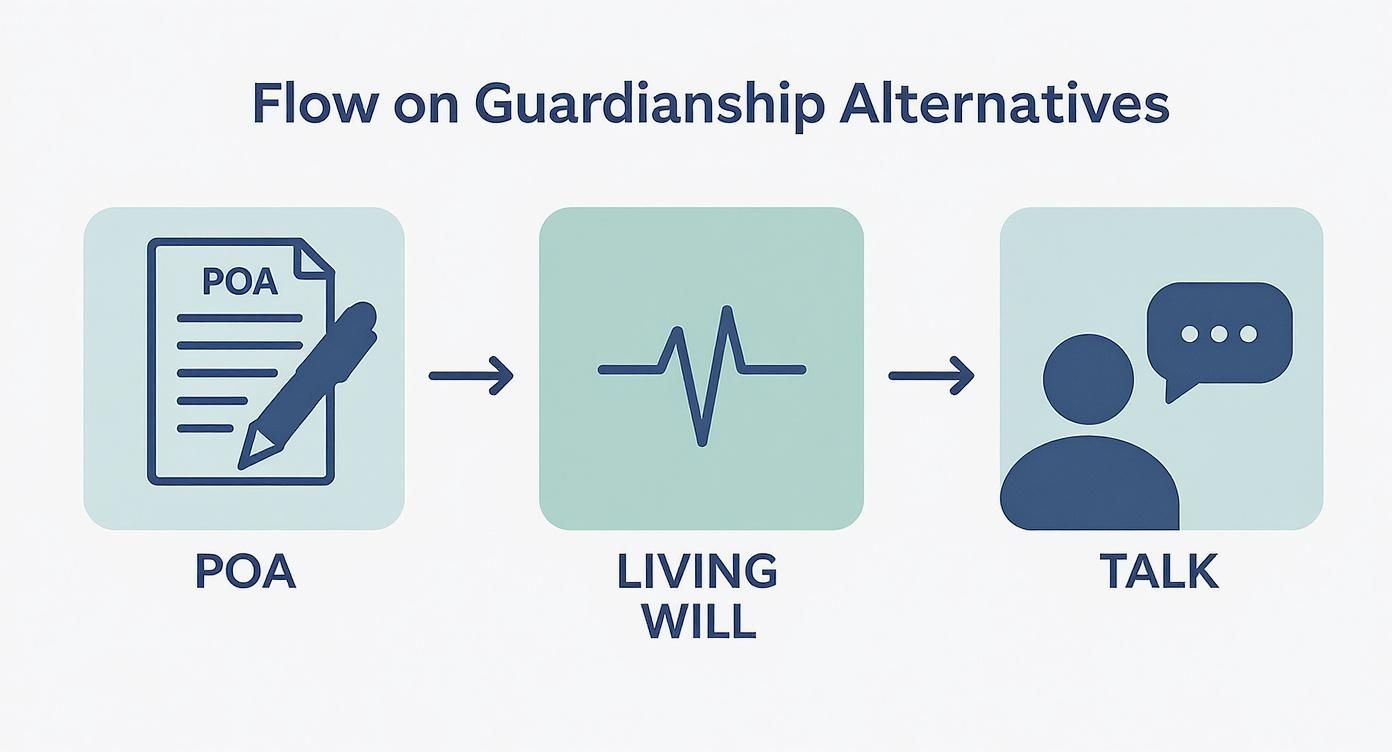
ALT TEXT: A flowchart showing that proactive planning with a Power of Attorney, Living Will, or family discussions are preferred alternatives to court-ordered guardianship.
Example: A Cuyahoga County Family's Journey
-
The Situation: David's 84-year-old mother, Mary, lives alone in Parma and has advancing dementia. She has stopped paying her utility bills, missed doctor's appointments, and recently wandered from her home. Mary never created a Power of Attorney.
-
Taking Action: David hires a Cleveland-based elder law attorney.
-
Filing the Paperwork: The attorney files the application with the Cuyahoga County Probate Court, attaching the required Statement of Expert Evaluation from Mary's geriatrician at the Cleveland Clinic.
-
The Court Steps In: The court appoints a local lawyer to represent Mary and a court investigator. The investigator visits Mary’s home and files a report confirming David's concerns about her safety.
-
The Hearing: At the hearing, the judge reviews the medical evidence and reports. After hearing testimony, the judge determines Mary is incompetent and appoints David as guardian of her person and estate, giving him the authority to manage her care and finances, including moving her to a secure memory care community in the area.
This initial phase usually takes several weeks. For a comparative view from another state, you can review this guide on how to get legal guardianship of a parent in Texas.
Preparing for Your Day in Probate Court

ALT TEXT: An illustration of a court hearing, with individuals at a table presenting documents to a judge, representing the formal guardianship process.
The court hearing can feel intimidating, but the judge’s only goal is to determine what is in your parent's best interest. Your job is to present a clear, honest picture of their situation. Your testimony should provide factual examples of why your parent can no longer manage their life safely.
Gathering the Right Evidence
Your attorney will guide you, but the most persuasive evidence shows a pattern of behavior backed up by documents.
-
Medical Records: Records stating a diagnosis like Alzheimer's or dementia.
-
Physician’s Statements: A letter from your parent’s doctor describing their limitations.
-
Financial Documents: Unpaid bills, bank statements showing odd transactions, or evidence of scams.
-
Witness Testimony: Letters or testimony from neighbors, friends, or other relatives who have seen your parent's struggles.
The report from the court-appointed investigator is also crucial, as it provides the judge with a neutral, third-party assessment.
Preparing Your Personal Testimony
Your own words matter immensely. Be organized, factual, and to the point. The goal is to show the judge why help is needed, not just tell them. Use the checklist below to organize your thoughts with specific examples.
Checklist: Preparing Your Testimony
| Prompt | My Specific Examples (Jot down 2-3 bullet points) |
| :--- | :--- |
| Daily Living Struggles | • Found spoiled food in the fridge multiple times.<br>• Parent was wearing summer clothes in November. |
| Medication Management | • I found a week's worth of pills still in the pill organizer.<br>• They couldn't remember if they took their blood pressure medicine this morning. |
| Safety Concerns | • A neighbor called because the stove was left on.<br>• They got lost driving home from the grocery store they've used for 30 years. |
| Financial Issues | • Received shut-off notices for utilities despite having money in the bank.<br>• They sent money to a phone scammer, believing it was the "lottery." |
| Changes in Personality/Behavior | • Once very social, they now refuse to leave the house.<br>• Became uncharacteristically suspicious of longtime friends. |
What this means for you: When you testify, stick to the facts. Instead of saying, "Mom is confused," give a specific example: "Last Tuesday, my mother called me three times asking what day it was." This kind of detail gives the court a clear window into your parent's reality.
The guardianship process is a major intervention. National data on guardianship is inconsistent, which highlights why thorough court oversight, as practiced in Ohio, is so important. You can dig deeper into national trends in this detailed analysis. The judge is simply trying to make the safest decision for your parent based on the facts you provide.
What to Expect After You’re Appointed Guardian
When the probate judge appoints you as your parent’s guardian, the legal battle is over, but your real work is just beginning. This is a formal, legal commitment with serious responsibilities and court oversight.
The Financial Realities of the Guardianship Process
You need to be prepared for the upfront expenses. These costs are typically paid from your parent's assets, not your own pocket.
-
Attorney Fees: This is the largest expense, often running several thousand dollars.
-
Court Filing Fees: In Ohio, this varies by county but is usually $200 to $300.
-
Expert Evaluation Fee: The fee for the required medical evaluation.
-
Guardian's Bond: The court may require you to purchase a surety bond, which is an insurance policy that protects your parent’s assets.
Your Ongoing Legal Duties: Life as a Fiduciary
Once appointed, you are a fiduciary. This legal term means you are bound to act only in your parent’s best interest and are accountable to the court for every decision.
The court will continue to supervise your actions. You must file formal reports, usually every year. These include a Guardian’s Report (detailing their health and well-being) and a Guardian’s Account (a detailed financial ledger of all income and expenses). Meticulous record-keeping is essential.
The Different Types of Guardianship in Ohio
Guardianship is not all-or-nothing. The court will tailor your authority to match your parent’s specific limitations.
| Type of Guardianship | Primary Responsibilities | When It's Used |
| :--- | :--- | :--- |
| Guardian of the Person | Making decisions about healthcare, housing, and personal care. This includes choosing an assisted living community or authorizing medical treatments. | When a parent can no longer make safe decisions about their physical health but may still handle simple finances. |
| Guardian of the Estate | Managing all financial matters, including paying bills, managing investments, and protecting assets. | When a parent is vulnerable to financial exploitation or cannot manage their finances. |
| Guardian of the Person and Estate | A combination of both roles, giving full authority over personal and financial decisions. | This is the most common type for a parent with advanced dementia or significant cognitive decline. |
Being a guardian is a demanding role that requires patience, organization, and a deep commitment to putting your parent first. It is a powerful way to ensure your parent is safe and treated with dignity.
What to Do Next: Your Cleveland-Area Resources
The guardianship process can feel overwhelming, but a few key actions will bring clarity. You do not have to take this journey alone.
What to Do Next
-
Schedule a consultation with an elder law attorney. Do not attempt this process yourself. You need a professional who specializes in Ohio guardianship law. They will provide a realistic assessment of your situation.
-
Gather important documents. Collect your parent's medical records, bank statements, and any existing legal documents like a will or an old POA. Being organized will make your meeting with an attorney more productive.
-
Explore local resources. Familiarize yourself with the probate court in your parent's county and state-level support systems.
Cleveland's Support Network for Families
Many local organizations are dedicated to helping families navigate this exact situation.
-
Finding the Right Lawyer: A great starting point is the Cleveland Metropolitan Bar Association's referral service. They can connect you with pre-screened attorneys experienced in this field.
-
Local Probate Courts: Each county’s probate court has its own forms and local rules.
-
State-Wide Guidance: The Ohio Department of Aging offers a wide range of programs and information for seniors and their families.
As you plan for long-term care, understanding the financial side is key. Our guide on the Medicaid Assisted Living Waiver in Ohio is a must-read for managing costs for Assisted Living (Residential Care Facility) care.
FAQ: Answering Your Top Guardianship Questions
Here are answers to some of the most common concerns we hear from families in the Cleveland area.
What if my parent fights the guardianship?
You can still be appointed guardian even if your parent objects. The probate court's decision is based on evidence of your parent's mental capacity, not just their wishes. If medical evaluations clearly show they can no longer make safe decisions, the court will act to protect them. Your parent will have a court-appointed attorney to represent their wishes, but the judge’s primary duty is to your parent's safety.
How long does the guardianship process take in Ohio?
For a straightforward, uncontested guardianship in a court like Cuyahoga or Lorain County, you can typically expect the process to take 30 to 90 days from filing to the final hearing. If the case is contested by other family members or involves complex finances, it could take several months. In a crisis, your attorney can file for an emergency guardianship, which can be granted in just a few days to ensure immediate safety.
What’s the difference between a “Guardian of the Person” and a “Guardian of the Estate”?
These are two distinct sets of responsibilities that a court can assign.
-
Guardian of the Person: Makes decisions about life and health, such as medical care, living arrangements (like moving to assisted living), and personal well-being.
-
Guardian of the Estate: Manages financial matters, including paying bills, handling investments, filing taxes, and protecting assets.
The court will define your authority based on your parent's specific needs.
Once guardianship is settled, the next step is often finding the right care. That’s where we can help. Guide for Seniors offers a free, personal advisory service to families across Greater Cleveland, helping you find the best-fit assisted living or memory care for your parent. Let our local advisors take the weight off your shoulders.
Need Help Finding Senior Living in Greater Cleveland?
Our Greater Cleveland local advisors compare pricing, schedule tours, and answer your questions — completely free.