Skilled Nursing vs. Assisted Living: A Guide for Greater Cleveland Families
-
TL;DR: Assisted living is for support with daily activities in a home-like setting. Skilled nursing is for 24/7 medical care and intensive therapy in a clinical environment.
-
Who it helps: Assisted living is for seniors who are mostly independent but need help with things like meals, medication reminders, or bathing.
-
Who it helps: Skilled nursing is for individuals recovering from surgery or managing complex medical conditions that require round-the-clock licensed nurses.
-
Cost Difference: In Ohio, assisted living is mostly paid for with private funds or a Medicaid AL Waiver for care services. Skilled nursing is often covered short-term by Medicare (after a hospital stay) or long-term by Ohio Medicaid.
Who This Guide Helps
This guide is for families in the Greater Cleveland area (including Cuyahoga, Lake, Lorain, Geauga, Medina, and Summit counties) who are trying to understand the difference between senior living options. We know you are likely stressed and short on time. Our goal is to provide clear, calm, and solution-oriented answers to help you make the best decision for your loved one.
Key Takeaways
-
The biggest difference is the level of medical care. Assisted living provides support, while skilled nursing provides intensive medical treatment.
-
Costs and payment sources are completely different. Medicare does not pay for assisted living room and board, but it can cover short-term skilled nursing stays.
-
The daily environment is distinct. Assisted living focuses on independence and community, while skilled nursing is structured around a medical care plan.
-
In Ohio, assisted living communities are licensed by the state as Residential Care Facilities. Skilled nursing facilities are regulated by both the state and the federal Centers for Medicare & Medicaid Services (CMS).
Disclaimer: This article is informational and not legal, financial, or medical advice. Please consult licensed professionals for case-specific guidance.
Comparing Skilled Nursing and Assisted Living
When you're choosing senior care, the decision boils down to one question: What level of medical support does my loved one need right now? The answer will point you toward either a supportive residential community or a dedicated clinical care environment.
Think of it this way: Assisted Living (Residential Care Facility) on its first mention; “assisted living” thereafter, is built to support and maximize independence. Staff are there to help with Activities of Daily Living (ADLs)—things like dressing, bathing, and managing medications. The atmosphere is social, with group dining and activities, and residents live in their own apartment-style units.
On the other hand, skilled nursing is all about providing intensive, 24/7 medical care. This is the right choice for someone with complex health conditions or a person recovering from a hospital stay who needs specialized services like wound care, IV therapy, or post-surgery rehabilitation.
This image simplifies the core difference between the supportive nature of assisted living and the medical focus of skilled nursing.
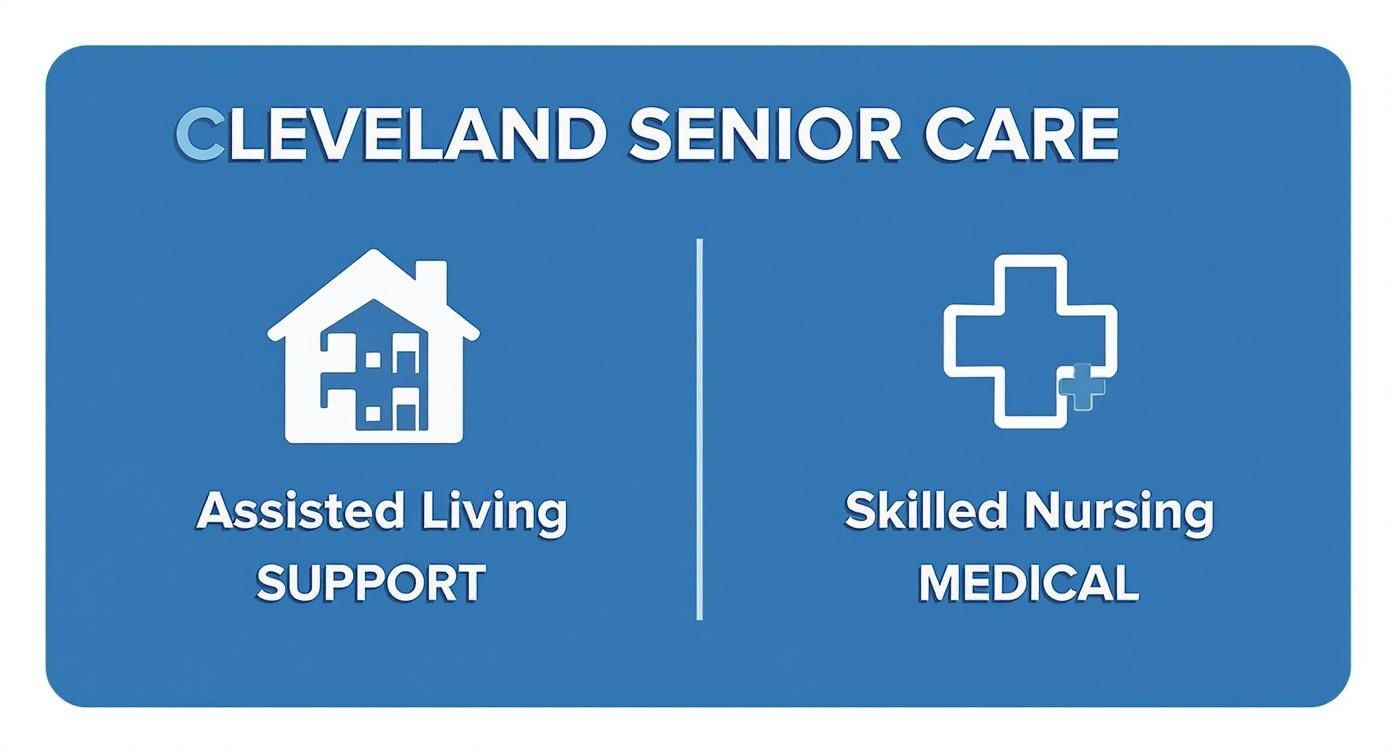
As you can see, one is centered on support for daily life, while the other delivers direct, hands-on medical care in a clinical setting.
The Role of Medical and Personal Care
The biggest difference between skilled nursing and assisted living is the type and intensity of care provided. If you're just starting your research, a good primer on understanding skilled nursing care can help clarify what it entails and who it's for.
In an assisted living community, care is typically scheduled and non-medical. For example, an aide might come by to help a resident get dressed in the morning or give them a reminder to take their pills. A licensed nurse is usually on staff or on-call to oversee care plans, but they are not providing constant, hands-on medical treatment.
A skilled nursing facility—often what people mean when they say "nursing home"—functions much more like a hospital. Registered nurses (RNs), licensed practical nurses (LPNs), and certified nursing assistants (CNAs) are on-site around the clock. They administer medications, monitor vital signs, and provide complex medical treatments under a physician's direct supervision.
What This Means for You: If your loved one’s main needs are companionship, meal preparation, and a helping hand with hygiene, assisted living is likely the right path. If they require daily medical procedures or intensive therapy from licensed professionals, skilled nursing is essential for their safety and health.
Daily Life and Independence
The day-to-day experience in these two settings is very different. Assisted living is designed to feel like home. Residents live in their own apartments and have the freedom to structure their own days, whether that means joining a planned social event, eating with neighbors, or relaxing in their private space.
Life in a skilled nursing facility is structured around a medical care schedule. Days are organized around therapy sessions, medical treatments, and mealtimes. There is less emphasis on personal autonomy and more focus on achieving specific health outcomes, so the environment feels more clinical.
A Side-by-Side Comparison
To help families here in Cuyahoga, Lake, and Lorain counties, seeing the differences laid out plainly can make a tough decision much clearer. This table breaks down the key distinctions you need to know.
| Feature | Assisted Living (Residential Care Facility) | Skilled Nursing Facility (SNF) |
| :--- | :--- | :--- |
| Primary Goal | Support independence and provide help with daily tasks in a social setting. | Deliver 24/7 medical care, rehabilitation, and manage complex health conditions. |
| Staffing Model | Aides for personal care, activity directors, with nurses on-call or available during business hours. | RNs, LPNs, CNAs, and therapists on-site 24/7 to provide direct medical care. |
| Physical Setting | Private or semi-private apartments, communal dining rooms, and activity spaces. | Hospital-like rooms, therapy gyms, and dedicated medical equipment. |
| Typical Stay | Long-term, often for many years. | Can be short-term (for rehab) or long-term (for chronic illness). |
| Ohio Licensing | Ohio Department of Health (ODH) | ODH and federal Centers for Medicare & Medicaid Services (CMS) |
It's also worth noting that preferences in senior care are shifting. While the skilled nursing market is still financially strong, the number of facilities and residents has been on a slight decline. In contrast, employment in assisted living has grown, which suggests that when possible, families and seniors are choosing less institutional settings for their long-term needs.
Navigating Costs and Payment Options in Ohio

For most Cleveland families, the financial piece of the senior care puzzle is a top priority. Once you understand how costs are structured and what payment options are available here in Ohio, you can move forward with confidence.
The price for senior living is almost never a single fee. It’s crucial to ask for a full breakdown, which usually has three parts:
-
Base Rate: This is the monthly rent for the room or apartment. It also covers essentials like meals, utilities, basic housekeeping, and community amenities.
-
Level-of-Care Fees: This is an additional monthly charge based on the amount of hands-on help a resident needs. This fee is not fixed and can change as care needs evolve.
-
One-Time Fees: Often called a "community fee," this is a one-time charge paid upon signing the agreement. It typically covers administrative costs and apartment preparation.
Assisted Living Costs And Payment Sources
In Northeast Ohio, most families pay for assisted living with private funds (savings, pensions, or proceeds from a home sale). Long-Term Care (LTC) Insurance can also be a key resource, provided the policy was purchased well in advance. For veterans and their surviving spouses, the VA's Aid & Attendance benefit can offer a monthly stipend to help with expenses.
For those with limited financial resources, Ohio provides a lifeline: the Medicaid Assisted Living Waiver (AL Waiver). This program is specifically designed to help Medicaid-eligible seniors pay for the care services portion of their assisted living bill.
What This Means for You: The AL Waiver does not cover room and board (the base rate). It pays for the crucial care services. Eligibility is based on financial and medical need, which is determined by your local Area Agency on Aging (AAA).
Example: Cuyahoga County family using the AL Waiver
A family in Parma has a mother who needs help with bathing and managing her medications. Her income and assets are below Ohio's Medicaid limits. They contact the Western Reserve Area Agency on Aging, which assesses her and confirms she qualifies for the waiver. Once approved, Medicaid pays the assisted living community directly for her care. The family uses her Social Security income to cover the room and board. This makes an otherwise unaffordable situation possible. You can learn more in our guide to the Medicaid Assisted Living Waiver in Ohio.
Skilled Nursing Costs And Payment Sources
Skilled nursing facilities are licensed medical settings, and their costs reflect this. In Ohio, the annual cost of a private room in a Skilled Nursing Facility (SNF) can exceed $108,000, while assisted living often ranges from $44,000 to $57,000 per year.
For short-term rehabilitation, typically after a hospital stay of at least three days, Medicare Part A is the primary payer. Medicare will cover up to 100 days of skilled care per benefit period under specific conditions:
-
Days 1–20: Medicare covers the full cost.
-
Days 21–100: You are responsible for a daily coinsurance payment.
-
After Day 100: You become responsible for all costs.
When long-term custodial care is needed, Ohio Medicaid becomes the most common source of payment. To qualify, an individual must meet strict income and asset limits. Many families work with an elder law attorney to navigate the "spend-down" process required to meet these financial rules.
Ohio Senior Care Costs and Payment Sources
| Cost Aspect | Assisted Living | Skilled Nursing |
| :--- | :--- | :--- |
| Typical Annual Cost | $44,000 - $57,000 | $108,000+ |
| Primary Private Payer | Personal savings, investments, home sale | Personal savings, often after Medicare days run out |
| Insurance Coverage | Long-Term Care (LTC) Insurance | Medicare Part A (for short-term rehab, up to 100 days) |
| Government Assistance | Medicaid AL Waiver (pays for care services, not room/board) | Ohio Medicaid (primary payer for long-term care once financially eligible) |
| Veteran's Benefits | VA Aid & Attendance | VA benefits may apply, but Ohio Medicaid is more common for long-term stays |
Choosing the Right Care for Your Family Member
Real-world examples make the choice between skilled nursing and assisted living clearer. The best decision always comes down to the specific, day-to-day needs of the person you’re helping.
A Tale of Two Scenarios
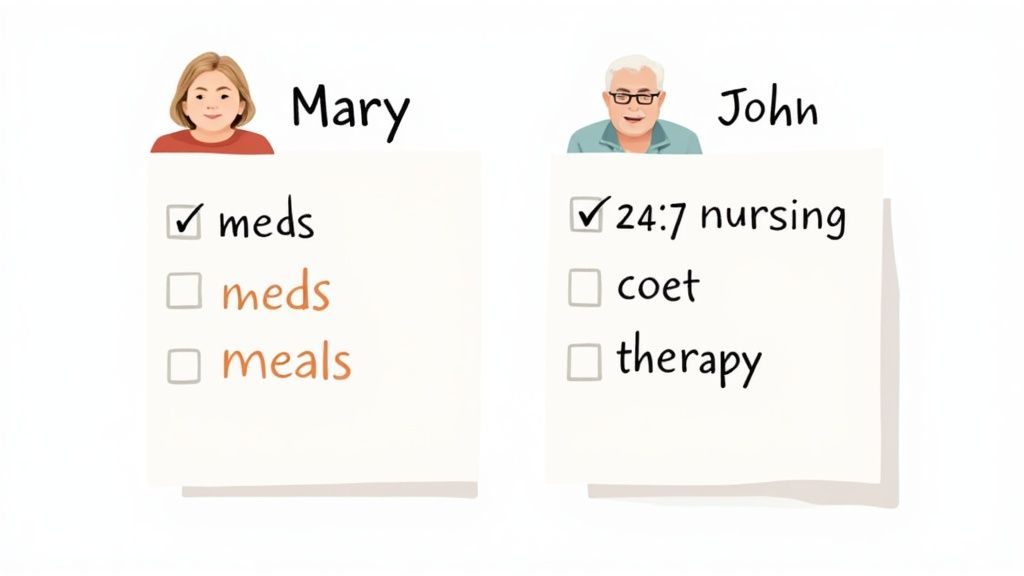
First, consider Mary, who lives alone in Lorain County. She’s mostly independent, but her family has noticed she’s forgetting her blood pressure medication and sometimes skips meals. While she has no complex medical issues, she needs help with her daily routine and would benefit from more social interaction. For Mary, assisted living is a perfect match.
Now, let's look at John in Summit County. He just had knee replacement surgery and needs weeks of intensive, daily physical therapy. His doctor has ordered a strict care plan that includes wound management and close monitoring by licensed nurses. His needs are clinical, specific, and short-term. For John, a skilled nursing facility is the only safe option.
Your Care Needs Checklist
Use this checklist to mark off the services your loved one needs right now. Your answers will paint a clear picture of whether their needs lean more toward assisted living or skilled nursing.
| Care Need | Typically Provided In... | Your Loved One Needs This: (Yes/No) |
| :--- | :--- | :--- |
| Daily Living Support | | |
| Help with bathing, dressing, and grooming | Assisted Living | |
| Medication reminders or management | Assisted Living | |
| Meal preparation and communal dining | Assisted Living | |
| Housekeeping and laundry services | Assisted Living | |
| Social activities and scheduled outings | Assisted Living | |
| Medical & Clinical Care | | |
| 24/7 nursing supervision by RNs/LPNs | Skilled Nursing | |
| Daily physical, occupational, or speech therapy | Skilled Nursing | |
| Post-surgery or post-hospitalization recovery | Skilled Nursing | |
| IV therapy or injections | Skilled Nursing | |
| Complex wound care | Skilled Nursing | |
| Management of complex medical conditions | Skilled Nursing | |
What This Means For You: If you checked "Yes" mostly under "Daily Living Support," your search should focus on assisted living. If the "Yes" marks are mostly under "Medical & Clinical Care," a skilled nursing facility is where you need to look.
These conversations often bring up important legal planning. Understanding documents like Power of Attorney and Advanced Directives is crucial to ensure a loved one's wishes are honored. For more expert advice, see our complete guide on choosing senior living.
How Senior Care Quality Is Regulated in Ohio
Knowing your family member will be safe and well-cared for is the top priority. In Ohio, the oversight for skilled nursing and assisted living are different because they operate under separate legal frameworks.
Assisted living communities, which Ohio law calls Residential Care Facilities, are licensed and inspected by the Ohio Department of Health (ODH). The state's focus is on maintaining a safe environment and ensuring personal care services are delivered properly.
Skilled nursing facilities (SNFs) have a much higher bar. They are also regulated by the ODH, but because they provide medical care, they must also meet strict federal standards from the Centers for Medicare & Medicaid Services (CMS).
Finding and Reading Inspection Reports
Both state and federal agencies conduct inspections (often called "surveys") and make their findings public. These reports are your best tool for seeing how a facility truly functions.
-
In Ohio, you can find reports for both facility types on the Ohio Department of Health’s Long-Term Care Consumer Guide. You can search for a specific community to see their latest inspection results.
-
For Skilled Nursing: The best resource is the federal CMS Care Compare website. This tool gives every Medicare-certified nursing home a simple five-star rating and lets you read the detailed survey findings behind that score.
The assisted living market reached about USD 157.28 billion globally in 2023, with roughly 30,600 communities in the U.S., according to Fortune Business Insights. As options grow, using these tools to verify quality is more important than ever.
Understanding Resident Rights and Advocacy
Ohio provides an independent advocate for residents through the Long-Term Care Ombudsman program. Ombudsmen are trained professionals who work to resolve complaints and protect the rights of anyone living in a long-term care setting. Their services are free and confidential. If a problem ever comes up, your local ombudsman is your first call.
What to Do Next: Your 4-Step Action Plan
Feeling overwhelmed is normal. Breaking the process down into clear, manageable steps can help you move forward with confidence.
Step 1: Assess Your Loved One's Needs
Use the Care Needs Checklist in this article. An honest assessment of daily needs is the most important step and will guide your entire search.
Step 2: Understand Your Budget and Funding
-
For Assisted Living: If you need financial assistance, your first call should be to the Western Reserve Area Agency on Aging at (216) 621-0303. Ask about the assessment process for the Medicaid AL Waiver.
-
For Skilled Nursing: For a short-term rehab stay after a hospital visit, talk to the hospital's discharge planner. They are experts in navigating Medicare coverage.
Step 3: Schedule Tours
Reading brochures is not enough. Schedule tours at one assisted living community and one skilled nursing facility. Seeing them in person will make the differences clear and help you get a feel for the environment.
Step 4: Check Inspection Reports
Before making a final decision, do your homework.
-
Look up state inspection reports on the Ohio Department of Health's Long-Term Care Consumer Guide.
-
For skilled nursing, review the star ratings and survey results on the federal CMS Care Compare website.
Frequently Asked Questions (FAQ)
Here are answers to common questions we hear from families in the Cleveland area.
Can a person move from assisted living to skilled nursing?
Yes, this is very common as health needs change. Many larger senior campuses, called Continuing Care Retirement Communities (CCRCs), have both assisted living and skilled nursing on the same grounds, which makes the transition much smoother.
Does Medicare pay for assisted living in Ohio?
No. Traditional Medicare does not pay for the room and board costs of assisted living. It is health insurance and may cover some medical services received there, but it does not pay the monthly rent. In Ohio, the main financial assistance program is the AL Waiver, which helps pay for care services for those who qualify for Medicaid.
What's the biggest difference in daily life?
It boils down to independence versus medical structure. In assisted living, the day is yours to plan around social opportunities and personal choice. In skilled nursing, the day is structured around a medical care plan, with routines shaped by therapy appointments and nursing check-ins.
How can I report a concern about a facility in Ohio?
You have powerful advocates.
-
To report a concern to the state licensing agency, call the Ohio Department of Health hotline at 1-800-342-0553.
-
To speak with a resident advocate, contact your Regional Long-Term Care Ombudsman. They provide free, confidential help to resolve problems for residents in Cuyahoga, Lake, Lorain, Geauga, and Medina counties.
We know these decisions are tough. Guide for Seniors provides free, one-on-one support to help families in Northeast Ohio find the right care. Our local advisors have personally visited the communities and can help you find the place that feels right.
Get started with our quick, two-minute assessment: Find Senior Living Options in Northeast Ohio
Need Help Finding Senior Living in Greater Cleveland?
Our Greater Cleveland local advisors compare pricing, schedule tours, and answer your questions — completely free.