How Much Does a Retirement Community Cost in Cleveland, Ohio?
Figuring out the cost of a retirement community in Northeast Ohio can be stressful. Monthly prices in the Cleveland area can range from $3,000 for independent living to over $8,000 for specialized memory care. The final cost depends almost entirely on the level of hands-on support your loved one needs.
-
TL;DR: Key Cost Insights
-
Prices vary by care type: The more help someone needs (assisted living vs. memory care), the higher the monthly cost.
-
It’s more than rent: Your bill has two parts: a base rate for the apartment and meals, plus separate level-of-care fees for personal support like help with medications or bathing.
-
Ohio offers help: The Medicaid Assisted Living Waiver (AL Waiver) can help cover care costs for those who qualify, but not every community accepts it.
-
Expect annual increases: Most communities raise their rates by 3% to 7% each year. Ask for a community’s rate increase history.
Who This Guide Helps
This guide is for families in Cuyahoga, Lake, Lorain, Geauga, Medina, and Summit counties who are:
-
Trying to compare different types of senior living (assisted living, memory care, skilled nursing) for a parent or loved one.
-
Feeling overwhelmed by confusing pricing and the fear of hidden fees.
-
Working to figure out how to pay for care using savings, insurance, or Ohio-specific programs.
-
Looking for a clear, calm way to compare the true value of one community against another.
Key Takeaways for Your Search
-
Costs Vary Widely: The monthly price tag reflects the care provided, the apartment size, and the community's location and amenities.
-
Understand the Bill: Your total cost is a combination of a base rate for housing and meals, plus separate fees for personal support.
-
Ohio Programs Can Help: State programs like the AL Waiver can be a huge help, but you must meet strict eligibility rules.
-
Ask About Increases: It's a fact of life—rates go up. Don't be afraid to ask for a community’s rate increase history for the last few years.
Comparing Senior Living Options and Their Costs in Northeast Ohio
When you explore senior care in the Cleveland area, "senior living" isn't just one thing—it’s a range of options for different needs. To create a realistic budget, you first need to understand which type of community is the right fit.
A key thing to grasp is how most communities structure their pricing. Your total monthly cost is usually a combination of a base rent for your apartment and amenities, and a separate fee for any personal care you need.
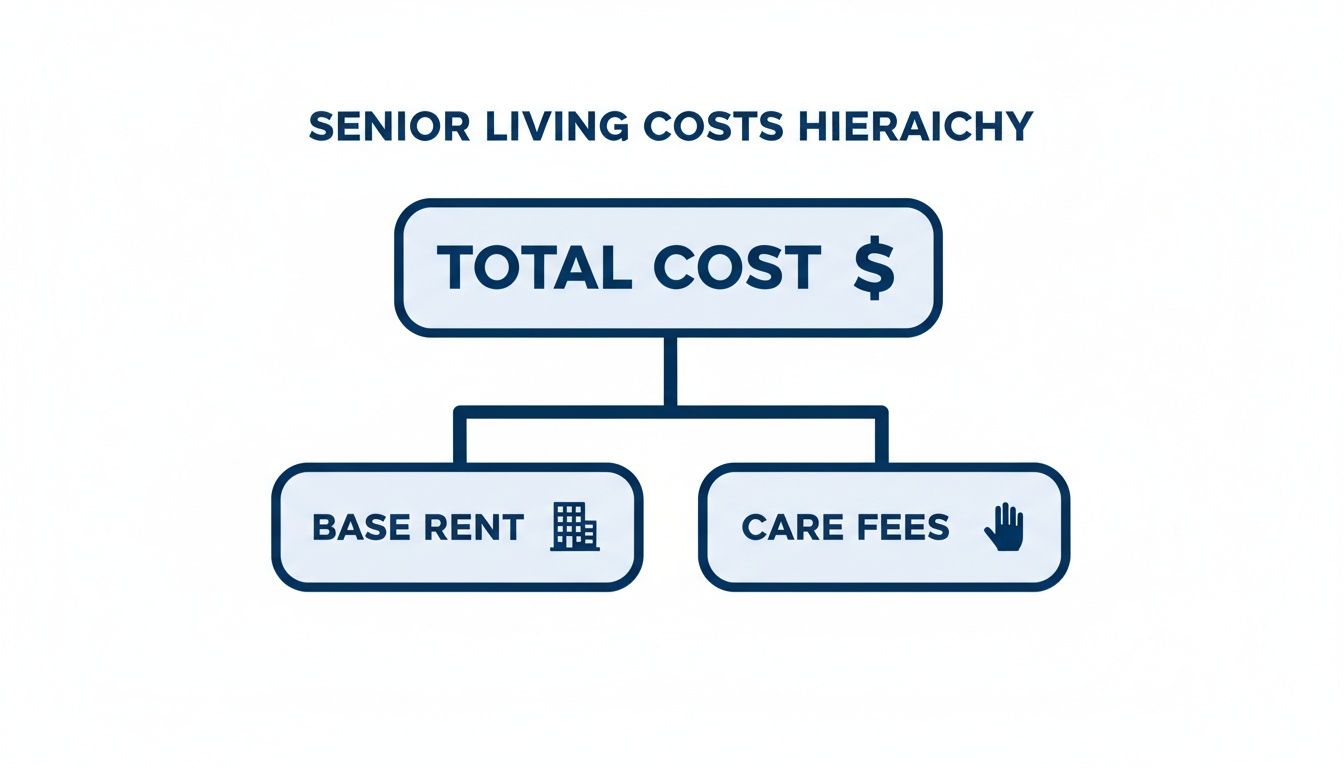
(Alt text: Senior living costs hierarchy diagram showing total cost, broken down into base rent and care fees.)
This means the "starting at" price you see in an ad is rarely the full story. The final bill depends on the specific, personal services someone requires.
Independent Living
Think of independent living as a lifestyle choice for active, healthy seniors who can manage their day-to-day lives but are ready to ditch home maintenance. It's about convenience, community, and social connection.
-
What you get: Apartment-style living with perks like meal plans, housekeeping, transportation, and a full schedule of social events.
-
How it's priced: A straightforward monthly rent that covers housing and shared amenities. Care services are not included.
-
Cleveland Area Monthly Cost Range: $2,800 – $4,500
Assisted Living
Assisted Living (Residential Care Facility) is the middle ground for seniors who are still largely independent but need a reliable helping hand with daily tasks. In Ohio, these communities are licensed by the state and provide support with Activities of Daily Living (ADLs)—things like bathing, dressing, managing medications, or getting around safely.
The big difference from independent living is the addition of personalized care. In assisted living, your monthly cost covers both your housing and a separate, tailored care plan. You can get a deeper look into what is included in assisted living costs.
-
What you get: All the amenities of independent living, plus a personalized care plan, 24/7 staff availability, and medication assistance.
-
How it's priced: A base rent for the apartment and meals, plus additional level-of-care fees based on the amount of daily support needed.
-
Cleveland Area Monthly Cost Range: $4,500 – $7,000+
Memory Care
Memory care communities are secure, specially designed environments for individuals living with Alzheimer's disease or other forms of dementia. The building layout, staff training, and daily activities are all created to reduce anxiety and provide a structured, supportive setting.
-
What you get: All assisted living services, plus dementia-trained staff, secure indoor and outdoor spaces to prevent wandering, and therapeutic activities that support cognitive function.
-
How it's priced: Usually an all-inclusive monthly rate. The higher price reflects the higher staff-to-resident ratio and specialized training required.
-
Cleveland Area Monthly Cost Range: $5,500 – $8,500+
Skilled Nursing Facilities
A Skilled Nursing Facility (SNF), often called a "nursing home," provides the highest level of care outside a hospital. These are medical environments regulated by the Centers for Medicare & Medicaid Services (CMS). They serve people with complex medical conditions or those needing short-term rehabilitation after a hospital stay.
An assisted living facility is state-licensed, while a skilled nursing facility is federally regulated by CMS.
-
What you get: 24/7 medical care, including round-the-clock nursing, physical and occupational therapy, and constant medical supervision.
-
How it's priced: Billed as a daily rate. Medicare may cover a short-term rehab stay, but long-term care is typically paid for with private funds or Medicaid after assets are spent down.
-
Cleveland Area Daily Cost Range: $280 – $400+
Comparing Senior Living Options in Northeast Ohio
This table breaks down the essentials for each type of community, giving you a clear, side-by-side view.
| Type of Community | Typical Monthly Cost Range (Cleveland Area) | Common Services Included | Best Suited For |
| :--- | :--- | :--- | :--- |
| Independent Living | $2,800 – $4,500 | Housing, meals, activities, transportation, maintenance. | Active, independent seniors who want convenience and community. |
| Assisted Living | $4,500 – $7,000+ | All of the above, plus help with bathing, dressing, and medications. | Seniors needing non-medical help with daily activities. |
| Memory Care | $5,500 – $8,500+ | All assisted living services, plus secure environment and specialized staff. | Individuals with Alzheimer's or other forms of dementia. |
| Skilled Nursing | $8,500 – $12,000+ ($280-$400/day) | 24/7 medical care, nursing supervision, and therapy services. | Individuals with complex medical needs or for post-hospital rehab. |
Key Factors That Determine Retirement Community Cost
The advertised "starting at" price is rarely the whole story. Several key factors combine to create your family's actual monthly bill. Understanding these variables is the first step to creating a realistic budget and avoiding surprises. Nationwide, the median assisted living cost is projected to be around $5,950 per month in 2025, according to data from Caring.com. You can dig deeper into these trends by checking out the latest assisted living statistics on caring.com.
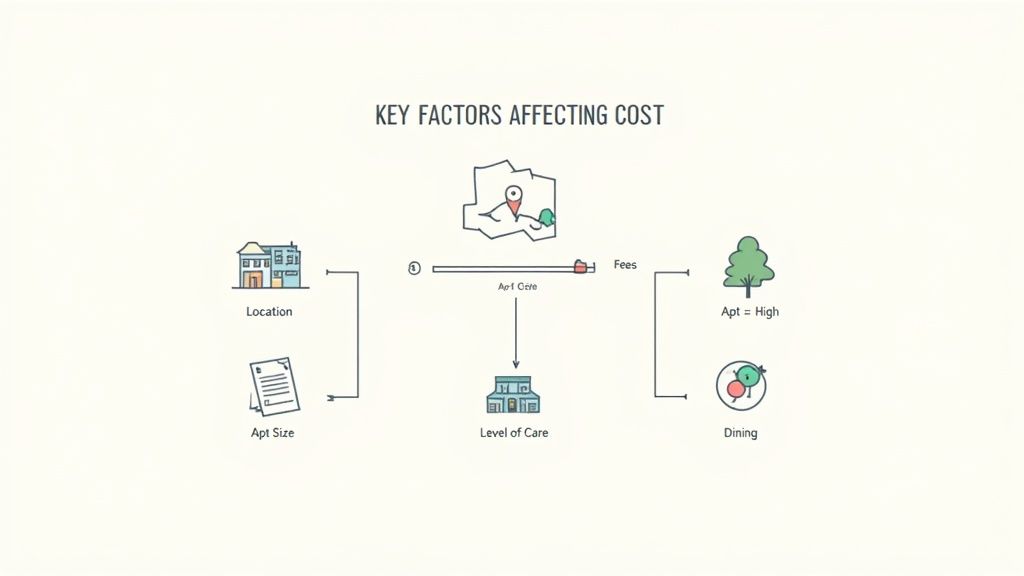
(Alt text: Diagram showing key factors affecting retirement community costs: location, apartment size, level of care, dining, and other fees.)
The Role of Location in Northeast Ohio
Just like with real estate, location is a huge driver of cost. A community in a high-demand Cleveland suburb like Westlake will almost always have higher fees than one in a quieter part of Geauga or Lorain County. This is due to local property values, staff wages, and proximity to major health systems like the Cleveland Clinic or University Hospitals.
Understanding Level-of-Care Fees
This is the most important piece of the cost puzzle. Level-of-care fees are charges added to your base rent that cover the hands-on, personal support a resident needs. Before move-in, a nurse will assess how much help is needed with Activities of Daily Living (ADLs), such as:
-
Bathing and showering
-
Getting dressed and grooming
-
Managing medications
-
Moving from a bed to a chair ("transferring")
-
Using the restroom
Based on this assessment, the resident is assigned a care level with a specific monthly fee. Someone who just needs medication reminders will pay far less for care than someone who needs help with dressing and bathing every morning.
What This Means For You: Ask for a complete fee schedule that clearly outlines the different care levels and their costs. Also ask how often a resident's needs are re-evaluated, as a change in health can change the monthly bill.
Apartment Size, Amenities, and One-Time Fees
Beyond location and care, a few other factors will affect your final cost:
-
Apartment Size and Style: A spacious two-bedroom apartment will cost more than a studio.
-
Community Amenities: A community with an indoor pool, a full-service salon, and multiple dining venues has higher operating costs, which are reflected in the monthly fees.
-
One-Time Fees: Most communities charge a one-time "community fee" before move-in. This can range from $1,000 to $5,000 and covers apartment preparation and administrative costs. Ask if any portion is refundable.
How to Pay for Senior Living in Ohio
<iframe width="100%" style="aspect-ratio: 16 / 9;" src="https://www.youtube.com/embed/F-HmzRq0m5s" frameborder="0" allow="autoplay; encrypted-media" allowfullscreen></iframe>For most Ohio families, paying for care involves piecing together several financial resources. Understanding your options is key to building a sustainable plan.
Private Pay and Personal Assets
Private pay means using your own money. This is how most families begin and typically comes from:
-
Retirement savings (401(k), IRA)
-
Pensions and Social Security
-
Proceeds from the sale of a home
-
Annuities and investments
Long-Term Care Insurance
If your loved one has a Long-Term Care (LTC) Insurance policy, review it carefully. Key details include:
-
Elimination Period: A time-based deductible (often 90 days) where you pay out-of-pocket before benefits begin.
-
Daily Benefit Amount: The maximum amount the policy will pay per day.
-
Covered Services: Ensure the policy covers care in a “Residential Care Facility,” which is Ohio's official term for assisted living.
Clarifying Medicare vs. Medicaid
-
Medicare: This is health insurance. It does NOT pay for long-term assisted living costs. It may cover a short, rehabilitative stay in a skilled nursing facility after a qualifying hospital stay, but it will not cover ongoing room and board in assisted living.
-
Medicaid: This is a joint federal and state program for people with limited financial resources. In Ohio, Medicaid is a critical tool for paying for long-term care through specific programs.
The Ohio Medicaid Assisted Living Waiver
The Medicaid Assisted Living Waiver (AL Waiver) is a program that helps pay for the care services a person receives in an assisted living community.
What this means for you: The AL Waiver helps cover the cost of care, but not room and board. The resident is still responsible for their rent and meals, which they typically pay for using their Social Security income. You can learn more about the Medicaid Assisted Living program in Ohio.
Qualifying is a two-part process:
-
Financial Eligibility: The applicant must meet strict income and asset limits set by Ohio Medicaid. As of early 2025, these limits are quite low.
-
Medical Eligibility: An assessor from the local Area Agency on Aging (AAA) must certify that the applicant needs an "intermediate level of care."
Example: Cuyahoga County family using the AL Waiver…
A family in Parma finds an assisted living community for their mom that costs $5,500 per month. Her only income is $1,800 a month from Social Security. After her savings are spent down on her care, she qualifies for the AL Waiver. Now, her $1,800 Social Security check goes to the community to cover her room and board, and the AL Waiver pays the community for all her care needs.
VA Aid & Attendance Benefits
If your loved one is a wartime veteran or the surviving spouse of one, they may qualify for a pension called Aid & Attendance. This is a tax-free monthly payment from the Department of Veterans Affairs that can be used to help offset assisted living costs. You can learn more and apply on the U.S. Department of Veterans Affairs website.
Your Checklist for Evaluating a Community's True Value
A tour is your chance to do some investigative work. This checklist will help you compare communities apples-to-apples and understand the true, long-term retirement community cost.

(Alt text: A clipboard with a 'Community Evaluation' document, a checklist, and a magnifying glass, depicting assessment.)
Checklist for Comparing Communities
✅ Costs and Contracts
-
Can I have a complete fee schedule with base rent and all level-of-care fees?
-
What has the average annual rate increase been for the past three years?
-
Do you accept the Ohio Medicaid Assisted Living Waiver (AL Waiver) if a resident's funds are depleted?
-
What does the one-time community fee cover, and is any part of it refundable?
✅ Care and Staffing
-
What are your staff-to-resident ratios for day, evening, and overnight shifts?
-
What training is required for caregivers, especially for memory care?
-
How is a medical emergency handled after hours or on weekends?
✅ Safety and Oversight
-
May I see a copy of your most recent inspection report from the Ohio Department of Health?
-
What systems do you use to ensure medications are managed correctly?
-
What specific security measures are in place, especially in memory care?
Using this checklist for every visit ensures you gather the same crucial information, helping you make a confident decision. For a deeper dive, check our guide on important questions to ask assisted living facilities.
What to Do Next
This process can feel overwhelming. Focus on these concrete steps to move forward. The senior housing market is tight, with demand often outpacing supply, as shown in a recent senior housing industry analysis on cbre.com. Starting your search early gives you more options and less pressure.
First Steps for Cleveland-Area Families:
-
Estimate Your Monthly Budget: Calculate what your family can comfortably afford each month from all income sources (pensions, Social Security, savings).
-
Define Your "Must-Haves": Make a short, non-negotiable list. Does the community need to be in a specific county like Lorain or Geauga? Is specialized dementia training for staff a top priority?
-
Contact Your Area Agency on Aging: This is the entry point for programs like the AL Waiver. For those in Cuyahoga, Lake, Geauga, Lorain, and Medina counties, contact the Western Reserve Area Agency on Aging.
-
Schedule Two or Three Tours: Based on your list, pick a few promising communities and visit. There is no substitute for seeing a place in person.
Essential Ohio Resources
-
Check Inspection Reports: Look up communities on the Ohio Department of Health's facility search portal.
-
Get Help or Report a Concern: The Ohio Long-Term Care Ombudsman is a free advocate for residents' rights.
Frequently Asked Questions (FAQ)
Are retirement community costs in Ohio tax deductible?
Sometimes. The portion of your monthly fees that pays for direct medical care services (like help with bathing or medication management) may be deductible as a medical expense. You will need an itemized statement from the community. According to IRS rules, you can only deduct medical expenses that exceed 7.5% of your adjusted gross income. Always consult a tax professional for advice specific to your situation.
How much do communities increase their rates each year?
You can generally expect an annual rate increase of 3% to 7% to cover rising costs for staff wages, food, and utilities. When touring, ask for the community’s rate increase history for the past three years to help you budget for the future.
What happens if we run out of money in assisted living?
This is a major worry for many families. If a resident’s private funds run out, they may qualify for the Ohio Medicaid Assisted Living Waiver (AL Waiver) to help cover care costs. However, not every community accepts the waiver. It is critical to ask this question upfront. Choosing a community that accepts the AL Waiver can provide significant peace of mind.
Disclaimer: This article provides informational guidance and is not a substitute for professional legal, financial, or medical advice. Please consult with a qualified professional for advice tailored to your personal situation.
Finding the right community is a balance of care needs, location, and budget. The local advisors at Guide for Seniors offer free, personalized guidance to help you sort through your options in Northeast Ohio. Learn more and get started at https://www.guideforseniors.com.
Get matched to communities in your budget
Our Cleveland advisors know current pricing and availability — free for families.
Need Help Finding Senior Living in Greater Cleveland?
Our Greater Cleveland local advisors compare pricing, schedule tours, and answer your questions — completely free.