Cost of Assisted Living in Ohio: A 2024 Guide for Cleveland-Area Families
Making decisions about senior care for a loved one can be stressful, especially when it comes to the cost. This guide is here to give Greater Cleveland families a clear, calm breakdown of what to expect for the cost of assisted living in Ohio, turning financial confusion into a confident plan.
-
Average Ohio Cost: The median monthly cost for assisted living in Ohio is approximately $5,500 as of 2024.
-
What Drives the Price: Your final bill depends on three key parts: the base rate (rent/meals), level-of-care fees (for personal help), and one-time community fees.
-
How to Pay: Most families use a mix of private funds, long-term care insurance, and public programs like the Ohio Medicaid Assisted Living Waiver or VA benefits.
-
Key Local Difference: Costs vary by city. For example, Cleveland's median cost is around $5,475, while nearby Akron is closer to $4,950.
Who this guide helps
This guide is for families in Greater Cleveland (Cuyahoga, Lake, Lorain, Geauga, Medina, and Summit counties) who are comparing senior living options like assisted living, memory care, and nursing homes and need a clear, practical understanding of the costs involved.
Key takeaways
-
Assisted living costs in Ohio are slightly below the national average, offering good value.
-
The advertised "base rate" is not the full price; always ask for a care assessment to estimate the final monthly bill.
-
In Ohio, the Medicaid Assisted Living Waiver can help pay for care services (but not rent) for those who qualify financially and medically.
-
Understanding the difference between assisted living and skilled nursing home costs is crucial to avoid overpaying for unnecessary medical services.
Understanding the Average Cost of Assisted Living in Ohio
When you begin researching care options, the first question is always: what will this actually cost? Establishing a clear baseline for the cost of assisted living in Ohio is your first step toward creating a realistic budget and comparing communities fairly.
In Ohio, what is commonly called "assisted living" is officially licensed by the state as a Residential Care Facility. These communities provide housing, meals, and help with daily activities.
The numbers can feel big at first, but Ohio is generally a moderately priced state for senior care, making high-quality options more accessible here than in many other parts of the country.
How Ohio Costs Compare Nationally
To understand the value, it helps to see the bigger picture. How does Ohio stack up against the rest of the country? This chart provides a quick visual comparison.
Alt text: A bar chart comparing the median monthly cost of assisted living in Ohio ($5,500) to the national average ($5,900).
As of March 2024, Ohio’s median monthly cost for assisted living is around $5,500. This is slightly more affordable than the national median of $5,900. This positions Ohio comfortably in the middle—significantly less than high-cost states on the East Coast but more than some states in the South. For more details, you can learn more about how assisted living in Ohio compares to other states.
Why Costs Vary Across Northeast Ohio
You’ll quickly notice that prices are not the same across the state. A community in a Cleveland suburb will likely have a different price than one in a more rural area. This is driven by local factors:
-
Local Real Estate Values: Metro areas like Cleveland and its surrounding suburbs have higher property costs, which increases the base rates for apartments.
-
Labor Costs: Wages for skilled nurses, aides, and support staff are often higher in urban centers like Cuyahoga County, and this cost is reflected in pricing.
-
Supply and Demand: In regions with a large senior population and high demand, you may see more competitive—and sometimes higher—prices.
Estimated Monthly Assisted Living Costs Across Ohio
This table compares median monthly costs in different Ohio cities. Remember, these are estimates based on recent data and should be verified with individual communities. Source: Genworth Cost of Care Survey, with local market analysis. Last updated: March 2024.
| Location | Estimated Median Monthly Cost |
| :--- | :--- |
| Cleveland | $5,475 |
| Akron | $4,950 |
| Cincinnati | $5,125 |
| Columbus | $5,600 |
| Dayton | $5,250 |
| Statewide Ohio Average | $5,500 |
| National Average | $5,900 |
What this means for you
If your family is in Cuyahoga County, you can expect costs to be close to the state average. However, if you are open to communities just outside the county, like in Akron (Summit County), you could find more budget-friendly options. The difference between Cleveland ($5,475) and Akron ($4,950) is over $500 a month. That adds up to $6,000 a year—a significant saving.
Having a solid grasp of these averages is the perfect starting point. Now, let’s look at what actually goes into that final monthly bill.
What Factors Influence Your Final Monthly Bill
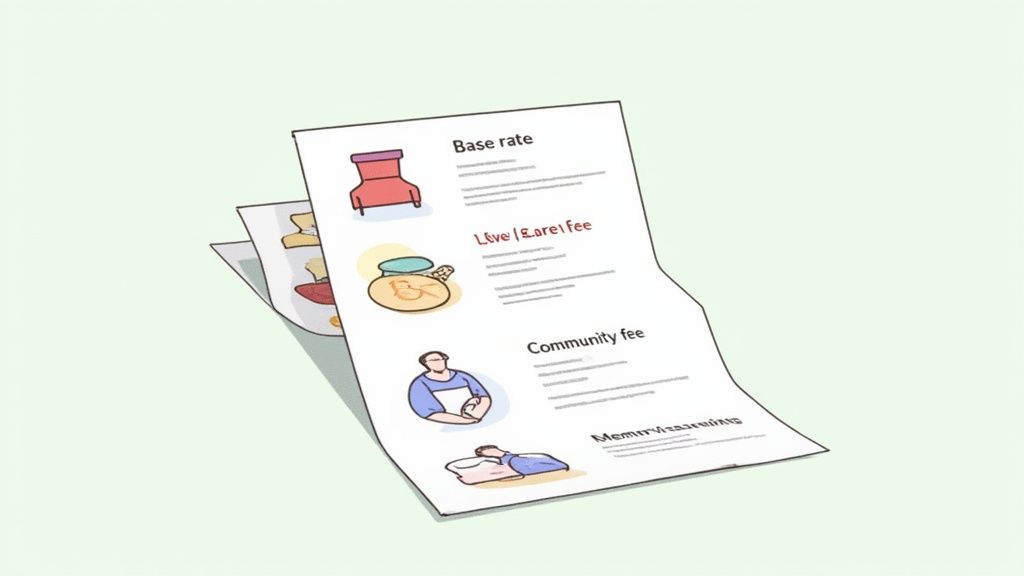
Alt text: Sample pricing documents for an assisted living community, showing line items for base rate, care fee, one-time community fee, and monthly insurance costs.
When you see an advertised price for assisted living, think of it as a starting point. To build a realistic budget and avoid surprises, you need to understand how the final bill is calculated. The cost of assisted living in Ohio has been rising, making it more important than ever to know exactly what you’re paying for.
Let's break down the three main parts of the total monthly cost.
Base Rate: The Foundation of Your Bill
The base rate is the most straightforward part of the bill. Think of it like rent for an apartment, but with important extras included.
This monthly fee almost always covers:
-
Housing: Your private or semi-private apartment or suite.
-
Meals: Usually three meals a day, plus snacks.
-
Utilities: Electricity, water, heat, and often basic cable and Wi-Fi.
-
Housekeeping: Light cleaning, typically weekly.
-
Activities: Access to the community’s social calendar, like fitness classes and group outings.
The biggest factor affecting the base rate is the apartment size. A spacious, private one-bedroom unit will have a higher base rate than a studio.
Level of Care Fees: Personalizing the Cost
Here is where the pricing gets customized. Level-of-care fees are additional monthly charges for the hands-on help a resident needs. Before moving in, a community nurse will conduct an assessment to understand how much help is needed with Activities of Daily Living (ADLs)—tasks like bathing, dressing, managing medications, or mobility.
Based on that assessment, your loved one is assigned a care level, and each level has its own monthly fee. Someone who is very independent might have a low care fee, while a person needing significant daily support will have a higher one.
What this means for you
A common mistake is budgeting only for the base rate. To get the real cost, you must ask for a care assessment before signing any agreement. This fee can add several hundred to over a thousand dollars to the monthly bill.
One-Time Fees and Specialized Care
Beyond the recurring monthly charges, a few other costs can affect your budget.
-
Community Fee: This is a one-time, non-refundable fee paid upon move-in. It covers administrative work and apartment preparation. In Ohio, these fees often range from $1,500 to $5,000.
-
Memory Care: If your loved one is living with Alzheimer’s or another form of dementia, they will likely need a specialized memory care unit. These secured areas have specially trained staff and a higher staff-to-resident ratio, making them more expensive than standard assisted living.
For a deeper look into what's typically bundled into these costs, our guide on what is included in assisted living costs is a great resource.
How to Pay for Assisted Living in Ohio
Once you have a sense of the cost, the next question is, "How will we pay for this?" Most families use a combination of resources. Let’s walk through the most common ways people in Ohio pay for assisted living.
Private Pay: Using Personal Resources
The most direct way to pay is with personal funds, often called "private pay." This is usually a mix of different sources:
-
Savings and Investments: Liquid assets like checking and savings accounts, stocks, or mutual funds.
-
Retirement Income: Social Security, pensions, and distributions from IRAs or 401(k)s.
-
Real Estate: Selling a home can provide a significant fund to cover care for many years.
-
Long-Term Care Insurance: If your loved one has a policy, it is specifically designed to cover assisted living services and can provide significant financial relief. You can learn more about long-term care insurance options.
Ohio's Medicaid Assisted Living Waiver Program
When personal funds are not enough, public benefits can help. The most important program for this is Ohio’s Medicaid Assisted Living Waiver (AL Waiver). This program allows seniors who need a nursing-home-level of care to receive that care in a less restrictive assisted living setting.
What the AL Waiver Covers (and What It Doesn't)
The waiver pays for care services—help with dressing, medication, bathing, and meals. It does not pay for "rent" (the room and board part of the bill). Residents are responsible for that portion, which they typically cover with their Social Security or other income.
The eligibility rules can be complex. You can find a full guide to the Medicaid assisted living waiver in Ohio for more details.
Example: A Cuyahoga County family is looking for care for their mother. Her income is from Social Security, and her savings are below the $2,000 asset limit. A doctor confirms she needs help with bathing and medication management. They apply for the AL Waiver through their local Area Agency on Aging. Once approved, the waiver covers her care fees at a certified assisted living community in Lakewood. Her Social Security income is then used to pay for her room and board.
Veterans Benefits (Aid & Attendance)
If your loved one is a veteran or the surviving spouse of a veteran, they may be eligible for a VA pension benefit called Aid & Attendance. This is a tax-free payment added to a regular VA pension, specifically for those who need help with daily activities.
To qualify, a veteran generally must have served at least 90 days of active duty, with at least one day during a period of war, and meet specific financial and medical criteria set by the VA. You can find official information on the U.S. Department of Veterans Affairs website.
Comparing Costs of Different Senior Care Options
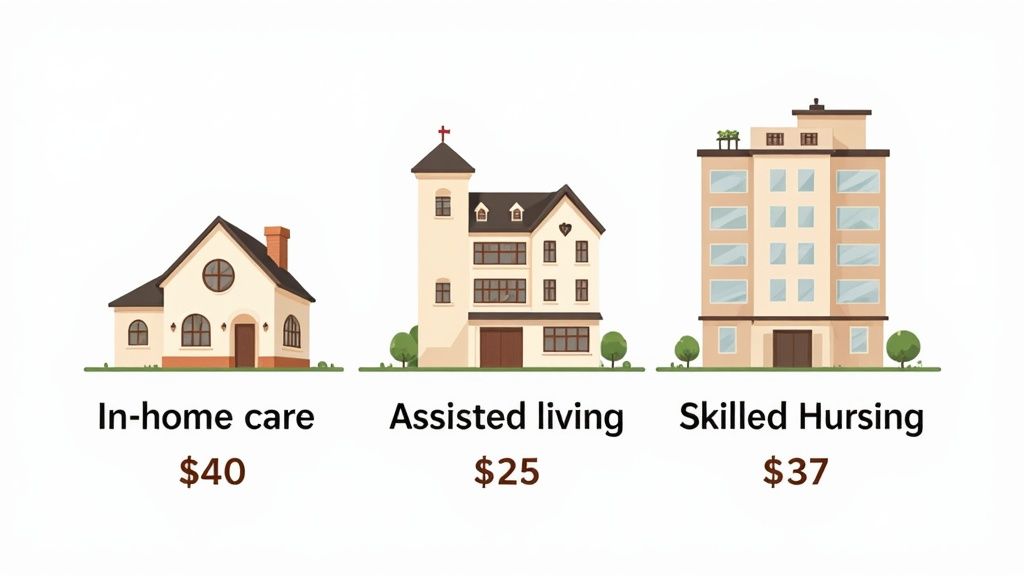
Alt text: A graphic comparing three senior care options: in-home care, assisted living, and skilled nursing, with typical hourly or monthly costs shown for each.
Is assisted living the right choice, both clinically and financially? Let's compare the three most common senior care options in Ohio to help you decide.
In-Home Care Costs
In-home care brings a caregiver into your loved one's home. It's a great option for seniors who are mostly independent but need help a few hours a week.
-
How it’s paid: By the hour.
-
Ohio average cost: Around $28 to $32 per hour.
-
Best for: Seniors who need help with tasks like cooking or transportation but do not need 24/7 supervision.
Costs can add up quickly. If care is needed for 20 hours a week, you're already looking at over $2,500 a month. Once the need for care exceeds 4-6 hours per day, assisted living often becomes more cost-effective.
Assisted Living Costs
Assisted living offers a blend of independence with the security of 24/7 support. In Ohio, these are state-licensed Residential Care Facilities.
-
How it’s paid: A monthly base rate plus level-of-care fees.
-
Ohio average cost: Around $5,500 per month.
-
Best for: Seniors who need help with daily activities like bathing, dressing, or medications but do not need the intensive medical care of a nursing home.
Skilled Nursing Facility (Nursing Home) Costs
A skilled nursing facility (SNF), or nursing home, provides the highest level of care outside a hospital. In Ohio, SNFs are federally regulated by the Centers for Medicare & Medicaid Services (CMS).
-
How it’s paid: An all-inclusive daily rate.
-
Ohio average cost: Often over $8,000 to $9,000 per month for a semi-private room.
-
Best for: Individuals with serious medical conditions who need 24/7 monitoring from licensed nurses, such as for post-surgery rehab or severe chronic illness.
What this means for you
The goal is to match the care to the need. Paying for a skilled nursing facility when your loved one only needs the personal support of assisted living means you're paying a premium for medical services they won't use.
What to do next: A 4-Step Action Plan
Here is a practical, step-by-step plan to help your Northeast Ohio family move forward with confidence. Focus on one task at a time.
Step 1: Create a Simple Budget
Before touring any communities, map out a clear financial picture.
-
List all monthly income: Add up Social Security, pensions, and any other regular income.
-
Estimate available assets: Consider savings, investments, or proceeds from selling a home that can be used for care.
-
Project monthly costs: Use the $5,500 Ohio average as a starting point. Be sure to add a buffer for level-of-care fees.
This gives you a realistic price range to guide your search.
Step 2: Contact Your Area Agency on Aging (AAA)
Even if you think you won't qualify for public benefits, this is a smart call. Your local AAA is your direct connection to programs like the Medicaid AL Waiver. They are the experts on eligibility in your county (Cuyahoga, Lake, Lorain, etc.) and can provide a definitive answer. This free call could save you thousands of dollars per month.
Step 3: Tour Communities and Ask Key Questions
This is when your research becomes real. Use this checklist during your tours to get the full financial picture.
Pricing Questions Checklist
-
What is the base rate for each apartment type (studio, one-bedroom)?
-
Can you provide a detailed list of what is included in the base rate?
-
How are your level-of-care fees structured? (e.g., tiers, points, à la carte)
-
Can we schedule a nursing assessment now to get a clear estimate of our monthly care costs?
-
How often do you reassess residents, and what might cause their care level to change?
-
What is the one-time community fee, and is any part of it refundable?
-
What has been your average annual rate increase over the last three years?
For more help, you can learn about senior living placement services that streamline this process.
Step 4: Know Your Rights and Resources
Your loved one has rights, and there are advocates to protect them.
-
Report a Concern: You can file a complaint with the Ohio Department of Health if you have an issue with a facility.
-
Talk to the Ombudsman: The Long-Term Care Ombudsman program is a free, confidential resource that advocates for residents and helps resolve problems.
For more comprehensive guidance, this resource on how to plan for long term care can provide valuable insights.
Disclaimer: This article is informational and not legal, financial, or medical advice. Please consult with licensed professionals for guidance on your family’s specific situation.
#
<!-- FAQ rendered separately -->Get matched to communities in your budget
Our Cleveland advisors know current pricing and availability — free for families.
Need Help Finding Senior Living in Greater Cleveland?
Our Greater Cleveland local advisors compare pricing, schedule tours, and answer your questions — completely free.