The Real Cost for Independent Living in Cleveland
-
TL;DR: The Bottom Line Up Front
-
In Greater Cleveland, the monthly cost for independent living typically ranges from $2,500 to $4,500.
-
This single monthly fee often bundles rent, utilities, maintenance, and amenities, offering a predictable alternative to the surprise costs of homeownership.
-
Most families use private funds (like home sale proceeds, pensions, and savings) to pay for independent living, as standard Medicaid in Ohio does not cover room and board.
-
Location (e.g., Cuyahoga vs. Geauga County) and amenities (like pools or gourmet dining) are the biggest factors driving the price.
-
Who This Helps: Families in Cuyahoga, Lake, Lorain, Geauga, Medina, and Summit counties who are comparing senior living options and need a clear, calm breakdown of independent living costs.
-
Key Takeaways:
-
Focus on the total value, not just the sticker price. Calculate what’s included versus the hidden costs of staying at home.
-
A higher price usually means more amenities or a prime location. Decide which features will genuinely improve quality of life.
-
Always tour at least three communities to get a real feel for the environment and a true apples-to-apples cost comparison.
Understanding Independent Living Costs in Cleveland

When you start exploring senior living for a family member in Northeast Ohio, the numbers can feel overwhelming. Our goal is to cut through the confusion and give you a straightforward look at independent living costs right here in the Cleveland area.
Independent living is for active, self-sufficient seniors ready to leave the hassles of homeownership behind. Think of it as downsizing the to-do list, not the lifestyle. The monthly fee simplifies budgeting by rolling many household bills into one predictable payment, which can be a huge relief for families managing a loved one's finances.
A Quick Glance At The Numbers
So, what should you really budget for? While every community sets its own prices, options in our area are often more affordable than the national median. This gives local families more breathing room to find a community that fits their budget without compromising on quality.
What this means for you: The cost for independent living in the Cleveland area is generally competitive. This allows you to explore a variety of communities and find a financial fit that provides peace of mind for your family.
To give you a clearer side-by-side view, we’ve put together a table comparing the estimated monthly costs.
Independent Living Costs at a Glance: Cleveland vs. National
Here’s a general comparison to help you see how local pricing stacks up against the national average.
| Cost Component | Estimated Greater Cleveland Range (Monthly) | National Median (Monthly) |
| :--- | :--- | :--- |
| Apartment Rent (1-Bedroom) | $2,500 – $4,500 | ~$3,065 |
| Utilities (Electric, Water, Gas, Trash) | Often Included | Often Included |
| Community Amenities & Activities | Included | Included |
| Basic Maintenance & Landscaping | Included | Included |
Sources: Data compiled from various national senior living resources and local market analysis as of March 2025. Please verify specific costs directly with communities.
For a deeper dive into how these costs compare across different levels of care, be sure to check out our detailed guide on senior living costs in Cleveland. This resource provides a broader look at pricing for Assisted Living (Residential Care Facility) and memory care, too.
What Your Monthly Fee Actually Covers
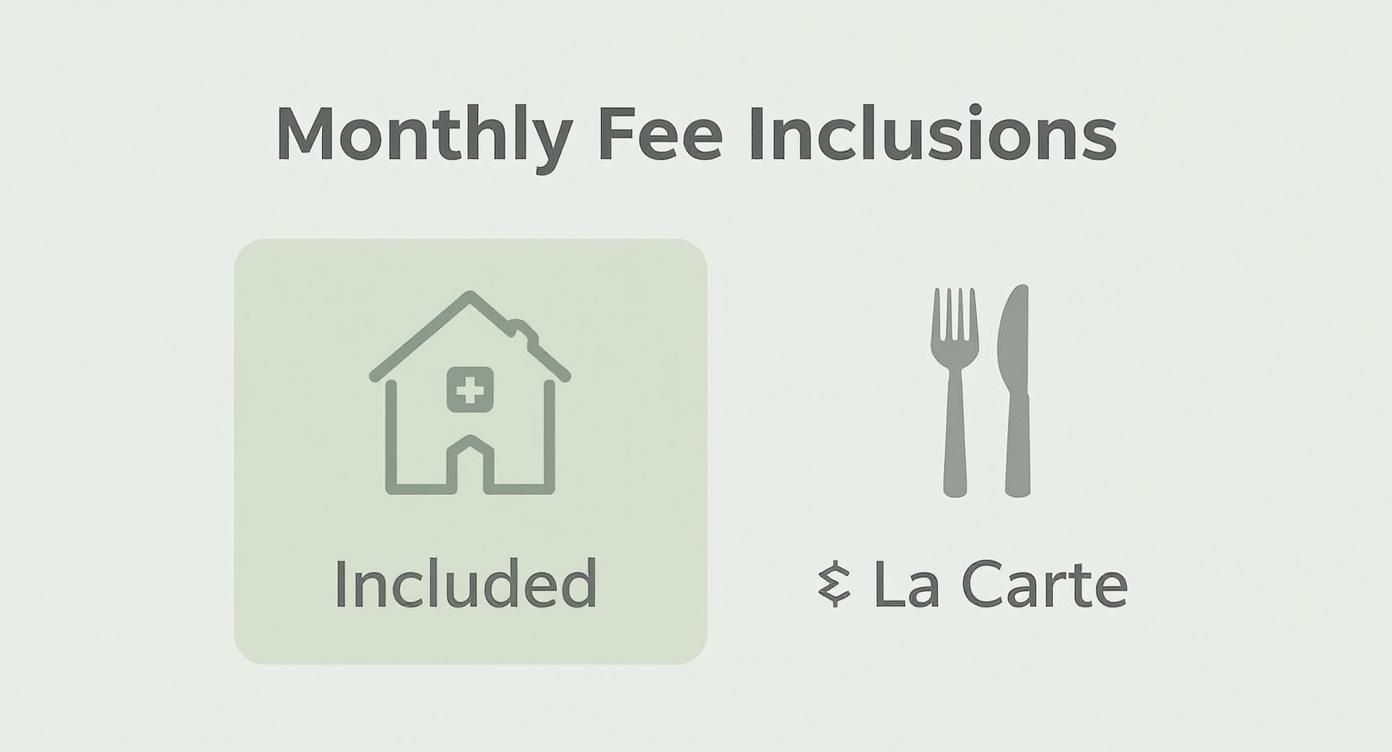
When you first see the monthly price for independent living, it's natural to ask, "What am I actually getting for that money?" Think of it like an all-inclusive payment. Instead of juggling a dozen separate bills for the mortgage, property taxes, gas, electric, and surprise home repairs, you get the peace of mind that comes with one consistent payment.
This makes budgeting much easier for everyone involved.
The Core Inclusions in Your Base Rate
The foundation of your cost is the base rate. While specifics can differ, this fee almost always covers the essentials that replace the biggest expenses of owning a home.
You can generally count on the base rate to include:
-
Your Private Apartment: The "rent" for your studio, one-bedroom, or two-bedroom home.
-
Most Utilities: Say goodbye to separate bills for electricity, water, gas, and trash removal.
-
All Maintenance: No more mowing lawns, shoveling snow, or calling a plumber for a leaky faucet.
-
24/7 Security and Staffing: This covers emergency response systems and on-site staff, giving your family peace of mind.
-
Community Amenities: Full access to shared spaces like fitness centers, libraries, game rooms, and social lounges.
-
Scheduled Activities and Events: A full calendar of social gatherings, educational classes, and recreational programs is typically included.
This bundle of services is where the real value lies. You're not just renting an apartment; you're investing in a lifestyle free from the constant chores and surprise costs of homeownership.
Common Services That May Cost Extra
Beyond the basics, most communities offer optional services on an à la carte basis. This means you only pay for what you actually use. These add-ons often include:
-
Meal Plans: While some places include one meal a day in the base rate, most offer flexible dining packages for an additional fee.
-
Housekeeping and Laundry Services: You can often schedule weekly cleaning or personal laundry services.
-
Reserved or Covered Parking: A designated spot, especially in a covered garage, might come with a small monthly fee.
-
Personal Transportation: While scheduled group trips are usually included, personal rides to a doctor’s appointment may be an extra charge.
Getting a handle on this two-part structure—the all-inclusive base rate plus optional extras—is the key to making an accurate comparison between different communities. According to NIC MAP Vision, the senior housing market has seen strong demand, with occupancy rates climbing to nearly 87.7% in late 2024. As you can see in this detailed market outlook on senior housing, this trend makes it more important than ever to know exactly what’s in your monthly fee.
This model is quite different from other types of senior care. For a helpful comparison, see our guide on what is included in assisted living costs.
Comparing Costs: Staying Home vs. Independent Living
One of the first questions families in the Cleveland area ask is: "Wouldn't it just be cheaper for Mom or Dad to stay home?" At first glance, it seems to make sense if the mortgage is paid off.
However, the true cost of aging in place is a collection of ongoing, unpredictable, and sometimes hidden expenses. When you compare these costs side-by-side with the predictable fee of an independent living community, the financial picture gets much clearer.
The Hidden Costs of Aging in Place
Even when you own your home outright, it's never truly "free." The costs shift from a mortgage to a steady stream of maintenance, repairs, and bills.
Let's break down the typical homeownership costs that often get overlooked:
-
Property Taxes: A significant annual expense in Cuyahoga County and the surrounding suburbs.
-
Home Maintenance: This is the real wildcard. A new roof can set you back $8,000-$15,000, and a furnace replacement can easily cost $5,000-$10,000.
-
Utilities: Bills for gas, electricity, water, sewer, and trash are a constant drain on a fixed budget.
-
Home Modifications: Making a home safer often means installing grab bars, building a ramp, or adding a stairlift, all of which come with a price tag.
-
In-Home Care: If your loved one eventually needs help with daily tasks, the cost of in-home care can quickly exceed the cost of a senior living community.
What this means for you: Budgeting for staying at home requires setting aside a significant amount each year for a major repair, because it’s a matter of when, not if, it will be needed.
The Real Cost of In-Home Care
Many families assume hiring an in-home aide is more affordable than moving. But the data often tells a different story. In reality, extensive in-home support can be one of the most expensive forms of long-term care.
According to research, the national median cost for homemaker services is around $6,068 per month. For a home health aide, that jumps to an average of $6,675 per month (as of 2025). These figures are often more than assisted living and significantly higher than independent living. You can read the full research on rising care costs to see how these numbers have changed over time.
The Value of a Predictable Budget
This is where the cost for independent living truly shines. Instead of juggling a dozen different bills and worrying about the next big repair, you have one predictable monthly payment. That single fee covers your apartment, utilities, maintenance, landscaping, and a full calendar of social events.
It’s also crucial to understand how independent living differs from other senior care options. Assisted Living, which is licensed by the state as a Residential Care Facility, includes hands-on personal care. Skilled Nursing, regulated by CMS, provides 24/7 medical care. Independent living is designed for active seniors who don't need that level of daily assistance, which is why its cost is lower.
By honestly adding up all current home-related expenses and comparing that total to the all-inclusive fee of an independent living community, you can make a truly informed decision.
How Location and Amenities Shape Cleveland Prices

As you explore independent living communities around Northeast Ohio, you'll notice a wide range of costs. It's no different than the housing market—a home in Chagrin Falls has a different price than one in Lakewood. The cost for independent living is driven primarily by two things: the community's location and the amenities it offers.
A community's address is a massive part of the cost. Local real estate values, property taxes, and labor costs all get baked into the monthly fee. You can expect a community in a quiet corner of Geauga or Medina County to be priced differently than one in a walkable, high-demand neighborhood in Cuyahoga County.
The Impact of Community Features
Beyond the zip code, the other half of the story is the lifestyle. The amenities and services on offer define the day-to-day experience and are reflected in the price. Some communities are built around providing fantastic core services, while others are designed to feel more like a resort with premium features.
What this means for you: A higher price tag usually means more options—more dining venues, more fitness classes, and more on-site services. The key is to figure out which of these perks your loved one will actually use. You want to pay for a better life, not just for features that sound impressive on a tour.
This isn't just a local trend. Across the country, the median cost for independent living hovers around $3,065 per month as of 2025. But that's just an average. You can discover more insights about these national cost differences to get a better sense of how Northeast Ohio stacks up.
Amenities Checklist: What Matters Most to You?
Use this checklist during your tours to compare communities and see where your money is going.
-
Dining Options:
-
Restaurant-style dining room
-
Casual bistro or café
-
Private dining room for family events
-
Flexible meal plans (e.g., one meal a day vs. three)
-
Health and Wellness:
-
Fitness center with modern equipment
-
Indoor swimming pool or hot tub
-
Group exercise classes (e.g., yoga, tai chi)
-
On-site wellness clinic or visiting physicians
-
Social and Recreational Spaces:
-
Library and computer lab
-
Movie theater or performance hall
-
Arts and crafts studio
-
Outdoor spaces like walking paths or gardens
-
Convenience Services:
-
On-site salon or barbershop
-
Scheduled transportation
-
Concierge services
-
Covered or garage parking
By focusing on what will genuinely improve quality of life, you can make a more confident and financially sound decision.
Navigating Your Payment and Funding Options
Figuring out how to pay for independent living can feel like a hurdle, but you have more options than you might realize. For most families in Northeast Ohio, it's about piecing together a few different resources to comfortably cover the costs.
How Most Families Pay for Independent Living
The vast majority of people pay for independent living out of their own pockets. This is often called private pay, which means you’re using your own income and assets rather than a government program.
It's usually a combination of things:
-
Pensions and Social Security: These reliable monthly income streams are the bedrock of most budgets.
-
Retirement Savings: This is what a 401(k) or IRA was for.
-
Sale of a Home: For many seniors, the equity built in their home becomes the primary asset that funds this next step.
-
Annuities and Investments: Other savings can be structured to provide steady funds.
What this means for you: The best first step is to take inventory of these resources. Adding them up gives you a clear picture of your monthly budget. That number is the most powerful tool you'll have when comparing communities.
Using Long-Term Care Insurance
If your family member has a Long-Term Care (LTC) Insurance policy, it's time to read the fine print. These policies are more common for covering assisted living or nursing care, but some may apply to independent living.
Every policy is different. Check for the "elimination period"—the waiting period you pay for out-of-pocket before benefits kick in. You also need to understand what "triggers" coverage. Often, a doctor must certify that help is needed with two or more Activities of Daily Living (ADLs), which might not be the case in a purely independent setting.
Veterans Benefits Can Provide Support
For eligible veterans and their surviving spouses, the VA Aid & Attendance benefit can be a game-changer. This is a monthly, tax-free payment added to a standard VA pension. The funds are flexible and can be used for living expenses, including the monthly fee at an independent living community.
Eligibility comes down to three main criteria:
-
Service Requirements: Specific wartime service qualifications.
-
Financial Need: Income and assets must be below a limit set by the VA.
-
Medical Need: A doctor must confirm assistance is needed with daily activities.
You can get official details at the U.S. Department of Veterans Affairs website.
A Note on Medicaid in Ohio
It’s very important to be clear on this: In Ohio, standard Medicaid does not pay for the room and board costs of independent living. Medicaid is designed to cover medical care and support services for people with limited income and assets, typically in assisted living or skilled nursing facilities.
While some Medicaid waiver programs might cover certain in-home care services that you could receive while living in an independent apartment, those programs will not pay the community's rent or monthly service fee. To learn more, see our guide on how Medicaid works for assisted living in Ohio.
What to Do Next
<iframe width="100%" style="aspect-ratio: 16 / 9;" src="https://www.youtube.com/embed/t3XFqVMcAOA" frameborder="0" allow="autoplay; encrypted-media" allowfullscreen></iframe>Feeling informed is the first big step. Now, let’s turn this information into a clear, manageable action plan.
-
Calculate Your True Budget. Before you compare communities, get a clear picture of current spending. Pull out bank statements and tally up everything—mortgage/rent, utilities, property taxes, home maintenance, groceries, and any in-home help. This number is your baseline for an apples-to-apples comparison.
-
Book a Few Tours. The only way to get a feel for a place is to visit. Schedule tours at three different communities to see how prices and atmospheres vary. When you're there, look at actual apartment sizes, check out amenities, and ask for a full fee schedule.
-
Ask Smart Questions. Go into a tour with a short list of questions to stay focused.
-
What exactly is included in the base monthly rate?
-
Are utilities like cable and internet part of the package?
-
What are the one-time fees, like a community fee or pet deposit?
-
What happens if my loved one needs more care in the future?
- Get Personalized Help. You don’t have to do this alone. A local expert can help you sort through options based on your specific budget and needs. When you're ready, reach out to us at guideforseniors.com.
For peace of mind, it’s also wise to ask about resident rights. You can always cross-reference information with resources like the Ohio Long-Term Care Ombudsman.
Example: Cuyahoga County Family Compares Costs
A family in Lakewood was trying to decide if their mother should stay in her home. They were stressed about her isolation and the surprise costs of repairs. Here’s how they broke down the numbers:
| Category | Cost to Stay Home (Monthly) | Independent Living Fee (Monthly) |
| :--- | :--- | :--- |
| Property Taxes, Utilities, Insurance | $1,100 | Included |
| Landscaping & Snow Removal | $250 | Included |
| Budget for Home Repairs (avg.) | $400 | Included |
| Groceries & Meal Prep | $600 | Includes 1 meal/day |
| Total Monthly Cost | $2,350 | $3,200 |
While the independent living fee was $850 higher, it also included 24/7 security, transportation, a full social calendar, and access to a fitness center. For them, the added safety and social connection were well worth the difference, providing a clear solution.
Answering Your Top Questions
Is There an Entrance Fee for Independent Living Communities?
Most of the time, yes. This is often called a one-time community fee. It's a non-refundable fee that covers the administrative work of moving in, preparing your apartment, and providing lifetime access to shared amenities. Always get this fee in writing so you can factor it into your initial budget.
Can I Deduct Independent Living Costs on My Taxes in Ohio?
The answer is "it depends." In Ohio, the portion of your fees paid directly for medical care might be deductible if it exceeds 7.5% of your adjusted gross income. Purely lifestyle costs like rent and meals usually don't qualify.
The bottom line: Talk to a tax professional. They are the only ones who can look at your specific finances and the community's fee structure to give you a definite answer.
What Happens If I Need More Help Later?
This is one of the most important questions to ask during a tour. Many communities are designed for this and are known as Continuum of Care Retirement Communities (CCRCs).
A CCRC has independent living, assisted living, and often memory care or skilled nursing all on the same campus. If your needs change, you can move to a different level of care within the same community you know and love. Ask the community to walk you through how that transition works, including the costs and whether current residents get priority.
Disclaimer: This article is for informational purposes and should not be considered legal, financial, or medical advice. Please consult with licensed professionals for guidance on your specific situation.
Trying to figure out all the costs and options can feel like a lot, but you're not in this by yourself. The local Senior Living Advisors at Guide for Seniors are experts in the Northeast Ohio market. We can get you personalized pricing, set up tours, and help your family find that perfect fit—and our help is always free.
You can start exploring options right now at https://www.guideforseniors.com.
Get matched to communities in your budget
Our Cleveland advisors know current pricing and availability — free for families.
Find Medicaid-Approved Communities Near You
Looking for a facility that accepts the Ohio Medicaid Assisted Living Waiver? Browse communities in these Cleveland suburbs:
Medicaid waiver communities on Cleveland's west side
East side communities accepting Ohio Medicaid
Affordable Medicaid options in south suburbs
Near-west Medicaid-approved communities
Southwest suburban Medicaid facilities
Central location with waiver-approved care
Need help navigating Medicaid? Our local advisors provide free guidance →
Need Help Finding Senior Living in Greater Cleveland?
Our Greater Cleveland local advisors compare pricing, schedule tours, and answer your questions — completely free.