A Cleveland Family's Guide to Retirement Homes in Ohio
Finding the right retirement home for a loved one can feel like an urgent, complicated puzzle. For families in Greater Cleveland, making a thoughtful decision under stress is a heavy burden. The options seem endless, and the costs—ranging from $3,800 to over $8,000 a month—can be overwhelming. This guide is built to give you a clear, calm, and solution-oriented path forward.
TL;DR: The Bottom Line, Up Front
-
Four Main Care Types: In Ohio, your main options are Independent Living, Assisted Living (officially a Residential Care Facility), Memory Care for dementia, and Skilled Nursing for intensive medical needs. The right fit depends entirely on your loved one’s current health.
-
Northeast Ohio Costs: Expect monthly costs to start around $3,800 for assisted living and climb past $8,000 for specialized memory care. Prices vary by county, the community's age, and the specific level of personal care required.
-
How Families Pay: Most people use a mix of private funds (savings, home equity), long-term care insurance, or Veterans benefits. For seniors with limited income and assets, Ohio's Medicaid Assisted Living Waiver (AL Waiver) can help cover the cost of care services.
Who this helps
This guide is for families in Greater Cleveland—specifically Cuyahoga, Lake, Lorain, Geauga, Medina, and Summit counties—who feel overwhelmed by the process of finding senior living. Whether you're just starting your research, actively comparing communities, or trying to understand payment options like Medicaid, you'll find clear, locally-focused answers here.
Key takeaways
This isn't just a generic overview. We'll walk through how to look up a facility’s official state inspection report online, provide a checklist of essential questions for your tour, and explain how to build a realistic budget based on Northeast Ohio pricing. It’s all about giving you practical tools to make a confident decision.
A Guide to the 4 Main Types of Senior Care in Ohio
When you start looking into retirement homes in Ohio, the different terms can feel confusing. But it really all comes down to four basic types of care, each designed to support a different stage of a senior’s journey. Understanding these categories is the best first step to finding a solution that truly fits your family’s needs.
This flowchart provides a visual roadmap of how the types of care, their costs, and the ways to pay for them all connect.
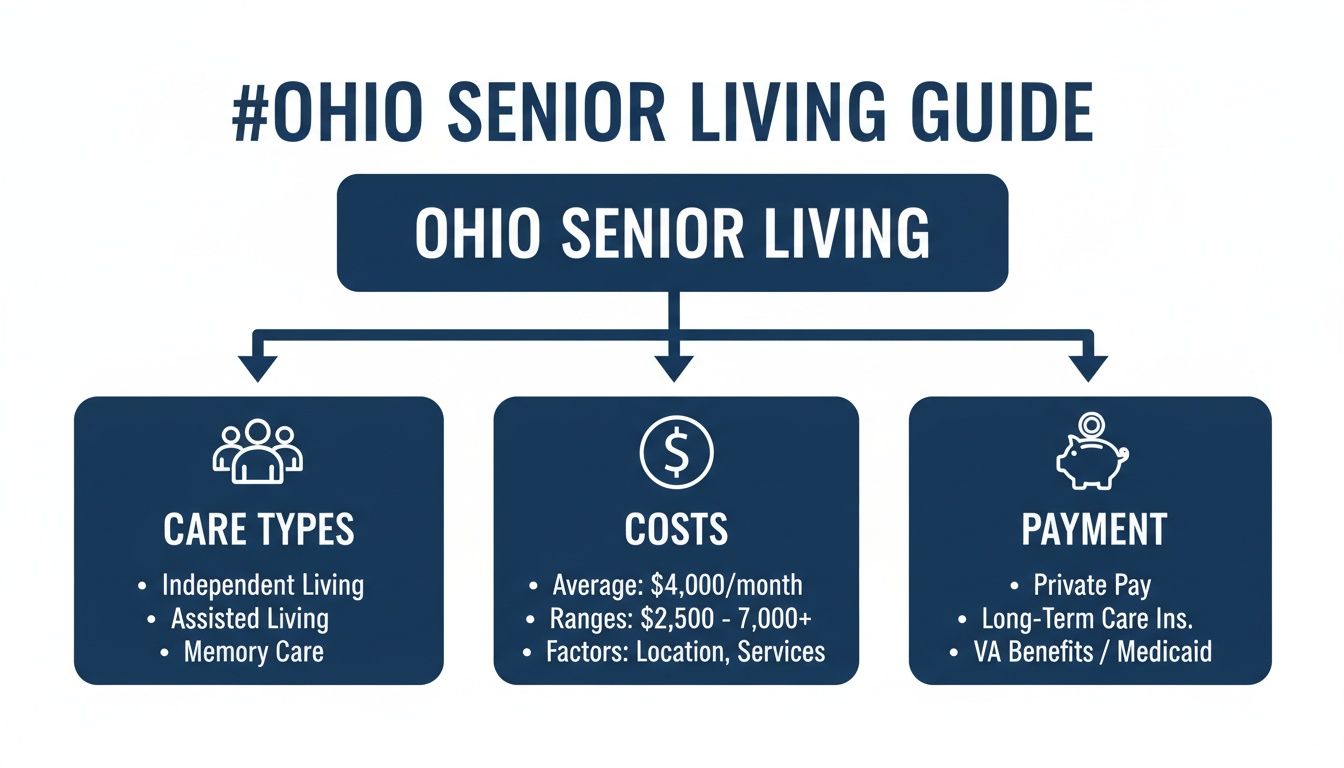
alt text: Flowchart showing senior living options in Ohio. It details the progression from Independent Living to Assisted Living, Memory Care, and Skilled Nursing, along with associated costs and payment methods like private pay, long-term care insurance, and Medicaid waivers.
To help you quickly compare your options, this table breaks down the basics for each type of care available in Ohio.
Ohio Senior Living Options at a Glance
| Type of Care | Best For... | Typical Services Provided | Ohio Licensing Authority |
| :--- | :--- | :--- | :--- |
| Independent Living | Active seniors who want community without home maintenance. | Social activities, dining, transportation, housekeeping. No personal care. | Ohio Department of Commerce (for rental agreements). |
| Assisted Living | Seniors needing help with daily tasks but not 24/7 medical care. | Help with bathing, dressing, medication reminders, meals, 24-hour staff. | Ohio Department of Health (licensed as a Residential Care Facility - RCF). |
| Memory Care | Individuals with dementia needing a secure, specialized environment. | 24-hour supervision, dementia-trained staff, secure setting, structured routines. | Ohio Department of Health (often a specialized unit within an RCF). |
| Skilled Nursing Facility | Individuals with complex medical needs or recovering from a hospital stay. | 24/7 nursing care, physical/occupational therapy, post-surgical rehab. | Ohio Department of Health (federally and state regulated). |
Now, let's explore what each of these means for your family.
1. Independent Living
Think of independent living as a lifestyle choice, not a healthcare decision. These communities are for active, self-sufficient seniors who are tired of home maintenance—no more shoveling snow, mowing lawns, or fixing leaky faucets. Residents live in private apartments and enjoy a vibrant social life with amenities like fitness centers, group dining, and organized outings.
What this means for you: If your parent is still driving, managing their health, and living independently but feels isolated or burdened by home upkeep, independent living is an excellent place to start your search.
2. Assisted Living (Residential Care Facility)
This is the option most people think of as a "retirement home." In Ohio, the official term on licenses is Residential Care Facility (RCF). Assisted living is for seniors who need a helping hand with daily tasks like bathing, getting dressed, or remembering to take medications. Staff is on-site 24/7, and the community provides meals, housekeeping, and social events.
3. Memory Care
Memory care is a specialized form of assisted living designed for people living with Alzheimer's or other forms of dementia. The top priority is safety. These communities are secured to prevent wandering and designed to minimize confusion. The staff is specially trained in dementia care to communicate effectively and manage behavioral symptoms with compassion. Activities are tailored to engage residents and provide a sense of purpose. For more details, see our guide on memory care vs. assisted living.
4. Skilled Nursing Facility (SNF)
A Skilled Nursing Facility (SNF), often called a nursing home, provides the highest level of care outside of a hospital. These are federally regulated healthcare settings for people with complex medical conditions that demand 24/7 attention from licensed nurses and therapists. A stay can be short-term for rehabilitation after surgery or long-term for residents who need around-the-clock medical care. Unlike assisted living, Medicare often covers a short-term, rehabilitative stay in an SNF.
Breaking Down Senior Living Costs in Northeast Ohio
Talking about the money side of senior care is often the most stressful part of the process. The key is to look past the single monthly price and understand what you are actually paying for.
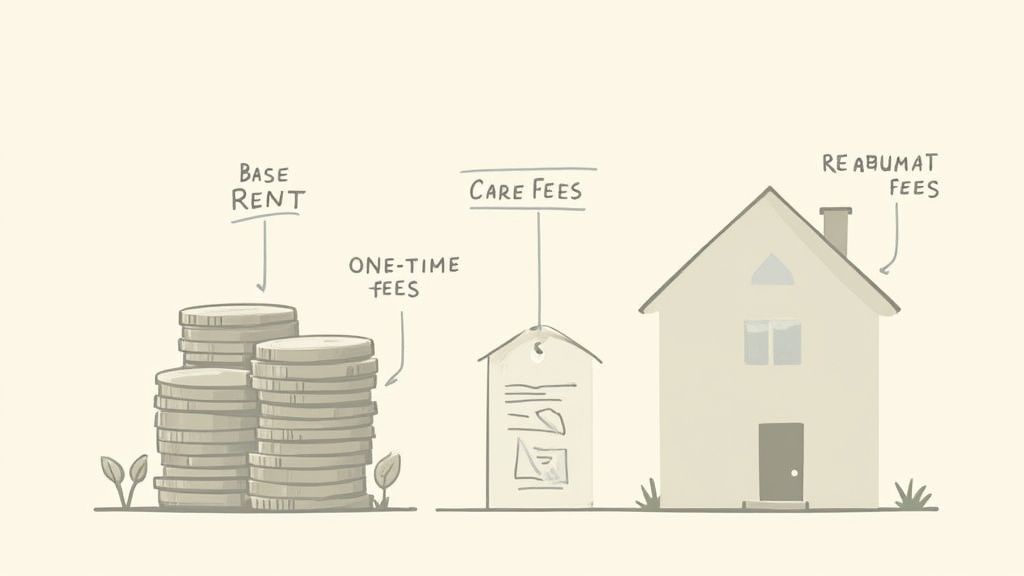
alt text: Illustration showing the different components of senior living costs: a base rent for housing, one-time community fees, and additional level-of-care fees for personal support.
Most retirement homes in Ohio use a similar pricing model, but the dollar amounts vary by community and county. Here’s what you can realistically expect.
How Pricing Works: A Three-Part Formula
A community's price quote usually has three parts:
-
Base Monthly Rent: This covers the apartment, three daily meals, utilities, housekeeping, and access to all community amenities and social programs.
-
Level-of-Care Fees: This is a separate monthly fee for personalized support. Before move-in, a nurse assesses your loved one's needs (e.g., help with bathing, dressing, medication management). This assessment assigns a care level with a corresponding fee that's added to the base rent. These are sometimes called activities of daily living (ADL) support fees.
-
One-Time Community Fee: Most communities charge a one-time, non-refundable fee upon signing the lease. This administrative fee covers apartment prep and initial assessments and can range from $1,500 to $5,000 or more.
Typical Costs in Cuyahoga, Summit, and Lorain Counties
These ranges (updated March 2025) offer a starting point for budgeting in Northeast Ohio. A community’s location, age, and amenities will affect the final price.
-
Assisted Living: Monthly base rent typically falls between $3,800 and $6,500.
-
Memory Care: Due to specialized staff and security, monthly rates usually start around $5,500 and can exceed $8,000.
What this means for you: When you ask about pricing, be direct: "Can you please break that down for me? What is the base rent, what are the different level-of-care fees, and what is your one-time community fee?" Getting all three numbers is the only way to make an accurate comparison.
How Families Pay for Senior Living
Most families use a combination of resources to cover costs. Ohio's housing index is lower than the national average, making it an appealing state for senior living. You can find more data on the growth of the senior living market on ibisworld.com.
Here are the most common payment methods:
-
Private Funds: Personal savings, pensions, Social Security income, or proceeds from selling a home.
-
Long-Term Care Insurance: If your loved one has a policy, check the daily benefit amount, waiting period ("elimination period"), and what specific conditions trigger coverage.
-
Veterans Benefits: The VA’s Aid and Attendance benefit provides a monthly pension to eligible veterans and surviving spouses to help with care costs.
Using Ohio's Medicaid AL Waiver
For seniors with limited financial resources, Ohio's Medicaid Assisted Living Waiver (AL Waiver) can be a lifeline. This waiver program helps pay for care services in an assisted living community.
Eligibility Basics (as of March 2025):
-
Financial Need: An applicant must meet Ohio's strict income and asset limits for Medicaid.
-
Care Need: An assessment must confirm the individual requires a nursing-facility level of care but can live safely in an assisted living setting.
-
Community Choice: The chosen assisted living community must be a certified provider for the AL Waiver program.
Example: A Cuyahoga County family is helping their mother, whose only income is Social Security and who has less than $2,000 in savings. After confirming she meets the medical criteria, they apply for the AL Waiver. Once approved, she moves into a participating community. She contributes her Social Security income (minus a small personal needs allowance), and the waiver pays the community for the rest of her care services.
For a deeper dive into local pricing, see our guide on understanding senior living costs in Cleveland.
How to Look Beyond the Brochure When Evaluating a Retirement Community
A grand lobby doesn't tell you what life is really like inside a community. When you’re looking at retirement homes in Ohio, you have to dig deeper into the factors that shape a resident's day-to-day safety and well-being. This means asking tough questions, observing carefully during your tour, and doing some research beforehand.
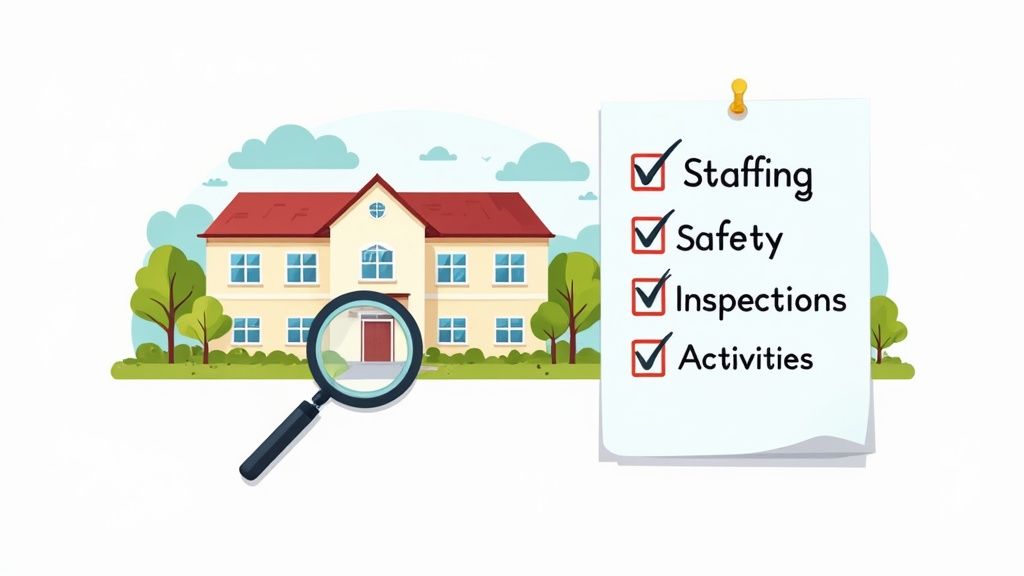
alt text: An illustration of a retirement community being evaluated. A magnifying glass focuses on a checklist that includes items like Staffing, Safety, Inspections, and Activities, symbolizing a thorough review process.
Staffing: The Heartbeat of the Community
A stable, well-trained, and caring team is the most reliable sign of a high-quality community. High staff turnover is a major red flag.
When you visit, pay attention to how staff members interact with residents. Do they seem stressed and hurried or warm and patient? Ask the director specific questions:
-
Turnover Rate: "What is your annual turnover rate for caregiving staff?" A low number is a good sign.
-
Staffing Ratios: "What are your staff-to-resident ratios for day, evening, and overnight shifts?" In Ohio, assisted living communities must meet state minimums, but the best ones staff well above them.
-
Ongoing Training: "What initial and ongoing training do caregivers receive, especially for dementia care?"
Decoding Ohio's Official Inspection Reports
Every licensed Assisted Living (Residential Care Facility) in Ohio is regularly inspected by the Ohio Department of Health (ODH). These public reports offer an unbiased look at how well a community follows state rules. You can find them on the ODH website. Reports may include "citations," which are violations of state regulations.
What this means for you: Not all citations are equal. A minor citation for a torn window screen is very different from a serious one for medication errors. Look at how severe the findings are, whether they were fixed promptly, and if there is a pattern of recurring problems. A single, minor issue is less concerning than recent, serious violations.
What is the Quality of Life Really Like?
Safety and staffing are vital, but so is daily quality of life. A great community nurtures a resident's social, emotional, and physical health.
-
The Dining Experience: Ask for a menu and try to stay for a meal. Does the food look appealing? Does the dining room feel like a friendly restaurant or a cafeteria?
-
Social Life and Activities: Review the monthly activity calendar. Is there a variety of programs that would interest your loved one? Look for a mix of activities that keep residents active, engaged, and socializing.
-
Emergency Protocols: How do they handle medical emergencies? Is a nurse on-site 24/7 or just on-call? What is their exact procedure for hospital transport?
Your On-Site Tour Checklist
A tour is your best opportunity to see everything firsthand. Use this checklist to stay focused. For a complete list, see our guide on questions to ask assisted living facilities.
Community Atmosphere & Cleanliness
-
Does the community have a clean, fresh smell?
-
Are common areas well-kept and inviting?
-
Do residents seem happy and engaged?
Staff & Resident Interactions
-
How do staff members talk to residents? (Listen for respectful, kind tones.)
-
Do you notice friendly, positive interactions?
-
Is the person at the front desk welcoming?
Safety & Accessibility
-
Are hallways bright and equipped with handrails?
-
Do bathrooms have grab bars and non-slip floors?
-
Are emergency exit plans clearly posted?
Your Step-By-Step Decision-Making Checklist
<iframe width="100%" style="aspect-ratio: 16 / 9;" src="https://www.youtube.com/embed/u3oP98zk5FI" frameborder="0" allow="autoplay; encrypted-media" allowfullscreen></iframe>Moving from "we need to do something" to signing a lease can feel like a marathon. By breaking the journey into four clear phases, you can turn an overwhelming process into a series of manageable steps.
Phase 1: Assess Needs and Finances
Before you visit any community, you need to get your bearings. This phase is about honest conversations and financial planning.
-
Define Care Needs: Involve your loved one and key family members in a frank discussion about current and future needs. Is help with daily tasks the priority (assisted living), or is specialized memory support essential (memory care)?
-
Create a Realistic Budget: Add up all monthly income (Social Security, pensions) and factor in assets (savings, home equity). You need a concrete number to know what you can afford.
-
Explore Financial Aid: Contact your local Area Agency on Aging to ask about Ohio’s Medicaid AL Waiver. If your loved one is a veteran, research VA benefits like Aid and Attendance.
Example: A Medina County Family's First Step
A family in Medina realizes their father, who has dementia, can no longer live safely at home. Their first call is to the Western Reserve Area Agency on Aging. A specialist explains the financial and medical criteria for the AL Waiver, giving them a clear understanding of whether that's a viable path before they start touring memory care communities.
Phase 2: Research and Shortlist Communities
With your needs and budget defined, you can start your search. Rely on objective sources, not just glossy brochures.
-
Use State Resources: Use the Ohio Department of Health's online portal to find licensed communities in your target counties, like Lorain or Geauga.
-
Read Inspection Reports: For every promising community, pull its latest state inspection report. This is non-negotiable. Note the severity and frequency of any citations.
-
Create a Shortlist: Based on location, services, and inspection history, narrow your list to your top 3-4 communities to visit in person.
Phase 3: Tour and Evaluate
An in-person tour is your chance to get a genuine feel for a place.
-
Schedule Tours: Call your shortlisted communities to set up a visit. Try to go during a busy time, like late morning or a mealtime, to see the community in action.
-
Use an Evaluation Checklist: Bring a prepared checklist to ask the same critical questions at each location. Cover staffing, dining, activities, and safety.
-
Observe Interactions: Watch how staff talks to residents and how residents talk to each other. A warm, respectful environment is a powerful sign of a good community.
Phase 4: Review and Decide
You've done the work. Now you can bring it all together to make a confident choice.
-
Compare Your Notes: Sit down with your family and compare your checklists side-by-side. Focus on what matters most to your family.
-
Review the Contract: Once you have a top choice, ask for a copy of the residency agreement. Have an elder law attorney or trusted financial advisor review it before you sign.
-
Plan the Transition: Work with the community's staff to set a move-in date and create a plan to make the transition as smooth as possible.
What to do next
You've just absorbed a lot of information. The key is to turn that knowledge into a single, concrete action. You don’t have to do it all at once.
Your Next 2–5 Steps
Here are a few simple, effective steps you can take today. Pick one that fits your family's immediate needs.
-
Check AL Waiver Eligibility: Contact your local Area Agency on Aging. For Cuyahoga, Geauga, Lake, Lorain, and Medina counties, that’s the Western Reserve Area Agency on Aging. Ask about the financial and medical requirements for the Medicaid AL Waiver.
-
Read an Inspection Report: Pick one community you're considering and look up its record on the state's Long-Term Care Consumer Guide. This will give you a real-world feel for how to interpret these reports.
-
Book One Tour: Call your top choice and schedule a visit. Getting that first tour on the calendar is a huge step forward.
-
Know Your Rights: Bookmark the Ohio Long-Term Care Ombudsman page. They are your free, confidential advocate for resolving any issues.
-
Report a Concern: If you have an urgent safety concern about any facility, you can file a complaint directly with the Ohio Department of Health.
What this means for you: You are not alone. Ohio has a solid network of support for families. Using these official resources gives you unbiased information and a powerful ally.
Disclaimer: This article is informational and not legal, financial, or medical advice. Please consult licensed professionals for case-specific guidance.
#
<!-- FAQ rendered separately -->Find Medicaid-Approved Communities Near You
Looking for a facility that accepts the Ohio Medicaid Assisted Living Waiver? Browse communities in these Cleveland suburbs:
Medicaid waiver communities on Cleveland's west side
East side communities accepting Ohio Medicaid
Affordable Medicaid options in south suburbs
Near-west Medicaid-approved communities
Southwest suburban Medicaid facilities
Central location with waiver-approved care
Need help navigating Medicaid? Our local advisors provide free guidance →
Need Help Finding Senior Living in Greater Cleveland?
Our Greater Cleveland local advisors compare pricing, schedule tours, and answer your questions — completely free.