Retirement Community vs. Nursing Home: A Cleveland Family's Guide
Choosing senior living can feel overwhelming. You’re hearing terms like “assisted living” and “nursing home” but aren’t sure what they mean for your family. This guide is designed to give you clear, simple answers so you can make the right decision for your loved one in the Greater Cleveland area.
-
TL;DR
-
Assisted Living is for social, largely independent seniors who need help with daily tasks like meals and medication reminders. It feels like home.
-
A Nursing Home is a medical facility for people with complex health conditions needing 24/7 skilled nursing care or intensive rehab after a hospital stay.
-
Payment is different: Assisted living is mostly paid for with private funds, while nursing home care is often covered by Medicare (short-term) or Medicaid (long-term).
-
In Ohio: Assisted living communities are state-licensed as "Residential Care Facilities," while nursing homes are federally regulated as "Skilled Nursing Facilities."
Who This Guide Helps
This guide is for families in Cuyahoga, Lake, Lorain, Geauga, Medina, and Summit counties who are:
-
Trying to understand the difference between assisted living and skilled nursing.
-
Feeling stressed and unsure about the next steps for a parent or spouse.
-
Planning for future care needs and want to understand the costs and options in Ohio.
Key Takeaways
-
The right choice depends entirely on the level of medical care needed.
-
Costs vary dramatically, so understanding payment sources like private savings, Medicare, and the Ohio Medicaid Assisted Living Waiver (AL Waiver) is critical.
-
Always check official inspection reports from the Ohio Department of Health (for assisted living) and Medicare.gov (for nursing homes).
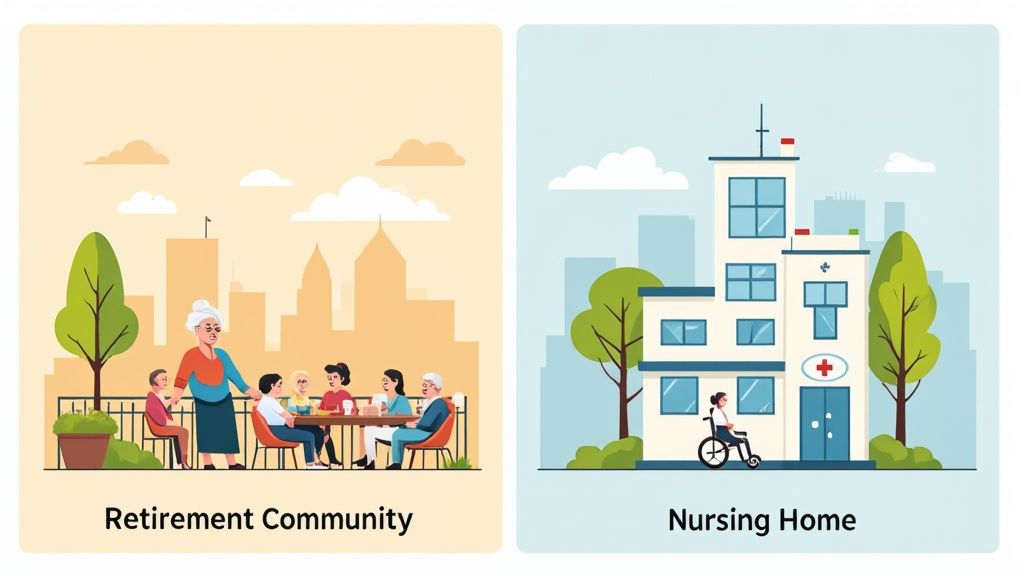
Getting the Definitions Straight: What's in a Name?
When you look for senior care, the words used matter. "Retirement community" and "nursing home" are not the same. In Ohio, they have different legal definitions, are overseen by different agencies, and provide very different levels of care. Understanding this is key to keeping your loved one safe and happy.
A retirement community is a broad term for senior housing. For families in Ohio needing help with daily tasks like dressing, meals, or medications, the specific option you're likely looking for is Assisted Living.
Ohio's Assisted Living (Residential Care Facilities)
In Ohio, communities we call "assisted living" are officially licensed by the Ohio Department of Health (ODH) as Residential Care Facilities (RCFs). This is an important distinction. It means the state sets rules for everything from staffing and safety to the services they can provide. The goal of an RCF is to offer a supportive, home-like environment, not to provide intensive, round-the-clock medical treatment.
What this means for you: When you tour an assisted living community in the Greater Cleveland area, you are looking at a place that must follow state rules designed to promote independence and quality of life. The ODH conducts regular inspections to ensure these standards are met, giving you a baseline for safety.
Nursing Homes (Skilled Nursing Facilities)
A nursing home is a medical facility first and a home second. These are federally regulated by the Centers for Medicare & Medicaid Services (CMS), and their official name is Skilled Nursing Facilities (SNFs).
This federal oversight is much stricter because SNFs are designed to provide 24/7 skilled nursing care from registered nurses (RNs) and licensed practical nurses (LPNs). They manage serious medical conditions, handle rehabilitation after a hospital stay, and care for individuals with significant physical needs. You can see this difference in the senior care industry, where nursing homes, focused on complex medical cases, make up a larger portion of spending than assisted living. You can explore more insights about senior care industry trends to see how market forces shape these roles.
Checklist for Verifying Oversight
Use this checklist to confirm the type of facility and check its official record:
-
For Assisted Living: Ask to see the community's Ohio "Residential Care Facility" license. You can then look up its inspection reports on the Ohio Department of Health website.
-
For Nursing Homes: Confirm it is a "Skilled Nursing Facility." You can find detailed ratings and full inspection reports using the federal Medicare Care Compare tool.
-
During a Tour: Ask the administrator to show you the results of their most recent state survey (for assisted living) or federal survey (for a nursing home).
Comparing Daily Life, Staffing, and Environment
Choosing between assisted living and a nursing home means choosing between two completely different ways of life. The environment, people, and daily schedule are designed for very different purposes.
In an assisted living community, the focus is on independence and social connection. It feels more like a service-rich apartment complex than a healthcare facility, with private apartments, restaurant-style dining, and common areas full of activities.
A nursing home, by contrast, is a clinical setting designed to deliver constant medical care. It often feels more like a hospital, with semi-private rooms, medical equipment in the hallways, and nurses' stations as the hubs of activity.
Staffing: Supportive vs. Medical Models
The staff in each setting reflects its mission. One is built for lifestyle support, the other for medical intervention.
In an assisted living community, the team helps with Activities of Daily Living (ADLs)—non-medical tasks like bathing, dressing, and getting around. The staff includes:
-
Personal Care Aides (PCAs): Frontline caregivers providing hands-on assistance.
-
Licensed Nurses (LPNs/RNs): Manage medications and monitor health, but do not provide complex medical treatments.
-
Activity Directors: Plan social events, classes, and outings.
A nursing home is staffed like a hospital wing for 24/7 medical management. Key staff include:
-
Skilled Nurses (RNs/LPNs): Always available to administer IV medications, provide wound care, and monitor vital signs.
-
Certified Nursing Assistants (CNAs): Provide personal care under the direct supervision of nurses.
-
Therapists: In-house physical, occupational, and speech therapists work with residents daily.
-
Medical Director: A doctor who oversees all clinical care in the facility.
What this means for you: If your loved one needs help with daily routines and wants an active social life, the lifestyle-focused staff in assisted living is a great fit. If they need constant medical supervision or are recovering from surgery, the clinical team in a nursing home is essential.
Breaking Down the Costs and Payment Options in Ohio
For most families in Northeast Ohio, understanding the cost of care is the most stressful part. How you pay for assisted living and how you pay for a nursing home are completely different.
How Assisted Living is Priced and Paid For
An assisted living bill usually has a few parts. Always ask for a detailed breakdown so there are no surprises.
-
Base Rate: This is like rent and usually covers the apartment, three meals a day, housekeeping, and activities.
-
Level-of-Care Fees: This is an extra monthly charge based on how much hands-on help a resident needs (e.g., for bathing or dressing). A nurse assesses this before move-in, and it can change if care needs increase.
-
One-Time Fees: Most communities charge a one-time, non-refundable "community fee" at move-in to cover administrative and apartment prep costs.
In Ohio, assisted living is almost always paid for with private funds—savings, pensions, Social Security, or proceeds from selling a home. Long-term care insurance can also cover a large portion of the cost.
How Nursing Home Costs Work
Nursing home costs are higher due to the intensive medical care. You’ll typically see a single daily rate that bundles room, meals, skilled nursing care, and medications. Payment sources are very different:
-
Medicare: This federal program only covers short-term, rehabilitative stays in a skilled nursing facility after a qualifying 3-day hospital stay. It can cover up to 100 days. Medicare does not pay for long-term custodial care.
-
Medicaid: For those who need long-term care and meet strict financial limits, Medicaid is the primary payer. Many people pay privately until their assets are "spent down" to the level where they qualify for Medicaid. Talking to an elder law attorney about protecting assets from nursing home costs can be a crucial step.
Ohio's Medicaid Assisted Living Waiver
While assisted living is mostly private pay, there is an important exception in Ohio: the Medicaid Assisted Living Waiver (AL Waiver). This program helps eligible, low-income seniors pay for the care services portion of their assisted living bill. The resident still pays for room and board, usually with their Social Security income.
Example: A Cuyahoga County family is looking for care for their mother. Her only income is a small pension, and she has very few savings. Through the local Area Agency on Aging, they discover she qualifies for the AL Waiver. The waiver pays for her care services at an assisted living community in Parma, and her pension covers the room and board fee. This makes a high-quality, home-like setting affordable.
If your loved one has limited financial resources, your first call should be to your local Area Agency on Aging to start the AL Waiver assessment process.
Ohio Payment Options: At-a-Glance
| Payment Source | Covers Assisted Living? | Covers Nursing Home? | Key Ohio Details |
| :--- | :--- | :--- | :--- |
| Private Pay | Yes, primary source. | Yes, for those who don't qualify for other aid. | Covers all costs: room, board, and care. |
| Medicare | No. | Yes, for short-term rehab only (up to 100 days). | Requires a 3-day qualifying hospital stay. |
| Ohio Medicaid | Yes, via the AL Waiver for care services. | Yes, primary payer for long-term care. | Strict financial and medical rules apply. |
| LTC Insurance | Yes. | Yes. | Check your specific policy for coverage details. |
Making the Right Choice for Specific Health Needs
Choosing the right care setting is about matching your loved one's real-world needs to the right environment. Let’s look at common scenarios Cleveland-area families face.
or 'Long-term Care' (paid by Private Pay/Medicaid).](https://cdn.outrank.so/5d03c21f-d46f-4ec4-811a-6a4fa5936936/078e984f-4e84-4859-a64e-31b60732f743.jpg)
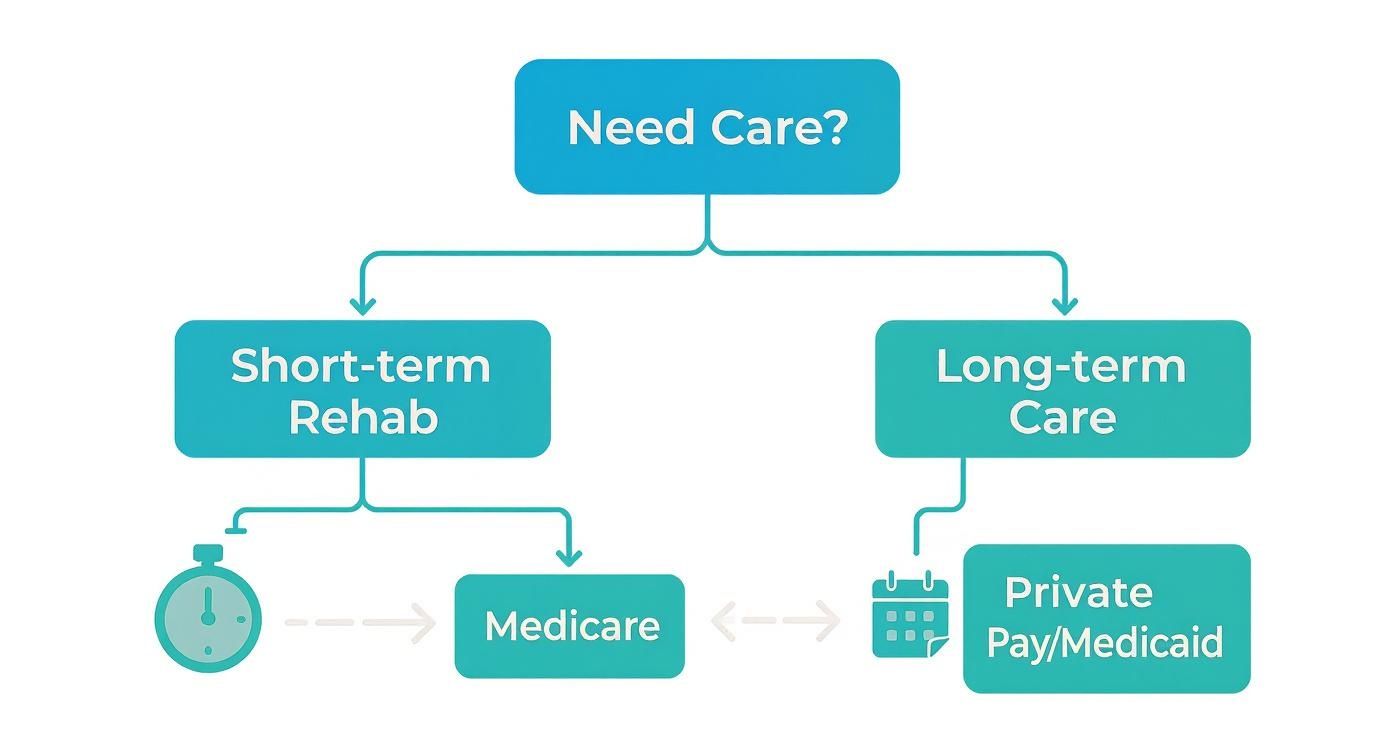
When Short-Term Rehab Is the Goal
Scenario: Your father in Lorain County just had a knee replacement. He needs intensive physical therapy and medical oversight for several weeks to recover before he can go home.
Best Fit: A nursing home (Skilled Nursing Facility).
A nursing home provides the structured, in-house rehabilitation covered by Medicare that is necessary for a safe recovery. An assisted living community is not equipped for this level of medical therapy.
For Early-Stage Dementia and Memory Support
Scenario: Your mother in Cuyahoga County has early-stage Alzheimer's. She is physically healthy but needs a secure environment with specialized activities and staff trained in dementia care.
Best Fit: A memory care unit within an assisted living community.
These secure "neighborhoods" offer 24/7 supervision in a home-like setting with staff who understand dementia. It is a much better fit than the clinical environment of a nursing home for someone who does not have complex medical needs. Explore local options in our memory care in Cleveland guide.
For Seniors Needing Daily Support and Social Life
Scenario: Your uncle in Geauga County is lonely and finds it hard to cook and clean. He is medically stable but needs help with daily chores and wants companionship.
Best Fit: An Assisted Living (Residential Care Facility).
This directly addresses his social and practical needs without the unnecessary medical services and higher cost of a nursing home. It offers independence with a safety net. This focus on lifestyle is why the senior living industry is growing, as highlighted in a 2025 investor outlook. You can read the full analysis on seniors housing investment trends to learn more.
What to Do Next: Your 4-Step Action Plan
Feeling informed is one thing; taking action is another. Here are concrete steps for families in Greater Cleveland.
Step 1: Complete a Care Needs Checklist
Before you tour, get clear on what you're solving for. Use this checklist to guide a family conversation.
-
Medical Needs: Do they need daily skilled nursing (e.g., wound care, IVs), or just medication reminders?
-
Daily Help: Where is help truly needed? Be specific: bathing, dressing, cooking, mobility.
-
Social Life: Is your loved one isolated? Would a community with planned activities improve their quality of life?
-
Safety: What are your biggest worries? Falls? Wandering? Being alone?
Step 2: Understand Your Budget
Review your loved one's income (Social Security, pension) and assets (savings, property) to set a realistic monthly budget. If resources are limited, contact your local Area Agency on Aging to see if they qualify for the Ohio AL Waiver.
Step 3: Research Official Sources
Don't rely on marketing materials alone. Use these government resources for unbiased information.
-
For Nursing Homes: Use the Medicare Care Compare tool to check federal ratings and inspection reports.
-
For Assisted Living: Use the Ohio Department of Health’s Long-Term Care Consumer Guide to read state inspection reports.
-
Report a Concern: If you have concerns about care, you can contact the State Long-Term Care Ombudsman.
Step 4: Tour at Least Three Places
Schedule tours and go prepared with questions. Observe how staff interacts with residents. Does it feel welcoming, clean, and safe? Trust your gut.
Frequently Asked Questions (FAQ)
Can my mom move from assisted living to a nursing home if her health gets worse?
Yes, this is a common transition. The assisted living staff and her doctor will help determine when she needs a higher level of care and can help coordinate the move to a local nursing home.
Can the VA Aid and Attendance benefit help pay for assisted living in Ohio?
Yes. For qualifying veterans and surviving spouses, this tax-free benefit can be used to help pay for assisted living costs. You must meet specific service, medical, and financial criteria. Get official details from the VA.gov website.
How do I find inspection reports for a facility in Lorain County?
-
For Assisted Living (Residential Care Facilities): Go to the Ohio Department of Health’s online portal and search by county or facility name.
-
For Nursing Homes (Skilled Nursing Facilities): Use the federal Medicare Care Compare tool for detailed ratings and reports.
Disclaimer: This article is for informational purposes only and does not constitute medical, legal, or financial advice. Please consult with licensed professionals for guidance on your specific situation.
Figuring all this out is tough, but you don’t have to do it alone. The local senior living advisors at Guide for Seniors provide a free service to families across Northeast Ohio, helping you find the right options that fit your needs and budget.
Take our two-minute assessment to find the right care for your loved one and let us help you find the way forward.
Need Help Finding Senior Living in Greater Cleveland?
Our Greater Cleveland local advisors compare pricing, schedule tours, and answer your questions — completely free.